Qualifications · Roofing
Florida Roofing Contractor License: Certified and Registered
Part of Roofer to Licensed Contractor · step 27 of 28 · next: California C-39 Roofing Contractor License
In learning paths: Roofer to Licensed Contractor
Assumes you know: Roofing Licensing by State
In Florida, a certified roofing contractor may contract anywhere in the state, and a registered roofing contractor may contract only in the jurisdictions they registered for. That is the reverse of what most people assume, because everyday English treats registration as the lighter step and certification as the higher bar. Here, certified is the broader license.
*Learn the Trades is a free study resource. We are not a licensing body, an authorized training provider, or an exam administrator. Reading this page does not award any card, license, or certification. Always verify requirements with the issuing authority linked in the sources.*Why it matters on the job
Get this backwards and you either apply for the wrong license or hire a contractor who cannot lawfully work on your building. Both are expensive, and both happen because two ordinary words carry statutory meanings that run against instinct.
The two categories
Certified means the department has issued a certificate of competency, and that certificate travels. The statutory language is explicit that a certified contractor contracts anywhere in the state “without being required to fulfill the competency requirements of that jurisdiction.” One competency demonstration, statewide reach.
Registered means the contractor satisfied the competency requirements of a particular local jurisdiction and registered with the department on that basis. The scope follows the source: the license is good in the jurisdictions whose requirements were met, and nowhere else.
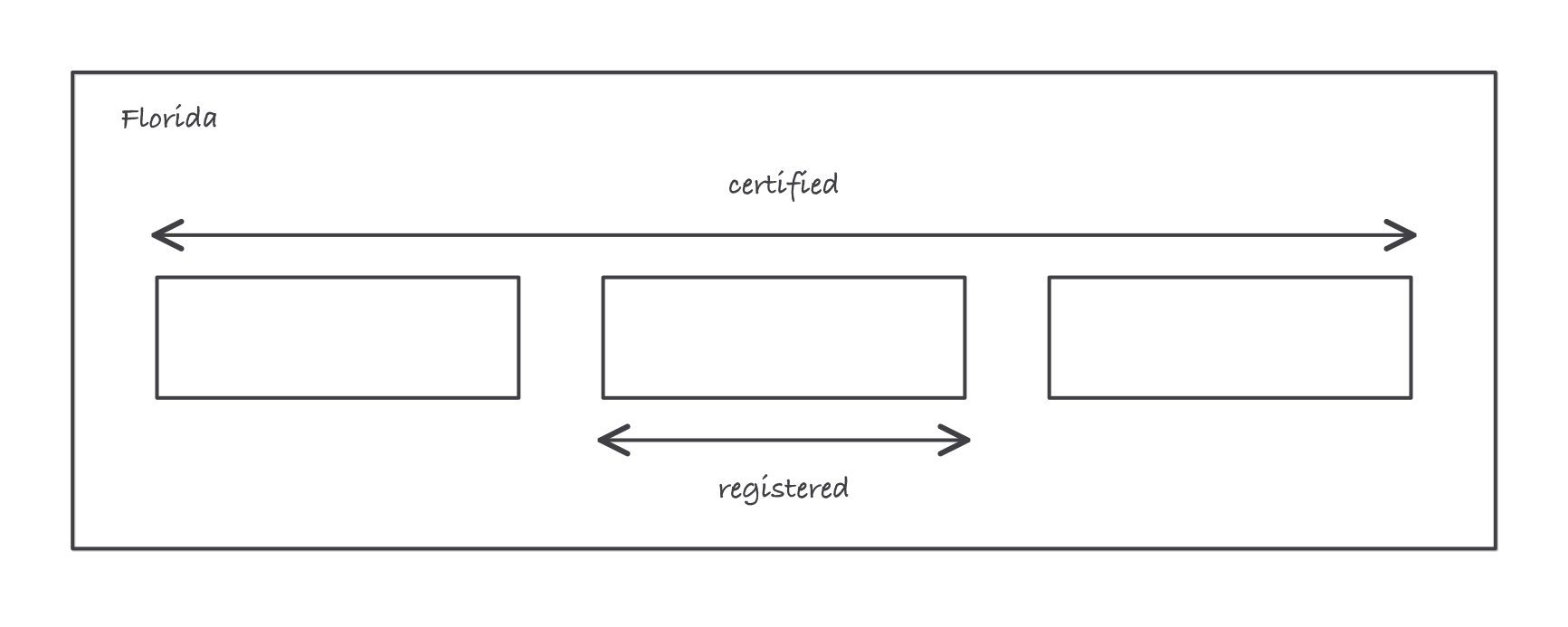
Certified reaches the whole state; registered reaches the jurisdictions whose competency requirements were satisfied
Roofing sits in Division II, the division covering specialty trades rather than general and building contractors. Its statutory definition is at s. 489.105(3)(e).
Financial responsibility and insurance
A competency demonstration is not the whole gate. Section 489.115 attaches financial responsibility requirements to licensure and requires an insurance affidavit, so an applicant satisfies the money and coverage side alongside the competency side.
The practical reading for a roofer planning this move: start assembling the financial and insurance documentation early, because it is a separate workstream from studying, and it is the one that stalls applications.
Continuing education
Florida Administrative Code 61G4-18.001 requires “at least 14 classroom or interactive distance learning hours of continuing education” per renewal cycle.
Six of those hours are designated, one hour each:
- a specialized or advanced module
- workplace safety
- business practices
- workers’ compensation
- laws and rules
- wind mitigation methodologies
That last hour is not general to all licensees. The rule attaches it to specific categories, and it names Roofing among them, alongside General, Building, Residential, Speciality Structure, and Glass and Glazing.
Do the arithmetic: 14 hours required, 6 hours designated, leaving 8 hours that are not pinned to a named subject by that list. Plan the six first, because they are the ones with a named subject attached.
Worked example: two roofers, one state
Contractor A holds a certified roofing license. She bids a job in Miami-Dade, then one in Orange County, then one in the Panhandle. Under s. 489.105(8) her certificate lets her contract in any jurisdiction in the state without meeting each jurisdiction’s competency requirements separately. Her license is not the constraint on where she works.
Contractor B holds a registered roofing license, obtained by satisfying the competency requirements of one county. He can contract in that county. When a customer two counties over asks him to bid, s. 489.105(10) is the answer: registered contractors “may contract only in such jurisdictions” as the registration covers. To take the work he must either satisfy that jurisdiction’s requirements and register there too, or pursue certification and stop repeating the exercise county by county.
Both hold valid Florida licenses. Neither is a lesser roofer. The difference is geographic reach, and for a contractor who intends to grow beyond one county it is the difference that decides which route is worth the effort.
Exam relevance
Competency is demonstrated to the department for certification, and to the local jurisdiction for registration, so the examination you face depends on the route you take. Get the current requirements, subject areas and fees from the department and, for the registered route, from the specific jurisdiction, because these are the details most likely to have changed since anything was written about them.
What is stable enough to plan around: roofing is Division II, both routes require a competency demonstration, financial responsibility and insurance are separate gates, and every renewal cycle carries 14 hours of continuing education with six designated hours inside it.
Where it bites
- The words mean the opposite of their everyday sense. Certified is statewide, registered is local. Read that twice before an application or a hiring decision.
- Do not export Florida’s meanings. Another state may use “certified” and “registered” for entirely different things, or for nothing at all. These definitions are terms of art in Florida’s statute.
- Registration does not accumulate into certification. Registering in three counties gives you three local licenses, not a statewide one.
- The wind mitigation hour is aimed at you. Roofing is named in the rule, which is a signal about what Florida considers the load-bearing competency in this trade.
- Financial responsibility is its own workstream. Start the insurance affidavit and the financial requirements alongside your exam preparation rather than after it.
Verified requirements
| Where | Expires | Renewal | Continuing education |
|---|---|---|---|
| Florida | Yes | 2 years | 14 hours per renewal cycle under Fla. Admin. Code R. 61G4-18.001, including one hour each of workers' compensation, workplace safety, business practices, laws and rules, an advanced module course, and wind mitigation methodologies. Roofing is explicitly named among the categories that must take the wind mitigation hour. |
| Florida | Yes | 2 years | 14 hours per renewal cycle under Fla. Admin. Code R. 61G4-18.001, on the same terms as certified contractors, including the wind mitigation methodologies hour required of roofing licensees. |
Information comes from issuing-authority sources. Confirm current rules, fees and eligibility with the authority before acting.