Learn · Roofing
Asphalt Shingle Installation
Part of Roofer to Licensed Contractor · step 8 of 28 · next: Underlayment and Flashing
In learning paths: Roofer to Licensed Contractor
Assumes you know: Roof Anatomy and Terminology
An asphalt shingle roof keeps water out by overlap and gravity. There is no seal anywhere in the field. Every course covers the joints and the fasteners of the course below it, and water runs downhill over the top of the laps. The system works because nothing gives it a reason to run uphill.
Why it matters on the job
This is the most common steep-slope system in the country, so it is where most roofers spend their first years and where most residential re-roofs land. It is also the system with a named installer certification attached to it, which tells you the trade treats it as a competency rather than a chore.
How the courses shed water
Shingles go on from the eave upward. Each course is offset sideways from the one below so the joints never stack, and each course covers enough of the one below to hide both the joint and the fasteners.
Exposure is the part of each shingle left visible after the next course goes on. Everything above the exposure is covered. That covered band is where the fasteners live, and it is the reason the fastener line is narrow. A fastener driven too high sits above the band the next course covers, so water can reach it. A fastener driven too low leaves the head of the shingle unattached. Both mistakes disappear from view the moment the next course goes on.
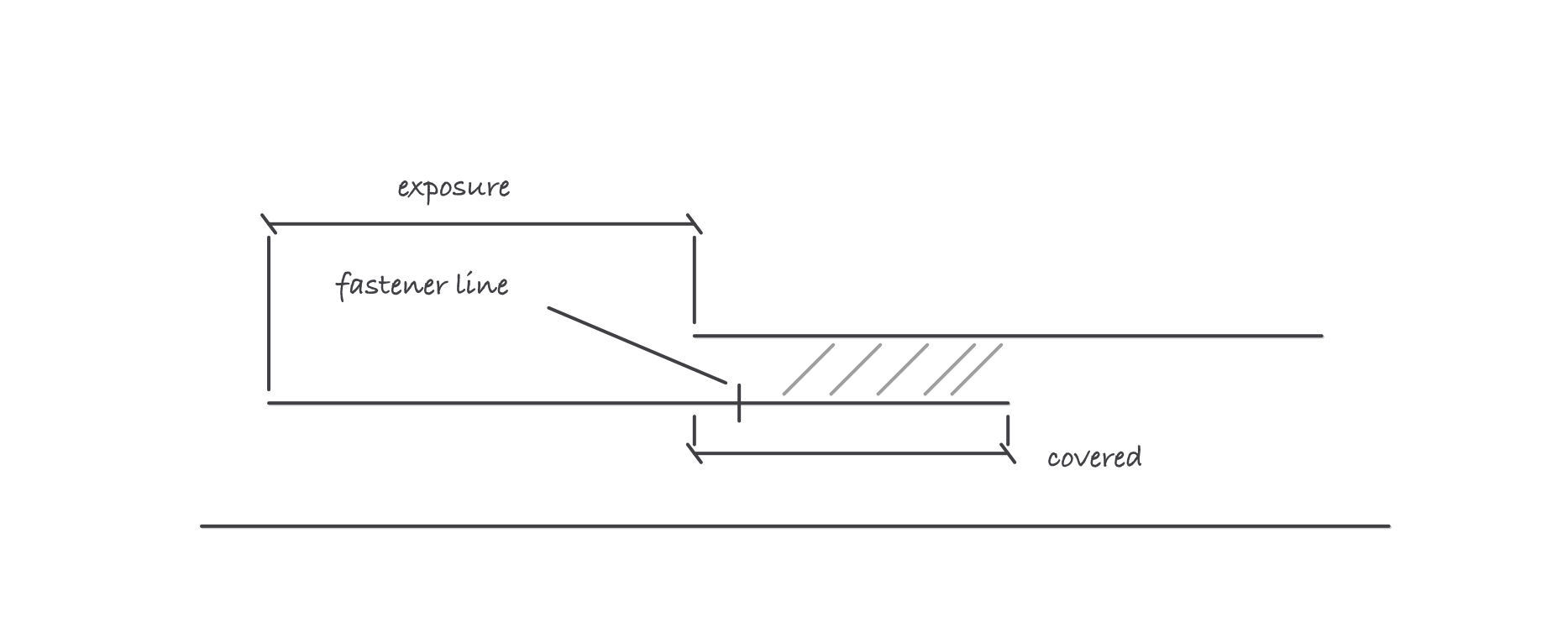
Only the exposure shows; the hatched band is covered by the next course, and that is where the fasteners belong
The exposure, the fastener count and the position of the fastener line are product-specific figures. They are printed on the wrapper and set out in the manufacturer’s installation instructions for that exact product. This page cannot tell you them, because they belong to the product rather than to the trade.
Below the first full course sits the starter course, a strip with its adhesive at the eave and no exposed cut-outs, so the joints of the first full course are covered and the eave edge is held down. Above, the hip and ridge pieces cap the intersections. In between, the field.
Ordering, and the two units people mix up
A square is 100 square feet of roof surface. It is the unit a roof is measured, ordered, estimated and sold in.
A bundle is how shingles are packaged so that a person can carry them up a ladder.
The two connect only through the specific product. The shorthand “three bundles to a square” holds for many standard three-tab shingles and fails for heavier laminated and dimensional products, which are frequently packaged four or five bundles to the square because a bundle has a weight limit a human body sets. Never build an order from a remembered ratio. The coverage per bundle is printed on the wrapper, and that printed figure is the only correct input.
Worked example
A roof surface measures 2,400 square feet.
Squares: 2,400 / 100 = 24 squares.
The wrapper on the specified laminated shingle prints 25.0 sq ft of coverage per bundle.
Field bundles: 2,400 / 25.0 = 96 bundles, which works out at 4 bundles per square for this product.
Now run the same roof on the remembered ratio: 24 × 3 = 72 bundles. That is 24 bundles short, a quarter of the order missing, and the shortfall announces itself on a Saturday afternoon with the deck open.
Field bundles are not the whole order either. Starter, hip and ridge, and the cutting waste at hips, valleys and rakes are counted separately, because none of that material ends up covering a field square.
Where it bites
- Squares measure roof surface, not building footprint. A steeper roof has more surface than the floor beneath it, so a footprint figure understates the order. The slope factor that converts one to the other is covered in Roofing Estimating.
- Layers are not plies. Two layers of shingles means somebody roofed over an existing roof once. Whether another layer is permitted at all depends on the number and condition of the existing layers and on the structure’s capacity to carry the added dead load, and that answer comes from the code adopted in your jurisdiction.
- A re-cover is a different job, not a cheaper version of the same job. It permanently hides the deck, so rot, failed flashing and somebody’s prior repair stay hidden and stay wrong. Price it and inspect it as its own scope.
- Most leaks on a shingle roof are not in the field. They are at the flashings. Underlayment and Flashing takes that up next.
Exam relevance
NRCA’s PROCertification program includes an Asphalt Shingle Systems Installer certification, and it belongs to an individual worker rather than to a company. NRCA publishes its requirements as 18 months of experience, a 60-question online eligibility exam, and a hands-on performance assessment watched by an assessor.
That two-part structure tells you what to study. The eligibility exam covers what you can be asked in words: materials, terminology, sequence, the units above. The performance assessment covers what an assessor can watch you do, which is where offset, exposure, fastener placement and the details at edges and penetrations are either habits or they are not. Fees, renewal cycles and current requirements come from NRCA.
Verified requirements
| Where | Expires | Renewal | Continuing education |
|---|---|---|---|
| United States (federal) | Yes | 3 years | Training completed within the 3-year renewal cycle, delivered in classroom, real-world or online environments |
Information comes from issuing-authority sources. Confirm current rules, fees and eligibility with the authority before acting.