Learn · Roofing
Fall Protection on Roofs: the Six-Foot Rule
Part of Roofer to Licensed Contractor · step 1 of 28 · next: Fall Protection on Low-Slope Roofs
In learning paths: Roofer to Licensed Contractor
Six feet is the number. Under 29 CFR 1926.501(b)(1), each employee on a walking or working surface with an unprotected side or edge 6 feet or more above a lower level “shall be protected from falling by the use of guardrail systems, safety net systems, or personal fall arrest systems.” A roof edge is an unprotected side or edge, and almost every roof in the country clears 6 feet at the eave.
Why it matters on the job
1926.501 is the most frequently cited OSHA standard in the United States, ranked first in OSHA’s FY2025 top ten list. Its training companion, 1926.503, ranks seventh. Two of the ten most cited standards across all of American industry are the rule that says you must be protected on a roof and the rule that says you must be taught how.
BLS puts the human side of it plainly in its occupational profile: roofers have one of the highest rates of injuries and illnesses of all occupations. Fall protection is not a module bolted onto the end of roofing training. It is the spine of the trade.
What OSHA counts as roofing work
The definition sits at 1926.500(b): “Roofing work means the hoisting, storage, application, and removal of roofing materials and equipment, including related insulation, sheet metal, and vapor barrier work, but not including the construction of the roof deck.”
Read the last clause twice. Building the deck is not roofing work under Subpart M. A crew sheathing a roof and a crew shingling that same roof stand in the same place at the same height and fall under different regulatory categories, which can put them under different paragraphs of 1926.501. Location does not determine the rule. The activity does.
The three systems the rule names
- A guardrail system physically stops a fall at the edge.
- A safety net system catches a worker who has already fallen, and is rigged below the working surface.
- A personal fall arrest system is the harness, connector and anchorage that arrests a fall in progress.
These are the three options 1926.501(b)(1) gives you. “I’m tied off” reports that a lanyard is connected to something. It says nothing about whether the anchorage can take arrest forces, whether the system chosen suits the hazard, or whether there is enough clearance below for an arrest to finish before you reach the ground.
Which paragraph applies: the 4 in 12 line
OSHA sorts roofs into two boxes and gives each its own paragraph. From 1926.500(b): “Low-slope roof means a roof having a slope less than or equal to 4 in 12 (vertical to horizontal).” And its counterpart: “Steep roof means a roof having a slope greater than 4 in 12 (vertical to horizontal).”
Low-slope roofing work is governed by 1926.501(b)(10), which opens up warning line combinations and, in one narrow case, a safety monitoring system used alone. Steep roofs are governed by 1926.501(b)(11), which does not. OSHA lists both paragraphs among the fall protection provisions it cites frequently in construction.
One warning before you carry this number anywhere else. The 4 in 12 threshold is a fall protection definition and nothing more. When you choose a roof covering, the trade and the building codes divide steep-slope from low-slope at a different and lower threshold, because a shingle that sheds water needs more slope than a membrane that resists standing water. The same phrase does duty in two rulebooks with two different numbers. Say which rulebook you are in every single time.
Worked example: measure the slope, find the paragraph
Do not eyeball a slope near the boundary. Measure it.
Hold a level out from the roof surface, mark 60 in along the level, then measure straight down from that mark to the roof.
Suppose that vertical measurement is 20 in. Slope in x-in-12 form is rise divided by run, times 12:
20 / 60 = 0.3333, and 0.3333 × 12 = 4.0, so the roof is exactly 4 in 12.
The definition says “less than or equal to 4 in 12,” so this roof is a low-slope roof and 1926.501(b)(10) applies.
Now take the same 60 in run on the building next door and measure 21 in of drop:
21 / 60 = 0.35, and 0.35 × 12 = 4.2, so 4.2 in 12.
That is greater than 4 in 12. It is a steep roof, 1926.501(b)(11) applies, and every warning line and safety monitor option in (b)(10) is off the table. One extra inch of rise across five feet of run moved the job into a different paragraph of the standard.
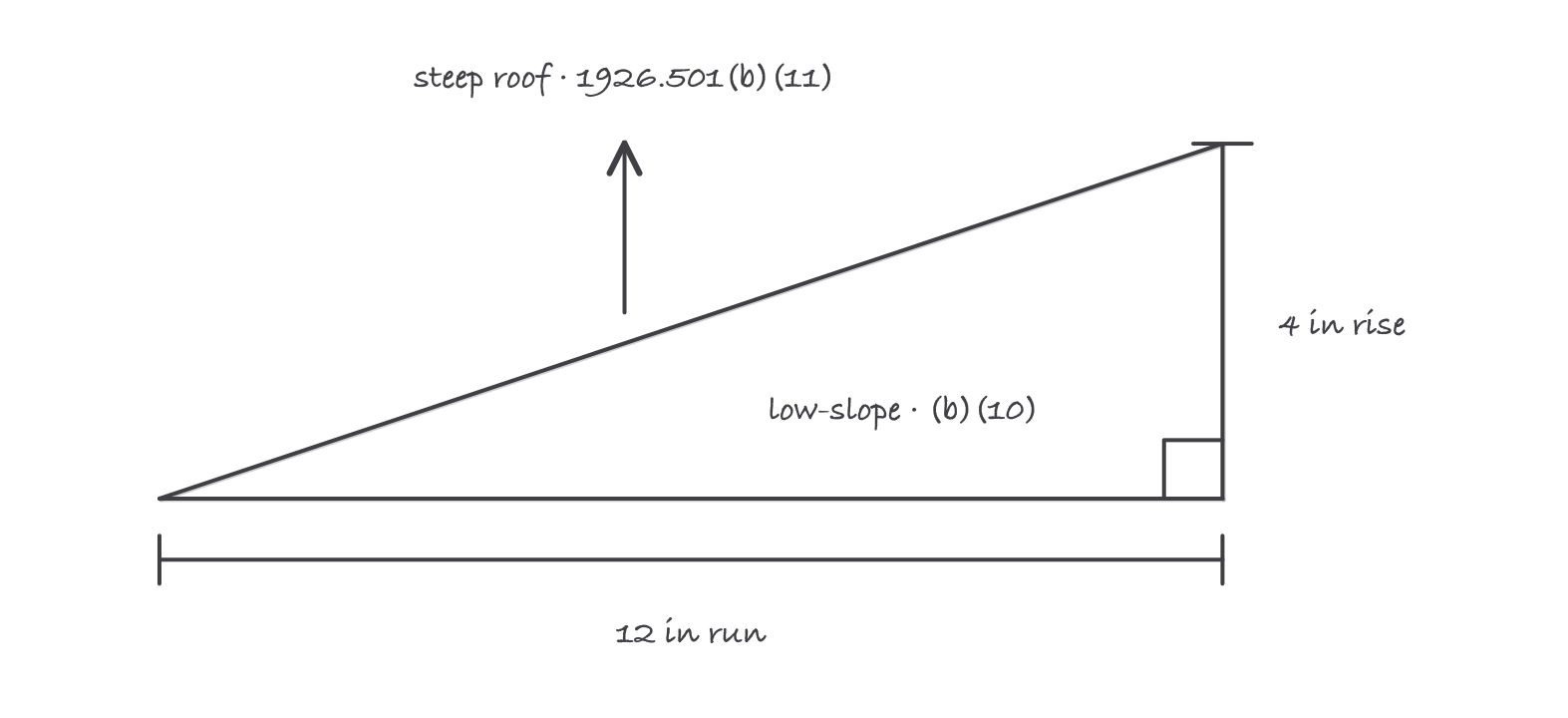
The 4 in 12 line is where 1926.501 changes paragraphs, and OSHA puts the equal case on the low-slope side
Where it bites
- 6 feet is a trigger, not a target. Reaching 6 feet is when protection becomes mandatory, not when it becomes sensible. Nothing stops you from being protected at 4 feet, and a fall to a concrete driveway does not consult the standard first.
- “Low-slope” without a rulebook is meaningless. A 3 in 12 roof is low-slope for choosing a fall protection system and is answered by an entirely different rule when you choose what to cover it with. Name the rulebook.
- Deck construction is carved out of the definition. If your crew is framing and sheathing rather than applying roofing materials, do not reach for the roofing paragraphs by reflex.
- Residential work is not a softer category. The belief that houses carry a relaxed rule has been wrong since 2011, and it still gets crews hurt. The residential lesson in this group covers what actually changed.