Learn · Roofing
Leak Diagnosis
Part of Roofer to Licensed Contractor · step 17 of 28 · next: Roof Inspection
In learning paths: Roofer to Licensed Contractor
Assumes you know: Underlayment and Flashing
The stain on the ceiling is where the water finished. It is almost never where the water started. Every leak call is really two jobs: find the point of entry, then fix the detail that let it in. The first job is the one people skip.
Why it matters on the job
Repairs made at the point where the water appeared are wasted trips. The homeowner points at the ceiling, somebody caulks the nearest thing above it, the roof leaks again in the next storm, and now there is an argument as well as a leak.
Water travels, and it only travels one way
Water enters at a defect and then goes wherever it can: across the top of the underlayment, down the underside of the deck, along the side of a rafter, down the shank of a nail, along a pipe or a wire. It drips when something finally stops it, which may be many feet down-slope and several feet sideways from where it came in.
One thing is reliable, and you build the whole search on it. Water runs downhill. The entry point is at or above the point where the water appeared, never below it. That single constraint turns a whole roof into a searchable wedge above the stain.
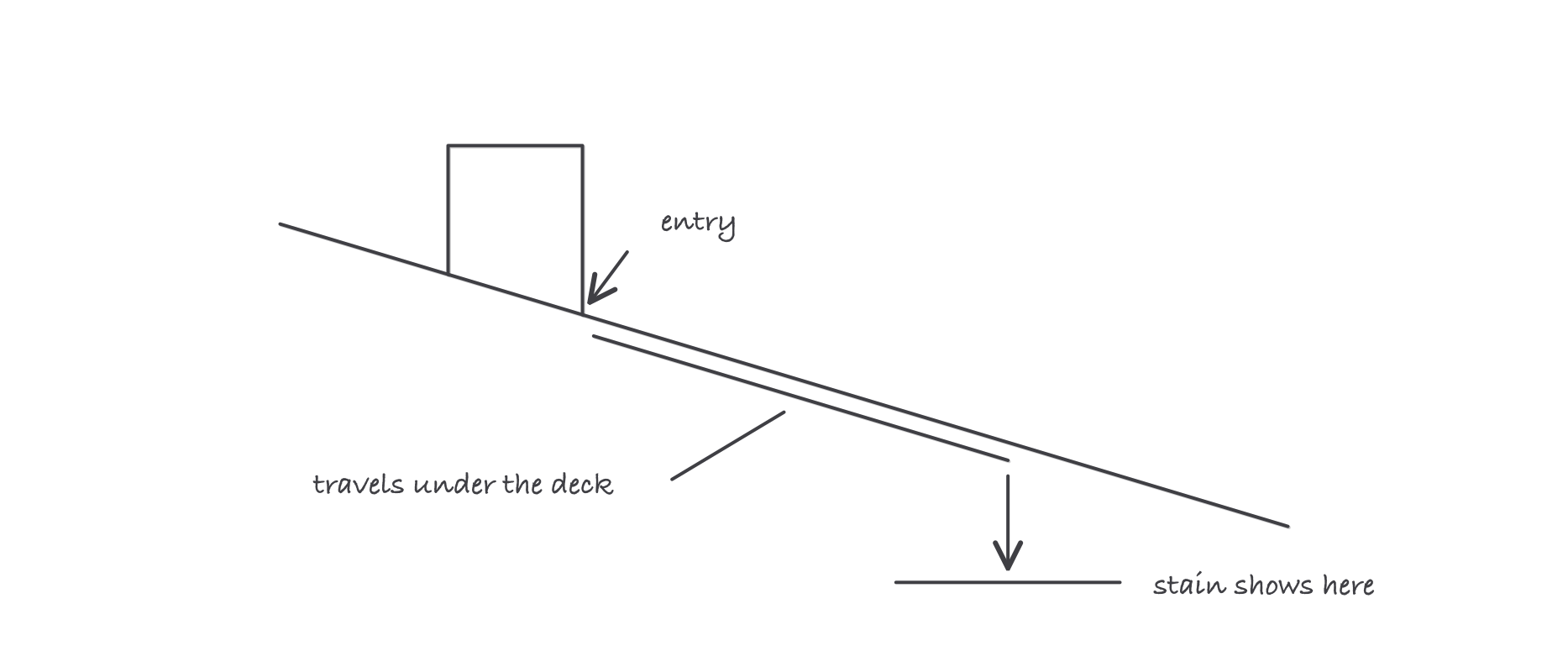
Entry is up-slope of the stain, always, which is why the search runs uphill from where the water showed
Start with the story
Before anyone goes on a ladder, ask when it leaks. The answer narrows the search more than any amount of walking around.
- Only in wind-driven rain: a detail that holds against falling water and fails when water is pushed sideways or uphill. Look at walls, penetrations and anything with a lap running the wrong way for that wind.
- Only in heavy or prolonged rain: capacity or backup. Drainage, valleys, a detail that copes until water gets deep enough to reach over it.
- Only after snow, or in a thaw: ice damming, or condensation, or both.
- All the time, including dry weather: this is probably not the roof. Condensation, a plumbing leak or an HVAC condensate line will all look exactly like a roof leak on a ceiling.
Then work inside, then up
Inside first, because the evidence is there and it is free to look at. Find the stain, then get above it if you can and look at the underside of the deck, the rafters and the top plates. The wet path on the framing points up-slope toward the entry far more precisely than anything visible from the roof.
Then go up and inspect the details up-slope of the point the wet path indicated. Penetrations, wall junctions, valleys, changes of slope, anything that goes through the roof or stops against it. Most leaks on a steep roof are flashing, not covering, and that is where to spend the time.
Water testing, if it comes to that
Test from the bottom up, in sections, with somebody inside watching and in contact with you. Start below the suspect area and work up-slope, one small area at a time, and give each area long enough to show.
Flooding the whole roof tells you that the roof leaks, which you already knew. The value of a water test is in the isolation, and isolation is destroyed the moment you wet more than one candidate at a time.
Worked example
A stain appears on a second-floor ceiling about 3 ft in from an exterior wall, and only after driving rain out of the west.
- The story says wind-driven, from one direction. That points at a vertical surface or a lap, on the west side.
- Inside, the ceiling stain is near the wall, but the deck above it is dry. The wet path is on the face of a rafter and on the top plate, and it runs up-slope.
- Follow the rafter up. It runs to a chimney about 8 ft up the slope from the stain.
- On the roof, the chimney’s west side has one long continuous piece of flashing with a bead of sealant along its top edge, where step flashing belongs.
- The mechanism. Rain driven west against the masonry runs down the chimney face, gets behind the failed sealant, lands on the deck, follows the rafter 8 ft down-slope, and drips through the ceiling 3 ft from the wall.
The repair is the flashing detail, rebuilt as step flashing with a counterflashing over it. Another bead of sealant buys one more storm.
Where it bites
- Condensation is not a leak, and it gets roofs replaced. It shows up in cold weather, it is widespread rather than local, and it comes from ventilation and air sealing rather than from the covering. Ask whether the pattern is one spot or the whole underside of the deck.
- One leak, several entries. A roof at the end of its life can be admitting water in three places that all drain to one stain. Finding one entry does not prove you found the entry.
- The obvious defect is not always the active one. A missing shingle in plain view three slopes away is a real defect and may have nothing to do with this stain. Chase the geometry, not the eye-catcher.
- Write down what you found before you fix it. The photograph of the failed detail is worth more than the memory of it, particularly when somebody later asks why the repair cost what it cost.
Exam relevance
NRCA’s PROCertification list includes a Service and Maintenance Technician certification, which is the credential aimed squarely at this work rather than at installing a system. It belongs to an individual worker, and like the other installer certifications it combines an online eligibility exam with a hands-on performance assessment in front of an assessor.
Diagnosis is what separates a service technician from an installer, so expect the material to reach the reasoning in this lesson: where water can and cannot have come from, what the timing of a leak tells you, and the difference between a repair that fixes the mechanism and a repair that covers the evidence. Experience minimums, fees and renewal terms come from NRCA.