Qualifications · Roofing
NRCA PROCertification
Part of Roofer to Licensed Contractor · step 25 of 28 · next: Roofing Warranties and Manufacturer Programs
In learning paths: Roofer to Licensed Contractor
Assumes you know: Asphalt Shingle Installation
NRCA PROCertification is held by a person and named for a system type. Not by a company, and not for roofing in general: an installer is PROCertified in Asphalt Shingle Systems, or in EPDM Systems, or in Slate Systems, because those are different competencies with different tools, different seams and different failure modes.
*Learn the Trades is a free study resource. We are not a licensing body, an authorized training provider, or an exam administrator. Reading this page does not award any card, license, or certification. Always verify requirements with the issuing authority linked in the sources.*Why it matters on the job
Four unrelated things in roofing share the word “certified,” which is why it tells you almost nothing on its own.
Knowing which of those four you are looking at is a hiring decision for a contractor, a pay decision for a worker, and a due-diligence question for a building owner.
The eleven certifications
NRCA lists eleven PROCertification credentials. Nine are named for a roof system:
- Architectural Metal Flashings and Accessories
- Asphalt Shingle Systems
- Clay and Concrete Tile Systems
- EPDM Systems
- Metal Panel Roof Systems
- Metal Shingle Systems
- Modified Bitumen Systems
- Slate Systems
- Thermoplastic Systems
Two are named for a role rather than a material: Service and Maintenance Technician and Roofing Foreman.
Notice that EPDM Systems and Thermoplastic Systems are separate credentials. That split is chemistry, not administration. EPDM is a thermoset rubber whose seams are made with adhesives or tape; TPO and PVC are thermoplastics whose seams are hot-air welded. A worker fluent in one has not thereby demonstrated the other, and the certification structure reflects that.
How the credential is earned
Two parts, and both have to be passed.
An eligibility exam, taken online, covering the knowledge behind the system. A hands-on performance assessment, scored against the program’s published exam specifications, which set the conditions and the assessor requirements for the practical. The assessment runs in the region of three to five hours: this is a working test, not a quiz.
Each certification also carries a documented experience minimum that must be satisfied before you sit. Training is available and is optional; the certification is the exam plus the assessment, not attendance at a course.
Certification renews on a three-year cycle.
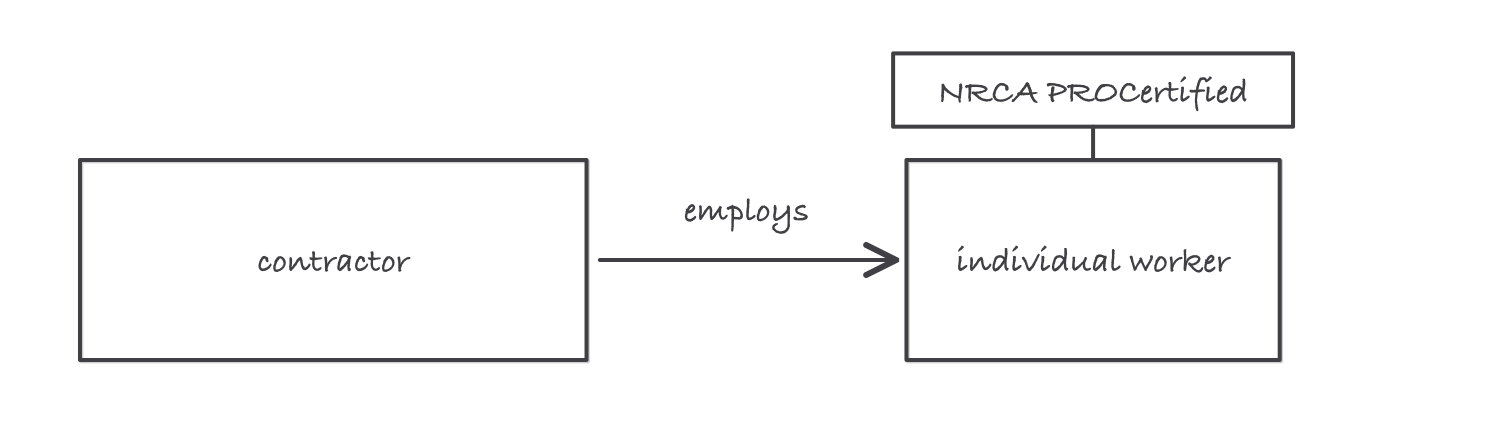
The credential stays with the worker; a firm’s recognition comes from employing people who hold it
A verified exemplar: Asphalt Shingle Systems Installer
The asphalt shingle credential is the one with the most published detail, so use it as the shape of the others.
Experience: 18 months of documented experience installing asphalt shingle systems, satisfied before the eligibility exam. Eligibility exam: 60 questions, online. Performance assessment: the hands-on installation test, conducted under the published exam specifications. Renewal: three years.
Now compare Thermoplastic Systems Installer, which requires 24 months of documented experience rather than 18. Six months more, for a system where a bad weld is invisible until it leaks. The experience minimum is set per credential and is worth checking rather than assuming.
Fees apply to both the exam and the assessment, and they are published per certification on NRCA’s pages. Read the current figures there rather than from any summary, this one included.
Exam relevance
For the eligibility exam, expect the knowledge that sits under the system you are certifying in: the materials, the sequence, the details where water is actually managed, and the manufacturer and code framework around them. The asphalt shingle exam’s 60 questions have to cover deck preparation, underlayment, flashing at every geometry, fastening, and the eave and rake conditions.
For the performance assessment, expect to be judged on work you produce in front of an assessor under defined site conditions. Reading about a valley will not carry you through building one. The realistic preparation is the same experience the credential requires you to have documented anyway.
Where it bites
- A certified worker leaving takes the certification with him. It is his, and a firm that built its reputation on one certified installer has built it on that person’s employment.
- System certifications do not stack automatically. Being PROCertified in Asphalt Shingle Systems says nothing about your competence in Slate or Modified Bitumen, and the program is structured to make that explicit.
- The experience minimum is documented experience. Keep records as you go. Reconstructing eighteen months of work history after the fact is unpleasant and sometimes impossible.
- Certification is not a license. In a state that licenses roofing contractors, no NRCA credential substitutes for the state license, and holding a state license says nothing about whether anybody on the truck is PROCertified. They answer different questions.
Verified requirements
| Where | Expires | Renewal | Continuing education |
|---|---|---|---|
| United States (federal) | Yes | 3 years | Training completed within each 3-year renewal cycle, plus documented system-specific work experience |
| United States (federal) | Yes | 3 years | Training completed within the 3-year renewal cycle, delivered in classroom, real-world or online environments |
| United States (federal) | Yes | 3 years | Training completed within the 3-year renewal cycle |
Information comes from issuing-authority sources. Confirm current rules, fees and eligibility with the authority before acting.