Learn · Roofing
Storm Damage Assessment
Part of Roofer to Licensed Contractor · step 19 of 28 · next: Roofing Estimating
In learning paths: Roofer to Licensed Contractor
Assumes you know: Roof Inspection
The question a storm assessment answers is narrow: did this event damage this roof, and where. It is not “is this roof old,” and it is not “does this roof need replacing.” A roof can be worn out and undamaged by the storm, and a nearly new roof can be badly damaged by it.
Why it matters on the job
Somebody is going to pay for the answer, and several people with different interests will read it. That makes this the assessment in roofing where your reasoning has to be visible and your observations have to be separable from your conclusions. It is also where you have to know exactly where the line sits between assessing damage and handling somebody’s insurance claim.
Storm damage has direction, and wear does not
Weather comes from somewhere. Wear comes from time.
Wind arrives from a direction and acts hardest at edges and discontinuities, so wind damage concentrates on the slopes that faced the wind, along rakes and eaves, at ridges and at anything already lifted or loose. Hail arrives from a direction too, so impact marks are denser on the slopes that faced the storm.
Age does none of that. Granule loss, curling, cracking, blistering and general brittleness appear on every slope regardless of which way it faces, because every slope is the same age.
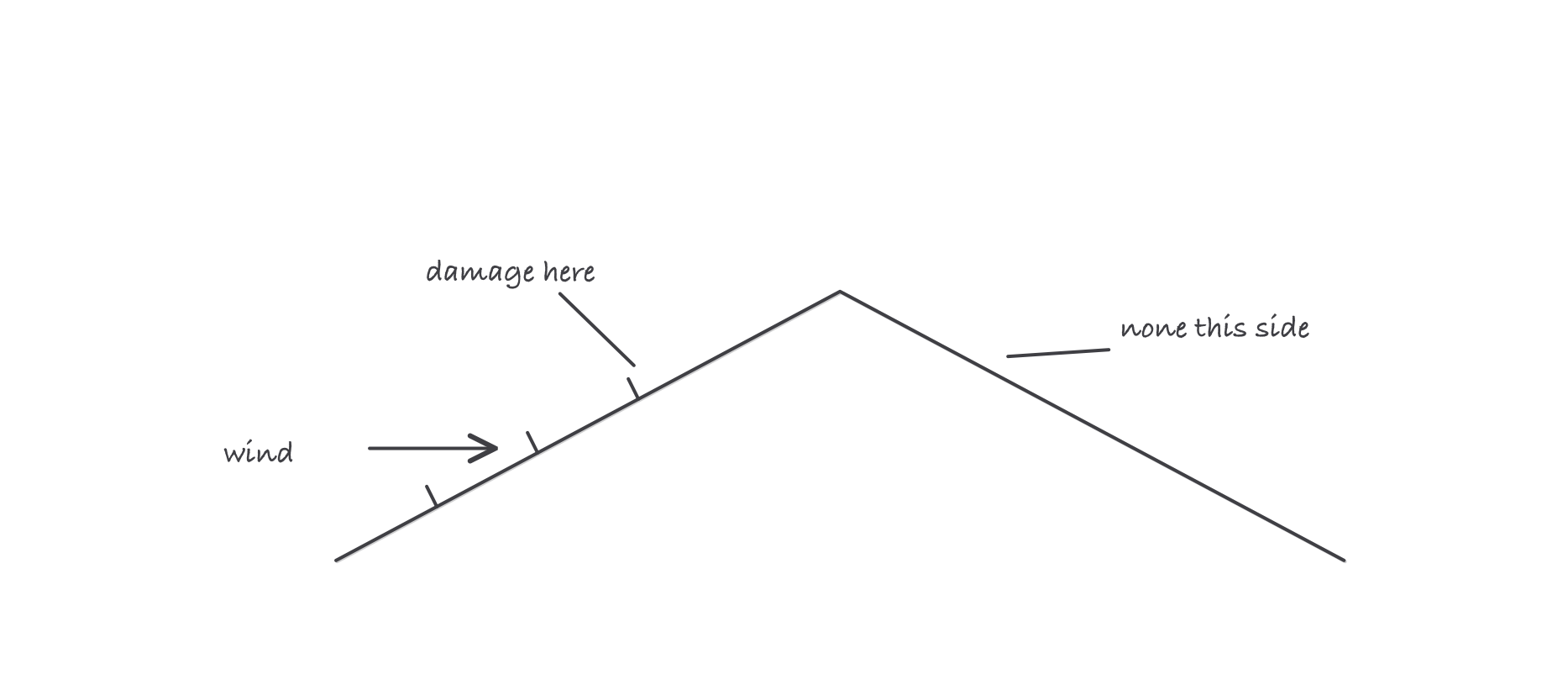
Weather has a direction and leaves a directional pattern; age is on every slope equally
So the first question at every observation is not “is this damage” but “is this directional.” A defect that is worse on one orientation is evidence about the storm. A defect that is uniform across all orientations is evidence about the roof.
The roof is not the only record
A storm hits the whole property, and everything soft enough to mark is a second record of the same event. Gutters, downspouts, fascia, vent caps, mechanical equipment housings, fences, mailboxes, siding: they were all outside on the same day, and they were not installed at different times or worn by different amounts of sun.
Reading them alongside the roof is how you separate what happened that day from what has been happening for fifteen years. It also gives your report corroboration that does not depend on anyone accepting your judgment about a shingle.
Worked example
A homeowner calls after a storm with sustained winds out of the west. On the roof you find four things.
- Lifted and creased tabs on the west-facing slope, concentrated along the rake and in the courses nearest the eave, with the middle of that slope largely intact.
- Ridge cap displaced at the west end of the ridge and sound at the east end.
- Nothing comparable on the east-facing slope.
- Uniform granule loss and some curling at the tab edges on every slope, west, east and the two on the ell.
Observations 1, 2 and 3 are directional. They are concentrated where wind loads concentrate and they are absent where the wind was not. Observation 4 is present everywhere regardless of orientation, so it is age.
The report states all four, in the observation section, with photographs located on the roof. Then, separately, the conclusion: wind damage to the west slope and the west end of the ridge, plus a roof in the later part of its service life. Two findings. They stay two findings, because merging them into “the storm destroyed this roof” is the sentence that gets a report thrown out.
Where the numbers live
Wind loads, and the wind resistance required of a roof covering, are provisions of the roof assemblies chapter of the adopted code. That is where the requirement for a given building in a given location comes from, and it is edition-specific and jurisdiction-specific.
Do not quote an uplift value, a fastener pattern or a wind speed requirement from memory. It is easy to remember wrong and expensive to be wrong about.
Where the licensing line sits
Assessing what a storm did to a roof is roofing work. Negotiating, adjusting or handling somebody’s insurance claim is regulated activity in many states, and often it is a separate license. Where exactly the line falls, and what a roofing contractor may say and do on a homeowner’s behalf, is a question for that state’s insurance regulator and contractor licensing board.
Do not assume the answer is the same as the last state you worked in, and do not assume it is permissive. This is one of the few places in roofing where a well-meaning contractor can commit an offense while trying to help a customer.
That the trade treats wind as a licensed competency is visible in the rules. Florida requires at least 14 hours of continuing education each renewal cycle for its construction license categories, and one of those hours must cover wind mitigation methodologies for licenses held in categories including Roofing. A state does not write a rule like that about a topic it considers optional.
Where it bites
- Uniform is not storm. If a pattern appears equally on every slope, no storm did it, whatever the pattern looks like.
- Old damage is real damage, and it is not this storm’s damage. A roof can carry marks from a hailstorm five years ago. Dating what you find is part of the work.
- Foot traffic looks like impact. Damage in a line, or clustered around a mechanical unit or a roof access point, has a much more likely explanation than weather.
- Be careful what you promise a homeowner. Anything you say about what an insurer will or will not pay is a statement about somebody else’s contract, made by someone who is not a party to it.
- Photograph the corroboration too. The dented gutter and the marked vent cap are often more persuasive than the roof surface, and they take thirty seconds.