Learn · Roofing
Metal Roofing
Part of Roofer to Licensed Contractor · step 10 of 28 · next: Tile and Slate
In learning paths: Roofer to Licensed Contractor
Assumes you know: Underlayment and Flashing
A metal roof sheds water the way every other steep-slope roof does, by overlap and gravity, with one extra problem to solve: metal moves. A panel expands when it heats and contracts when it cools, over its whole length, and a system that pins that panel rigidly at both ends will tear its own fastener holes open. Almost everything distinctive about metal roofing follows from that one fact.
Why it matters on the job
NRCA certifies metal panel roof systems and metal shingle systems as two separate installer competencies. That is the trade telling you these are two different jobs that happen to share a material. Panels run the length of the slope and move as one long piece. Metal shingles are small units laid in courses, and they behave much more like the shingle systems you already know.
Panels and shingles
Metal panel systems use long panels running from eave to ridge, or along the length of the run on a low-slope roof. The joint between adjacent panels is the seam, and the seam is what defines the system.
Metal shingle systems use small pressed units laid in courses with laps and interlocks, so the water path is a series of short overlaps rather than one continuous seam running the whole slope.
Where the fasteners are
Two families of panel system, and the difference between them is where the fasteners go.
Exposed-fastener panels are screwed through the face of the panel into the structure below, with a washer under each screw head sealing the hole. Every fastener is a deliberate penetration through the water plane, held closed by a gasket. The system is simpler and faster, and those gaskets are the maintenance item for the life of the roof.
Standing seam panels are held by concealed clips that engage the raised seam. The seam stands above the water plane, the clips sit under the panel instead of through it, and there is no penetration in the field at all.
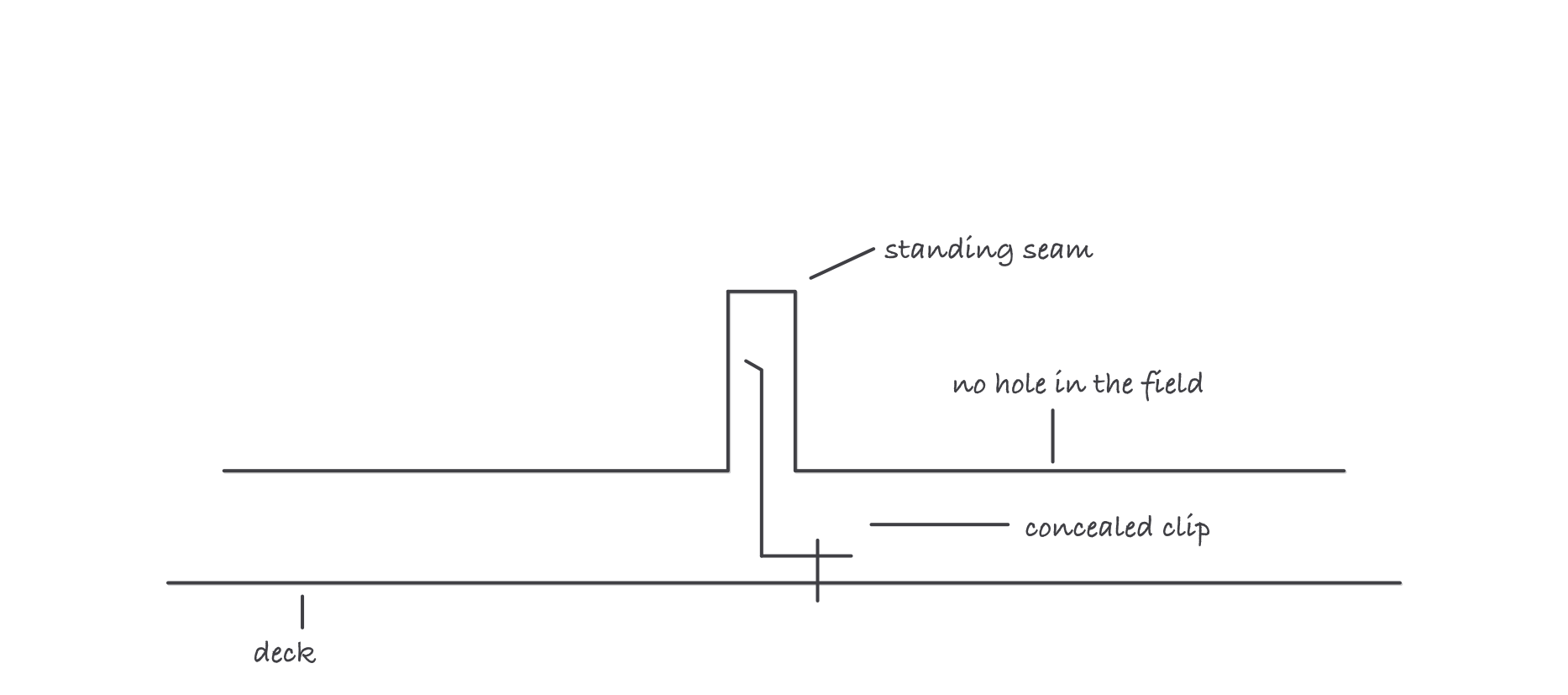
The seam stands above the water plane and the clip holds the panel from underneath, so nothing is screwed through the field
Movement is the design problem
Metal expands with heat and contracts with cold along its whole length, so a long panel moves more than a short one, and every panel on the roof does it on the same afternoon. That movement has to go somewhere.
A standing seam system sends it into the clips, some of which are made to let the panel slide rather than hold it fixed. An exposed-fastener system sends it through the fastener holes, which is why elongated and wallowed-out holes are what you find when you take an old exposed-fastener roof apart.
The permitted panel lengths, the clip spacing, the fastener pattern and the movement allowance are engineering figures published by the manufacturer for that specific profile. Read them for the product in front of you, because they change with the profile and with the length.
Slope, and which rulebook you are in
Metal panels are used on steep-slope roofs and on low-slope roofs, which makes metal the system where the two meanings of “low-slope” bite hardest. OSHA’s 4 in 12 line decides which fall protection paragraph governs your crew. It says nothing at all about whether a given panel may be installed at a given slope, which is answered by the roof assemblies chapter of the code adopted in your jurisdiction together with the manufacturer’s own minimum slope for that profile. Two questions, two sources, and neither one answers the other.
Where it bites
- Standing seam names a seam type, not a material. An exposed-fastener panel is a metal roof too, with a different fastening strategy, a different price and a different maintenance profile. Say which one you mean.
- Panels are formed to length. A panel cut short cannot be lengthened, and on a roll-formed job the measurement error travels down the whole stack.
- Where you may walk is a manufacturer instruction. Panels dent, and metal is slick when wet or frosted. Denting a finished panel with your own boot is an expensive way to learn the rib spacing.
- Metal over an existing roof is still a re-cover. Every re-cover question applies: how many layers are already there, what condition the deck is in, and whether the structure carries the added load. The adopted code answers it, not the sales pitch.
Exam relevance
NRCA’s PROCertification list carries three metal credentials: Metal Panel Roof Systems Installer, Metal Shingle Systems Installer, and Architectural Metal Flashings and Accessories Installer. Three certifications, three competencies, and each one belongs to an individual worker rather than to a company.
Each is earned the same way as the rest of the installer certifications: an online eligibility exam, then a hands-on performance assessment in front of an assessor. For panel work, expect the assessment to look hard at the things that only show up later, which are seam engagement, clip placement, and whether the detail leaves the panel free to move. Experience minimums, fees and renewal terms are published by NRCA for each certification.