Learn · Roofing
Roofing Codes: Which Book Governs Your Roof
Part of Roofer to Licensed Contractor · step 15 of 28 · next: How the Code Frames Wind and Uplift
In learning paths: Roofer to Licensed Contractor
Assumes you know: Roof Anatomy and Terminology
Two model codes govern roof assemblies in the United States, and which one governs yours is decided by what the building is, not by what the roof is. The International Residential Code carries roofing in Chapter 9, Roof Assemblies. The International Building Code carries it in Chapter 15, Roof Assemblies and Rooftop Structures. The IRC covers one- and two-family dwellings. The IBC covers the rest.
Why it matters on the job
Every argument about a roof that ends in an inspector’s opinion started with somebody reading the wrong book, the wrong edition, or a national summary of a local rule. A foreman who can name the book, the edition and the amendment set before the crew arrives has removed most of the ways a roof gets torn back off.
The codes are also where the numbers live: fastener patterns, underlayment locations, permitted slopes for each covering, ventilation ratios. This site does not reproduce any of them, and the reason is in the next section.
Three questions, in order
1. Which book? Answered by the building’s occupancy. A detached house is IRC territory; a warehouse, a school or a mid-rise apartment block is IBC territory. The precise scope statement is in each code’s own Chapter 1, and it is worth reading once so that the edge cases stop being guesses.
2. Which edition? Answered by your jurisdiction. ICC publishes editions on a three-year cycle, and the 2024 IRC and 2024 IBC are current publications. That is not the same as being in force where you work. Adoption happens jurisdiction by jurisdiction, and plenty of the country enforces an earlier edition today.
3. Which amendments? Answered locally again. States and municipalities routinely adopt a model code with amendments, and roofing attracts amendments because wind, ice and fire exposure are regional problems. A state amendment can add a requirement the model code never contained.
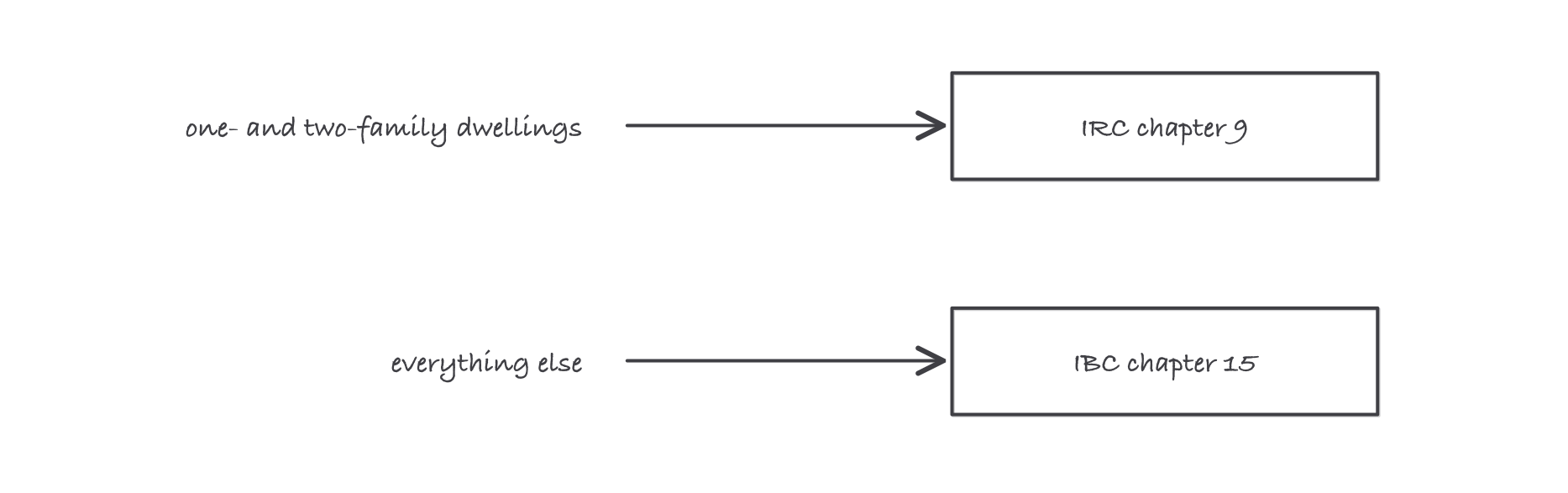
The occupancy picks the book; your jurisdiction picks the edition and the amendments
Why this site quotes no roofing code numbers
Uplift values, fastener patterns, nailing schedules and required underlayment locations are edition-specific and jurisdiction-specific. They are exactly the numbers most likely to be wrong when recalled from memory, and getting one of them wrong on a roof is a life-safety and property-loss failure rather than a rework item. Section-level code text also sits behind a paid subscription on ICC’s own platform, so no free summary anywhere is the authority.
So this site frames where to look. The adopted code in your jurisdiction supplies what the number is. Anyone who tells you a fastener count for asphalt shingles without asking your state and your edition first is telling you something they cannot know.
Worked example: three buildings, three answers
A detached single-family house, re-roof. One- and two-family dwelling, so the IRC governs, and roofing is IRC Chapter 9. Next question: which edition has your state adopted, and has the county amended it? Two phone calls or one visit to the building department settles both.
A six-story apartment building. The end use is residential, and it does not matter. Multi-family at that scale is outside the IRC’s scope, so this is IBC Chapter 15. Note how differently the word “residential” behaves here from the way it behaves in OSHA’s fall protection directive: two rulebooks, two definitions, the same English word.
A single-story dental office. Not a dwelling at all, so IBC Chapter 15 again. Same chapter as the apartment block, different requirements inside it once occupancy, height and fire classification are applied.
In all three cases the second and third questions are identical, and neither of them can be answered from a national source.
Where it bites
- “Current edition” and “adopted edition” are different things. The newest ICC publication may be years away from being enforced where you work, and quoting it to an inspector who enforces an older edition wins nothing.
- Amendments are not footnotes. In high-wind and ice-dam regions the local amendment often is the requirement that matters, and it will not appear in any model code copy.
- The IRC and the IBC do not agree. A detail that satisfies IRC Chapter 9 on a house is not automatically acceptable under IBC Chapter 15 on a duplex-turned-triplex. Requalify the building whenever its use changes.
- Manufacturer instructions and code requirements are separate documents. Meeting one does not establish that you have met the other. Read both, and where they differ, take the question to the building department before the roof goes on rather than after.