Learn · Roofing
Fall Protection on Low-Slope Roofs
Part of Roofer to Licensed Contractor · step 2 of 28 · next: Fall Protection on Steep Roofs
In learning paths: Roofer to Licensed Contractor
Assumes you know: Fall Protection on Roofs: the Six-Foot Rule
On a low-slope roof, 1926.501(b)(10) gives you more ways to comply than any other roofing paragraph, and that generosity is exactly where crews get it wrong. The options are a fixed menu, not a set of ingredients you can recombine, and one of them is not equipment at all.
Why it matters on the job
Commercial roofing lives on low-slope decks, and (b)(10) is the paragraph an inspector opens when a crew is working a membrane roof. It is one of the fall protection provisions OSHA cites frequently in construction. Knowing the menu by heart is what lets a foreman set up a compliant roof in the morning instead of arguing about it in the afternoon.
Remember which rulebook this is. Low-slope here means OSHA’s definition at 1926.500(b): a slope less than or equal to 4 in 12. The threshold that decides what covering the roof gets is a different rule with a different number.
The menu in (b)(10)
For roofing work on a low-slope roof with unprotected sides and edges 6 feet or more above a lower level, the standard permits:
- a guardrail system, or
- a safety net system, or
- a personal fall arrest system, or
- a combination: warning line system plus one of guardrail system, safety net system, personal fall arrest system, or safety monitoring system.
Then the narrow case. “Or, on roofs 50-feet (15.25 m) or less in width, the use of a safety monitoring system alone (i.e. without the warning line system) is permitted.”
Read the combination bullet carefully. A warning line never appears on its own. It always pairs with something that either stops a fall or watches for one.
The warning line is not a barrier
OSHA’s definition at 1926.500(b) settles it. A warning line system is “a barrier erected on a roof to warn employees that they are approaching an unprotected roof side or edge, and which designates an area in which roofing work may take place without the use of guardrail, body belt, or safety net systems.”
The verb is warn. The line marks out a designated area; it does not restrain anybody. A worker who trips at the line goes over it, and then over the edge.
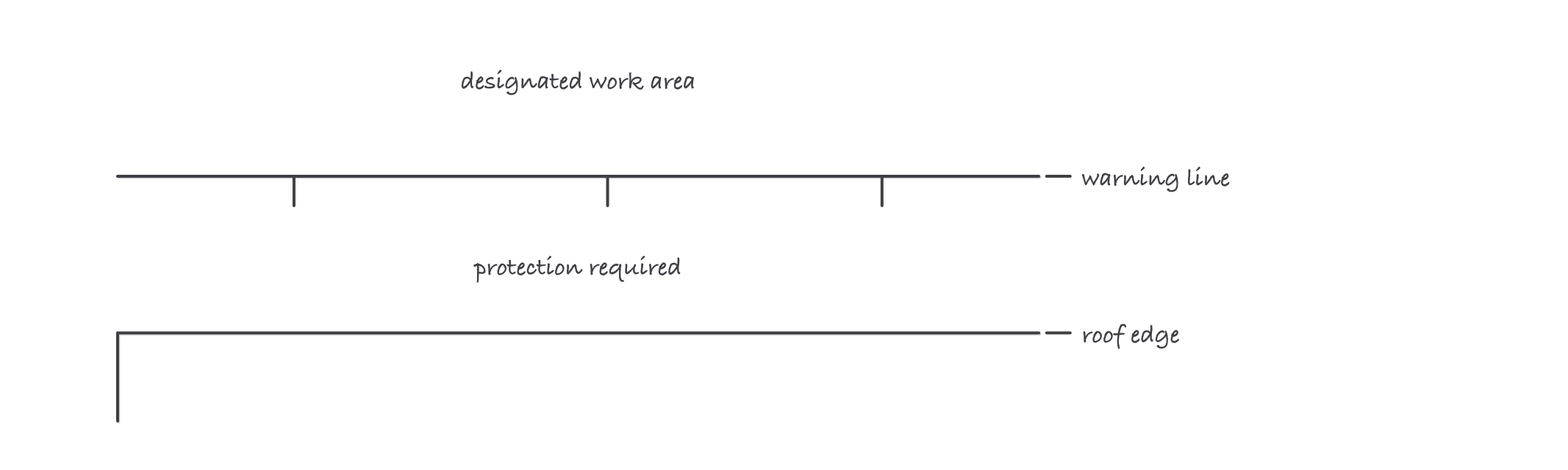
Inside the line is the designated work area; between the line and the edge you are back to guardrails, nets or arrest
The safety monitor is a person, not a product
The other definition people misread: a safety monitoring system is “a safety system in which a competent person is responsible for recognizing and warning employees of fall hazards.”
You do not install a safety monitoring system. You designate one, and the designation only means something if the person is genuinely competent, genuinely watching, and genuinely free to do nothing else. A monitor who is also carrying bundles is not a monitor. He is a roofer with a title.
Worked example: two roofs, two menus
Roof A. A single-story commercial building, 40 ft by 110 ft, slope 1 in 12, tear-off and new TPO. Roof surface is 40 × 110 = 4,400 sq ft, which at 100 sq ft to the square is 44 squares of work.
Slope check: 1 in 12 is less than 4 in 12, so it is a low-slope roof and (b)(10) governs. Width check: 40 ft is 50 ft or less, so the full menu is available, including a safety monitoring system used alone.
Roof B. Same slope, same system, but the building is 80 ft by 110 ft. Surface is 80 × 110 = 8,800 sq ft, or 88 squares, twice the work.
Slope check: still low-slope, still (b)(10). Width check: 80 ft is greater than 50 ft, so the monitor-alone allowance is gone. What remains is a guardrail, net or personal fall arrest system, or a warning line paired with one of those three or with a monitor.
Nothing about the roof changed except its width, and one compliance option disappeared. That is why the tape measure comes out before the crew does. If you are unsure which dimension of an irregular roof counts as its width, resolve it with your competent person against the standard rather than guessing in your favor.
Where it bites
- Warning line alone is never compliant. It is always half of a pair, on any roof of any width. If the only thing on the roof is a line of stanchions, the setup is wrong.
- The 50 ft allowance is about width, not area. A long narrow roof can qualify while a smaller but squarer roof does not.
- Monitoring is a full-time assignment. The moment the monitor picks up a tool or turns his back to run material, the system has stopped existing while everyone still believes it is in place.
- Warning line setback distances live in 1926.502(f), not here. (b)(10) tells you a warning line may be used; the criteria that make one a valid warning line, including how far back it goes, are in the criteria section. Read it before you set the first stanchion.
- Skylights and holes are not covered by this paragraph. A warning line at the perimeter does nothing about an opening in the middle of the roof, and falls through skylights kill roofers on roofs that were otherwise protected.