Learn · Ironworking
Tying and Splicing Rebar
Part of Ironworker, Steel and Rebar · step 7 of 25 · next: Reinforcing Ironwork Compared With Structural Erection
In learning paths: Ironworker, Steel and Rebar
Assumes you know: Rebar: Grades, Sizes, Placement
A tie holds a bar in position until the concrete sets. A splice carries force from one bar into the next. They look similar on a mat and they are doing completely different jobs. Confusing them produces a persistent misconception: that the wire at a lap is what makes the lap work.
Why it matters on the job
Everything you tie disappears under the pour. What survives is the geometry: the bars at the spacing, cover and lap the drawing called for, still in position after the concrete crew has dragged hose over them and vibrated around them. Ties are the only thing keeping that geometry through the roughest hour of the job.
Ties hold position, not force
Tie wire is soft annealed black wire, and it has essentially no structural role. Nobody designs a mat assuming the ties carry anything. Their entire purpose is to stop bars moving under foot traffic, hose drag, vibration and the buoyancy of wet concrete.
Four ties cover almost all field work.
- Snap tie (simple tie): wire around the crossing, twisted, cut. Fast, and adequate wherever the mat sees light traffic.
- Wrap and snap: one full wrap around one bar before the twist. Holds better against sliding along the bar.
- Saddle tie: the wire comes up around the under bar on both sides in a U before twisting, which resists the top bar rotating or lifting.
- Wrap and saddle: a saddle with an extra wrap, used at corners and wherever the mat has to survive a lot of walking.
Twist the wire until it is tight, then stop. Over-twisting nicks and breaks the wire, and a broken tie found on pour day is worse than a loose one. Cut the tails and turn them into the mat rather than up toward the surface, where they become rust stains on a finished slab and a hazard to hands and knees.
Repetitive bending and hand twisting across thousands of intersections is the leading source of lost time in this discipline, well ahead of anything dramatic. Powered tying tools and stand-up bar carts exist because the injury pattern is chronic rather than sudden.
Splices carry force
Where one bar ends and the next begins, the force has to keep going. Three ways to do that.
Lap splice is the common one: the two bars overlap by a specified length and the force transfers out of the first bar into the concrete through bond along the deformations, then back into the second bar the same way. The concrete does the work. The tie only holds the two bars in the right relative position while that concrete is placed.
Mechanical splice uses a coupler that joins the two bar ends directly, used where laps would congest the section or where the design requires a positive connection.
Welded splice joins the bars with a qualified welding procedure. Rebar is not general-purpose weldable steel, and field-welding a bar because it is easier than getting the right length is a design change, not a shortcut.
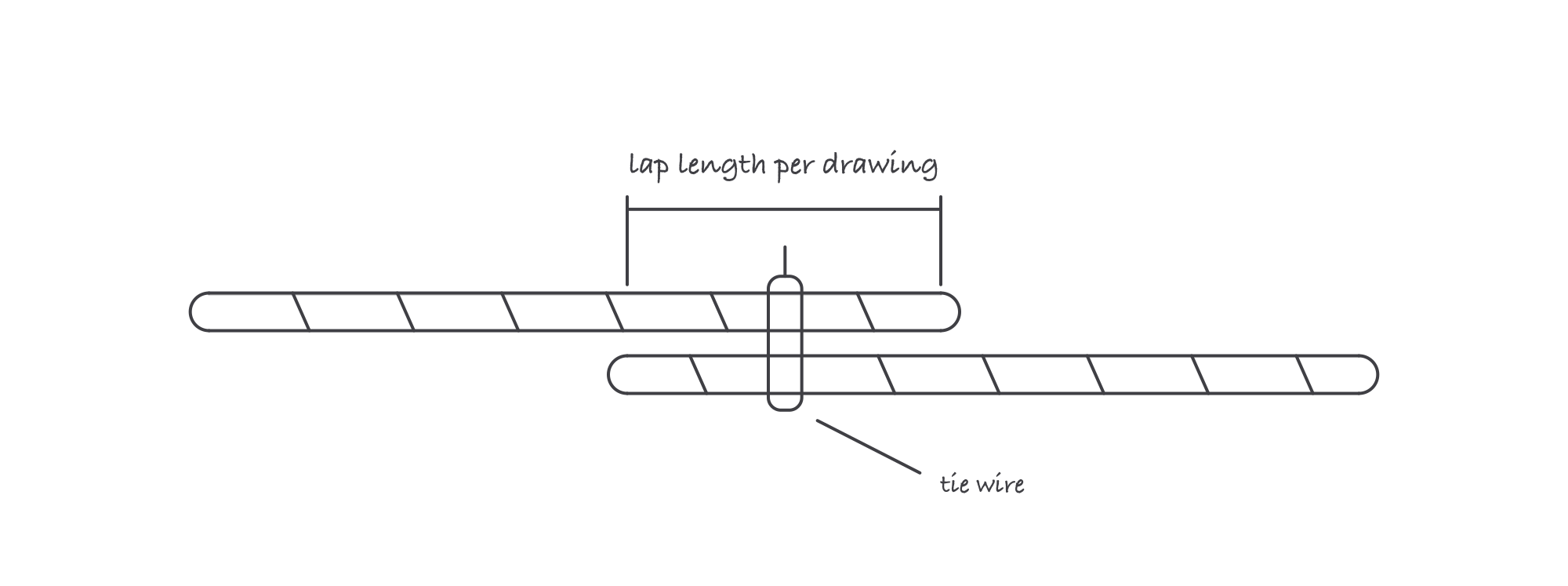
The wire holds the lap in place; the bond between bar and concrete is what carries the load across it
Lap length is never something you can quote from memory. It depends on bar size, bar grade, concrete strength, cover, spacing and whether the bar is a top bar, and it comes off the drawings or the project’s lap schedule for that job. Stagger laps when the drawing says to stagger them, because laps all landing in the same section is exactly what the staggering rule exists to prevent.
Worked example
Take the slab mat from the previous lesson: 20 ft by 30 ft, #5 bar at 12 inches on center each way, giving 21 bars one way and 31 the other.
Intersections in the mat: 21 × 31 = 651.
If the specification calls for every intersection to be tied, that is 651 ties. If it allows the field to be tied in a checkerboard (alternate intersections) the count drops to 326, because with 21 lines one way and 31 the other the alternate pattern takes 11 × 16 + 10 × 15 = 176 + 150 = 326 of them.
That is 325 ties saved, close to half. Put a hypothetical 4 seconds on a hand tie and the difference is 651 × 4 = 2,604 seconds (43.4 minutes) against 326 × 4 = 1,304 seconds (21.7 minutes), so roughly 22 minutes of stooping per mat.
Which pattern applies is a specification question, not a production decision. Ask before the crew starts, rather than discovering at the third mat that half the ties were never required.
Where it bites
- The tie is not the splice. Wiring two bar ends together with more wire does not make a shorter lap acceptable. Lap length is a bond length in the concrete, and wire has nothing to do with it.
- Ties at every intersection are not automatically better. Over-tying costs hours and can lock a mat rigid enough that it fights the placing crew. Follow the drawing.
- Tails up is a finish defect. Wire ends turned toward the surface end up inside the cover zone and rust through the slab face.
- Protruding bar still has to be guarded. 1926.701(b) is one sentence with no exceptions: “All protruding reinforcing steel, onto and into which employees could fall, shall be guarded to eliminate the hazard of impalement.” Verticals left standing out of a mat you are tying are covered by that sentence from the moment they go in, not from the moment the mat is finished.