Learn · Ironworking
Multiple Lift Rigging
Part of Ironworker, Steel and Rebar · step 15 of 25 · next: How OSHA Subpart R Governs Steel Erection
In learning paths: Ironworker, Steel and Rebar
Assumes you know: Sling Angles and Load Calculations
Multiple lift rigging is the procedure that lets one hoist carry up to five members at once. The field calls it Christmas treeing. 1926.753(e) permits it only inside a tightly drawn set of conditions, and every one of them is checkable before the crane picks up.
Why it matters on the job
Five beams to the floor on one hook instead of five trips saves crane time on a job where crane time is the schedule. The hazard scales the same way. You now have five independent loads swinging above connectors, and a mistake anywhere in the assembly puts all five in motion.
The rule allows the procedure and then bounds it with counts, distances, a certified rigging assembly and mandatory training. Treating it as a matter of crew preference misreads the rule completely.
The conditions, all of them
1926.751 defines the hardware: multiple lift rigging is “a rigging assembly manufactured by wire rope rigging suppliers that facilitates the attachment of up to five independent loads to the hoist rigging of a crane”. Shop-fabricated substitutes are not that.
From 1926.753(e), a multiple lift may be performed only if:
- A multiple lift rigging assembly is used.
- A maximum of five members are hoisted per lift.
- Only beams and similar structural members are lifted.
- Everyone engaged in the lift has been trained in these procedures under 1926.761(c)(1).
- The crane manufacturer’s specifications and limitations do not forbid the use.
The assembly itself has to be specifically designed and assembled with a maximum capacity for the total assembly and for each individual attachment point, certified by the manufacturer or a qualified rigger, based on the manufacturer’s specifications with a 5 to 1 safety factor for all components.
Then the rigging sequence:
- Members attached at their center of gravity and kept reasonably level.
- Rigged from the top down.
- Rigged at least 7 feet apart.
- Set from the bottom up.
- Controlled load lowering used whenever the load is over the connectors.
Top down to rig, bottom up to set. That pairing is the part people invert under pressure, and inverting it means unhooking a member with four more hanging below it.
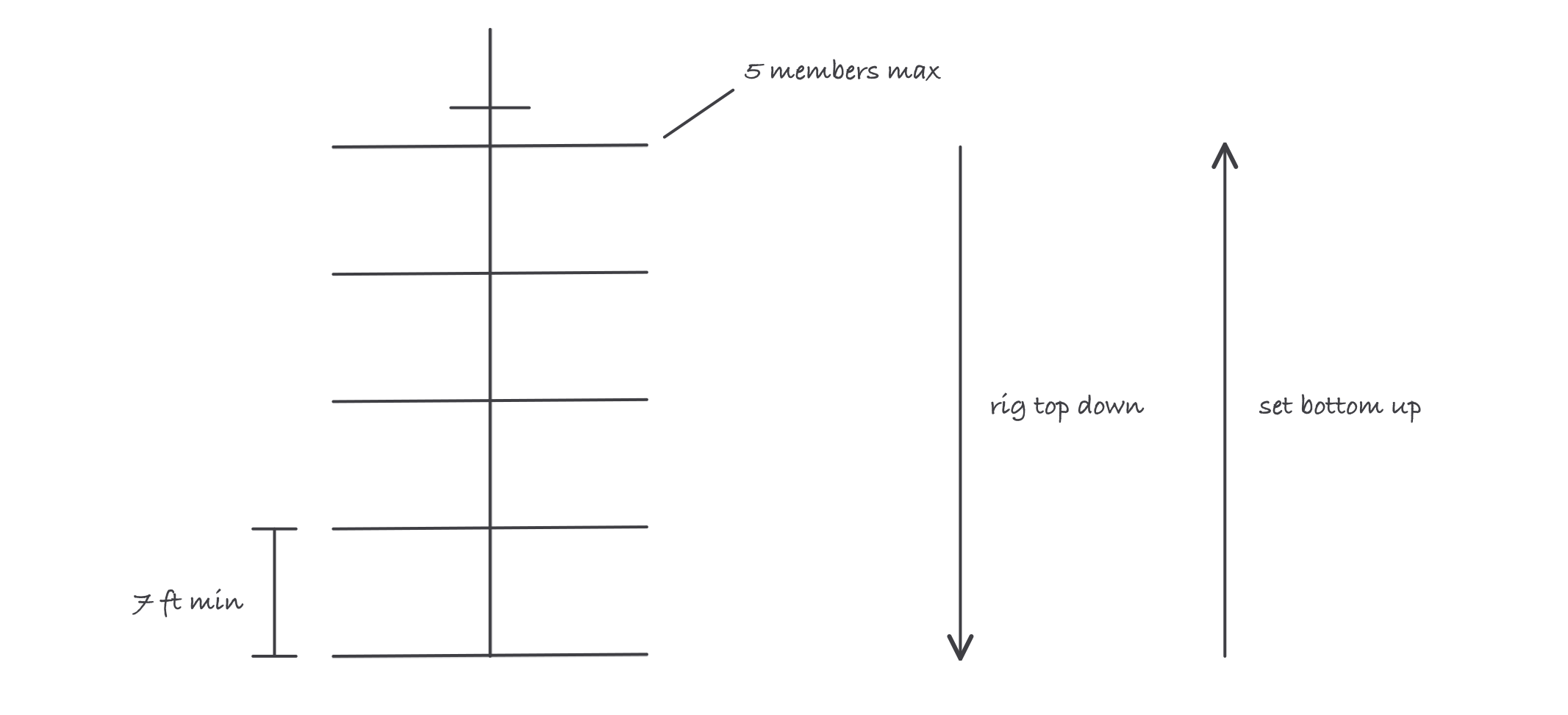
Five members maximum, 7 feet apart, rigged from the top and set from the bottom
Worked example: checking one multiple lift
Five infill beams to the fourth floor. Each beam weighs 2,400 lb. The multiple lift rigging assembly weighs 900 lb, is rated at 15,000 lb total with 4,000 lb per attachment point, and the crane’s load chart shows 18,000 lb at the working radius.
Total load.
- Members: 5 × 2,400 = 12,000 lb.
- Plus the assembly: 12,000 + 900 = 12,900 lb.
Against the crane. 12,900 / 18,000 = 0.717, so the lift uses 71.7 percent of the load chart at that radius.
Against the rigging. 12,900 / 15,000 = 0.86, so the lift uses 86 percent of the rigging rating.
The rule says the total load may exceed neither the rated capacity in the hoisting equipment load charts nor the rigging capacity in the rigging rating chart. Both pass here, but notice which is tighter: the rigging at 86 percent, not the crane at 71.7 percent. On multiple lifts the assembly is usually the governing number, and a foreman who only checks the load chart is checking the wrong document.
Per attachment point. The heaviest member is 2,400 lb against a 4,000 lb point rating, so 2,400 / 4,000 = 60 percent. Fine.
Safety factor. The 15,000 lb rating carries a 5 to 1 factor, so the components are built to 15,000 × 5 = 75,000 lb minimum breaking strength. That factor is why nobody “borrows” a little capacity: the margin is already spent by design.
Vertical envelope. Five members at the 7 ft minimum spacing gives 5 - 1 = 4 gaps, so 4 × 7 = 28 ft from the top member to the bottom one, before you add the assembly above and the hook height above that. Check that against your available headroom at the boom tip, because a tree that will not clear the erected steel is a plan problem discovered at the worst moment.
Where it bites
- Only beams and similar members. Decking bundles, joists, miscellaneous iron and anything else are outside the rule. Five picks is the answer.
- Five is the ceiling, not the target. Nothing requires you to fill the assembly, and a four-member tree that clears the steel beats a five-member tree that does not.
- Center of gravity, every member. Attaching at a convenient hole rather than the center of gravity is how a level tree becomes a tilted one, and a tilted tree loads the attachment points unevenly.
- Training is specific and named. 1926.761(c)(1) is a distinct program for this procedure. General rigging experience does not stand in for it.
- Controlled load lowering is required over connectors. Free-fall lowering with people underneath is not a technique choice.