Learn · Ironworking
Reinforcing Ironwork Compared With Structural Erection
Part of Ironworker, Steel and Rebar · step 8 of 25 · next: Rebar Impalement and Placement Safety
In learning paths: Ironworker, Steel and Rebar
Ironworkers come in two very different kinds. Structural hands erect the steel frame; reinforcing hands, known everywhere as rodbusters, place and tie the steel that goes inside concrete. Same union hall, same apprenticeship system, and almost no overlap in materials, heights, rulebooks or injuries.
Why it matters on the job
Career decisions get made on this fork, and so do safety decisions. BLS treats the two as separate occupations, and OSHA regulates them under separate subparts. Someone who learns Subpart R and then walks onto a rebar mat is carrying the wrong rulebook, and someone who chooses the trade expecting to work at 200 feet may find themselves at grade for a decade, or the reverse.
The size of each
BLS counts 85,100 US ironworkers in 2024, split into two occupations.
- Structural iron and steel workers: 65,700. That is 65,700 / 85,100 = 0.772, so 77.2 percent of the trade.
- Reinforcing iron and rebar workers: 19,400, or 19,400 / 85,100 = 0.228, so 22.8 percent.
The projection to 2034 is 4 percent growth across the trade, about 0.04 × 85,100 = 3,400 more jobs over ten years, with roughly 7,000 openings a year from all causes. Against 85,100 workers, 7,000 / 85,100 = 0.082, so about 8 percent of the trade turns over annually. Most of those openings come from replacement rather than growth, which is what an 8 percent annual opening rate against 0.4 percent annual growth means.
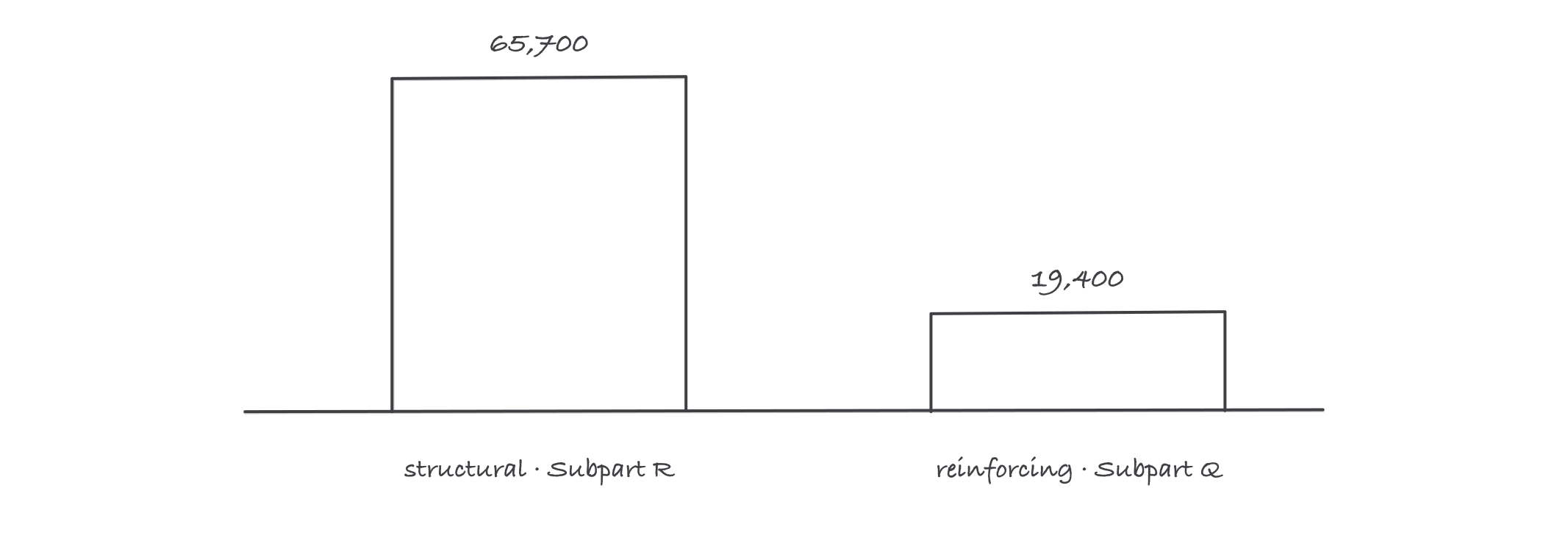
Roughly three structural hands for every rodbuster, working to different rulebooks
Different rulebooks
This is the distinction that matters most day to day.
Structural erection is governed by 1926 Subpart R. Its scope at 1926.750 covers “rigging, hoisting, laying out, placing, connecting, guying, bracing, dismantling, burning, welding, bolting, grinding, sealing, caulking, and all related activities”. Fall protection triggers at more than 15 feet, connectors get a carve-out between 15 and 30 feet, and controlled decking zones exist.
Reinforcing work is governed by 1926 Subpart Q, concrete and masonry construction. 1926.750 puts the placement of reinforcing steel for concrete outside Subpart R, so none of the above applies to it as such. Subpart Q’s requirements for reinforcing work are short and blunt. 1926.701(b) is one sentence: “All protruding reinforcing steel, onto and into which employees could fall, shall be guarded to eliminate the hazard of impalement.”
Subpart Q also covers what happens around the pour: construction loads determined from information supplied by a person qualified in structural design (1926.701(a)), post-tensioning barriers with no employees permitted behind the jack during tensioning (1926.701(c)), no riding concrete buckets (1926.701(d)), and elevated buckets routed away from employees (1926.701(e)).
Different days
| Structural | Reinforcing | |
|---|---|---|
| Where you work | Off the hook, at height, on the frame | At grade or on mats over formwork |
| What you handle | Rolled shapes, decking, joists, bolts | Bar, wire, chairs, couplers, bar supports |
| Governing rule | Subpart R, plus Subpart CC for the crane | Subpart Q |
| Signature hazard | Falls and struck-by from lifted loads | Impalement, silica, struck-by around the pour |
| Signature injury | Trauma from a fall or a swinging load | Cumulative strain from bending and tying |
| Pace driver | The crane | The pour date |
The last row explains more than it looks like it does. Structural crews sequence around crane time, so the picks set the rhythm and the crew waits between them. Rodbusters sequence around concrete, so the mat has to be complete and inspected before a truck arrives, and the pace is continuous rather than punctuated.
Where it bites
- Rodbusting is not the entry level for structural work. They are parallel disciplines, not steps. Plenty of ironworkers spend a whole career in one.
- Ergonomics is the reinforcing career risk. Tying thousands of intersections a day, bent over a mat, is what ends rodbusting careers, and it accumulates too slowly to feel dangerous on any given shift. Tools, rotation and technique are the trade’s real protective equipment.
- The 15-foot trigger does not follow you onto a mat. Different subpart, different duties. Learn which rule governs the work in front of you before you argue about a number.
- Neither branch is licensed. There is no journeyman ironworker license and no state exam in either discipline. The credential is completion of a registered apprenticeship, plus portable qualifications like a welder performance qualification.