Learn · Ironworking
Site Layout and the Site-Specific Erection Plan
Part of Ironworker, Steel and Rebar · step 17 of 25 · next: Column Anchorage and Structural Stability
In learning paths: Ironworker, Steel and Rebar
Assumes you know: How OSHA Subpart R Governs Steel Erection
Before a single piece of steel leaves the ground, the controlling contractor owes the steel erector two pieces of paper. 1926.752(a) makes them a precondition: the concrete has to be proven strong enough to take the frame, and any anchor rod repairs have to be documented. Until both arrive in writing, 1926.752(b) says the erector does not start.
Why it matters on the job
A column landing on green concrete is a collapse waiting for its trigger, and the crew on the iron has no way to see it. That is why OSHA moved the duty upstream to the party who controls the site and the pour schedule, and made the proof written rather than a verbal assurance at the tailgate meeting. If you run steel, the notifications are the first thing you ask for and the last thing you accept a promise about.
The same section covers the two ground conditions that decide whether the crane can work at all: access and laydown.
The two written notifications
Concrete strength. 1926.752(a)(1) bars the controlling contractor from permitting steel erection until it has given the erector written notification that the concrete in the footings, piers and walls, or the mortar in masonry piers and walls, has reached either 75 percent of the intended minimum compressive design strength or enough strength to carry the loads imposed during steel erection, determined by an appropriate ASTM standard test method.
Anchor rod work. 1926.752(a)(2) requires written notification that any repairs, replacements or modifications to the anchor rods were done in accordance with 1926.755(b), which is the paragraph that puts that authority with the project structural engineer of record.
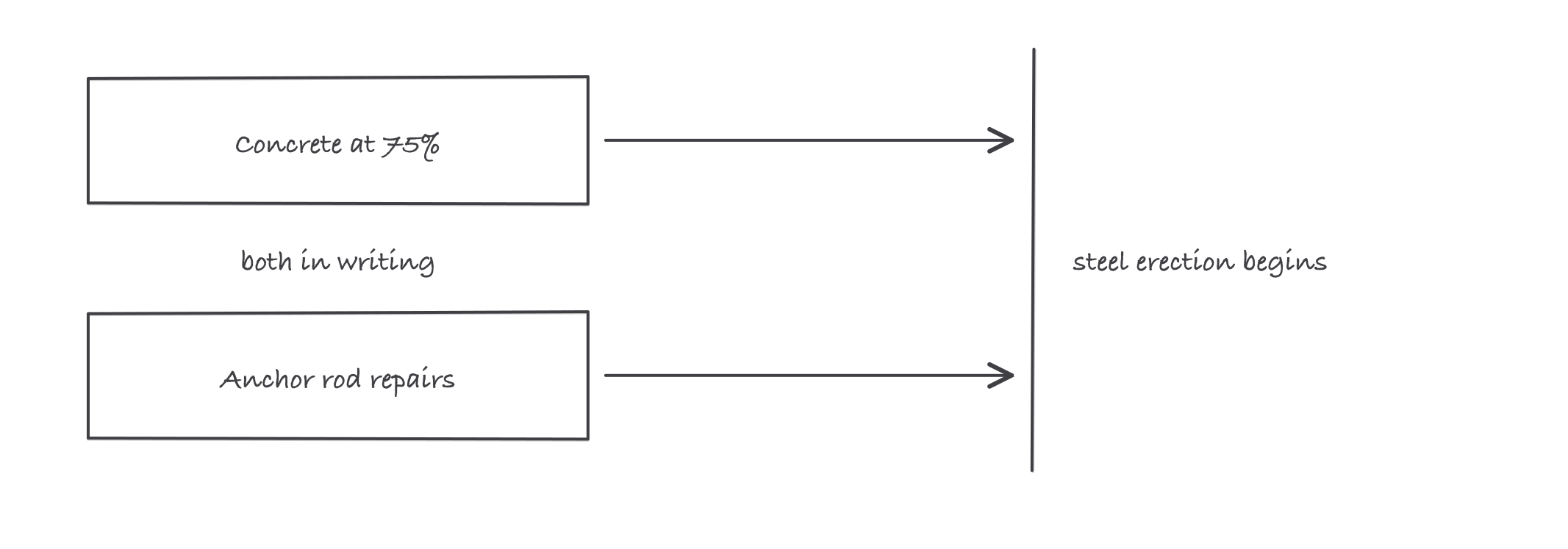
Both notifications are written, and both come before the first pick
Ground the crane can work from
1926.752(c) sets two site conditions.
- (c)(1) Access. Adequate access roads into and through the site for the safe delivery and movement of derricks, cranes, trucks and the material to be erected, plus means and methods for pedestrian and vehicular control. Roads outside the construction site are outside the requirement.
- (c)(2) Laydown. “A firm, properly graded, drained area, readily accessible to the work with adequate space for the safe storage of materials and the safe operation of the erector’s equipment.”
That second clause is the rule behind shake-out, the trade’s word for sorting delivered steel on the ground into erection sequence so each member comes to the hook the right way around. Shake-out is not in the standard by name, but soft or sloping ground makes it impossible, and a crew that cannot shake out ends up flying members twice.
1926.752(d) adds that all hoisting operations in steel erection are pre-planned, which is where load routes get chosen so nobody stands under the load.
The site-specific erection plan
1926.752(e) is narrower than most people assume. It is not a plan every steel job must produce. It is the mechanism an employer uses when site conditions push it to develop alternate means and methods in place of three specific requirements, and when that happens the plan is developed by a qualified person and kept available at the worksite. Appendix A to Subpart R gives the guidelines for writing one.
The qualified-person requirement is the substance here. 1926.751 defines a qualified person as someone with a recognized degree, certificate or professional standing, or extensive knowledge and experience, who has demonstrated the ability to resolve problems in the subject matter. A foreman with 20 years on the iron may or may not meet that; the title alone does not.
Worked example: reading a cylinder break
A concrete frame is specified at 4,000 psi intended minimum compressive design strength. The GC wants steel to start on the podium walls.
- 75 percent of 4,000 psi = 3,000 psi. That is the number the erector is waiting for.
- The 7-day cylinder breaks at 2,850 psi. As a fraction of design, 2,850 / 4,000 = 0.7125, so 71.3 percent. Short. No notification, no steel.
- The 10-day cylinder breaks at 3,120 psi. That is 3,120 / 4,000 = 0.78, so 78 percent, clear of the threshold.
The notification goes out on day 10, in writing, and the erector starts. Note what the arithmetic does not settle: the alternate branch of (a)(1) lets the controlling contractor certify sufficient strength to support the erection loads instead, which can clear earlier or later than 75 percent depending on what the frame actually imposes. That is an engineering determination, not a foreman’s estimate.
Where it bites
- A verbal “you’re good to go” is not the notification. The word in the standard is written, and the duty is on the controlling contractor. Erectors who start on a handshake carry the citation with the GC.
- Anchor rod repairs get quietly done and never reported. A bent rod straightened by a laborer with a cheater bar is a modification, and 1926.755(b)(1) puts approval with the project structural engineer of record. The (a)(2) notification exists precisely because this happens.
- The erection plan is conditional, not universal. Writing a site-specific erection plan for a routine job is harmless; assuming one exists because a job is big is not. Ask which alternate means it covers.
- Laydown gets value-engineered away. Gravel and grading cost money, and it is the first thing squeezed on a tight site. A crew working off soft, ungraded ground is a (c)(2) problem before it is a scheduling problem.