Business · Ironworking
Running Work: Foreman and Beyond
Part of Ironworker, Steel and Rebar · step 24 of 25 · next: Getting Into an Ironworker Apprenticeship
In learning paths: Ironworker, Steel and Rebar
Running work means owning the sequence. A foreman on a steel job spends far less time on the tools than the crew imagines and far more on the three things that decide whether the day goes: what gets picked in what order, what has to be true before each pick, and which decisions only one named person is allowed to make.
Why it matters on the job
Every hour a crane sits is eight or ten ironworkers standing. That is why running work is judged on flow rather than on effort, and why the foreman’s real product is a sequence that nobody has to stop and renegotiate. Subpart R happens to agree: most of what it puts on the person in charge is planning, and most of the rest is a small set of judgment calls it will not let anyone else make.
What the standard puts on the person in charge
Pre-planning. 1926.752(d) requires that all hoisting operations in steel erection be pre-planned so the requirements of 1926.753(d) are met, which is where load routes get set so nobody works under a load. Pre-planning is the foreman’s task even when nobody writes it down.
Site conditions. 1926.752(c) gives the erector a right to adequate access roads and to “a firm, properly graded, drained area, readily accessible to the work with adequate space for the safe storage of materials”. If the laydown will not let you shake out in sequence, that is a condition to fix before the first delivery rather than a nuisance to work around for six months.
The written notifications. Under 1926.752(a) the controlling contractor owes written notice on concrete strength and on anchor rod repairs, and under (b) the erector does not start without them. Chasing those before the crane mobilizes is the cheapest hour a foreman spends.
Training. 1926.761(a) requires that training be provided by a qualified person. 1926.761(b) sets the fall hazard training program, and 1926.761(c) adds three special programs: multiple lift rigging, connector procedures, and controlled decking zone procedures. Matching those against who will do what this week is a scheduling problem that belongs to whoever builds the crew.
The calls only a competent person makes
1926.751 defines a competent person as one who can identify existing and predictable hazards and who is authorized to take prompt corrective measures to eliminate them. That second half is the whole definition in practice: the authority to stop the work is what the role is.
Subpart R hands that person specific decisions.
- The pre-shift visual inspection of the hoisting equipment, under 1926.753(c).
- Whether a column needs guying or bracing, under 1926.755(a)(4).
- Whether a cantilevered member needs more than two bolts for stability, under 1926.756(a)(2).
- When plumbing-up equipment may come off, under 1926.754(d).
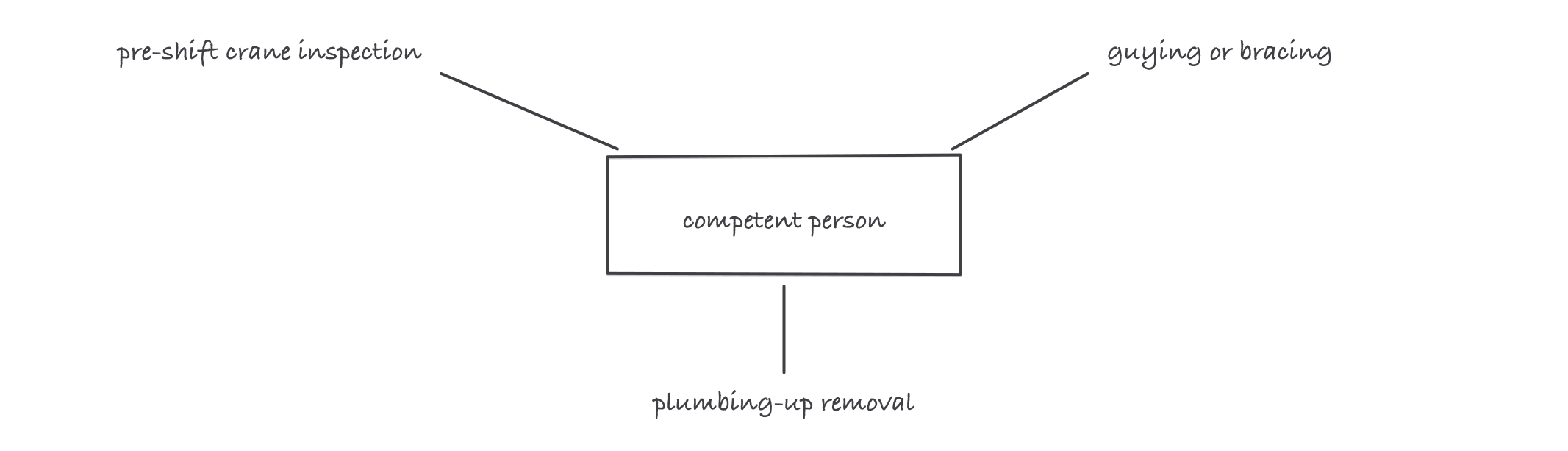
Three of the calls Subpart R reserves for the competent person
Separately, a qualified person writes the site-specific erection plan under 1926.752(e) and delivers the training under 1926.761(a). The two roles are defined by different tests (demonstrated ability for one, authority for the other), so a crew can easily have one and lack the other.
Worked example: planning a week for a crew of eight
Eight ironworkers. Three will connect this week, four will run initial decking inside a controlled decking zone, and two will rig multiple lifts. Some people appear in more than one group.
Training obligations.
- Fall hazard training under 1926.761(b): all 8.
- Connector training under 1926.761(c)(2): 3.
- CDZ training under 1926.761(c)(3): 4.
- Multiple lift rigging training under 1926.761(c)(1): 2.
- Total training attendances to have on file: 8 + 3 + 4 + 2 = 17.
Seventeen records for eight people, delivered by a qualified person. Nobody discovers a gap in that list at a convenient moment, which is why the check happens when the crew is built rather than when the work reaches them.
What a hold costs. The crew works 10-hour days, so a full day is 8 × 10 = 80 crew-hours. A two-hour wait for a written notification that should have arrived Friday costs 8 × 2 = 16 crew-hours, which is 16 / 80 = 0.20, or 20 percent of the day, and it costs the crane the same two hours. Run the same number against a five-day week: 16 hours out of 5 × 80 = 400 crew-hours is 4 percent of the week, gone, for a phone call nobody made.
That arithmetic is the argument for front-loading. Every planning item in 1926.752 costs minutes in advance and crew-hours in arrears.
The ladder past foreman
The progression runs journeyman, foreman, general foreman, superintendent, and from there into project management, estimating, safety or ownership. BLS counts 85,100 ironworkers in 2024 with about 7,000 openings a year, so 7,000 / 85,100 = 0.082, roughly 8 percent of positions turning over annually. Supervision is where a career survives the physical arithmetic of the trade. The people who get there tend to be the ones already thinking about tomorrow’s sequence while everyone else was thinking about this pick.
No license gates any of it. Ironworking has no state licensing exam at any level, so what qualifies a foreman is the completed apprenticeship, the record, and whatever portable qualifications the work calls for.
Where it bites
- Designating a competent person is a delegation of authority. If the person you named cannot stop work without calling someone, they do not meet the definition, and the calls the rule assigns to them are not being made.
- The plan is the deliverable, not the paperwork about the plan. Pre-planning hoisting means deciding routes and sequence, and it counts whether or not anyone files a form.
- Training gaps surface at the worst moment. The connector who has not had connector training is discovered at 7 a.m. with a crane on the clock.
- Sequence problems look like productivity problems. A crew that seems slow is often a crew waiting on shake-out, on deck, or on a notification. Fix the upstream item before you push the people.
- The controlling contractor’s duties do not become yours by default. 1926.752(a) and 1926.759(b) put specific obligations on the controlling contractor. Absorbing them quietly to keep the peace also absorbs the liability.