Learn · Ironworking
Fall Protection for Connectors
Part of Ironworker, Steel and Rebar · step 19 of 25 · next: The Controlled Decking Zone
In learning paths: Ironworker, Steel and Rebar
Assumes you know: How OSHA Subpart R Governs Steel Erection
Steel erection is the one part of construction where the fall-protection trigger is not 6 feet. 1926.760(a)(1) sets it at more than 15 feet above a lower level, and inside that rule connectors get a narrower duty of their own between 15 and 30 feet. If you carry one number out of Subpart R, carry 15.
Why it matters on the job
Bringing the Subpart M number onto a steel job produces two opposite failures. Crews that expect 6 feet argue with a rule that is not being broken; crews that hear “15 feet” and stop listening miss the fact that the carve-out is narrow, conditional, and attached to a defined role rather than to a job title.
A connector under 1926.751 is “an employee who, working with hoisting equipment, is placing and connecting structural members and/or components”. That is a task you occupy for part of a shift, not a rank. The moment you stop placing and connecting members off the hook, the carve-out stops applying to you.
The three bands
Up to 15 feet. Subpart R’s general trigger is not met. Other rules can still apply, and the employer can still require protection, but 1926.760(a)(1) is not what compels it.
More than 15 feet. Everyone engaged in steel erection is protected from fall hazards by guardrails, safety nets, personal fall arrest, positioning devices or fall restraint, with the equipment meeting the criteria in 1926.502 as required by 1926.760(d).
Connectors, over 15 and up to 30 feet. 1926.760(b) says each connector is provided with a personal fall arrest system, positioning device system or fall restraint system, and wears the equipment necessary to be able to tie off, or is given other protection meeting (a)(1). Above 30 feet or two stories, whichever is less, the connector is back under the general rule with no carve-out.
Read the verb. The employer’s duty in that band is to provide and to have the connector wearing usable equipment. The band exists because a connector walking iron to catch a swinging beam can be put in more danger by a lanyard that snags than by the exposure itself. OSHA drew the exception narrowly rather than pretending the conflict did not exist.
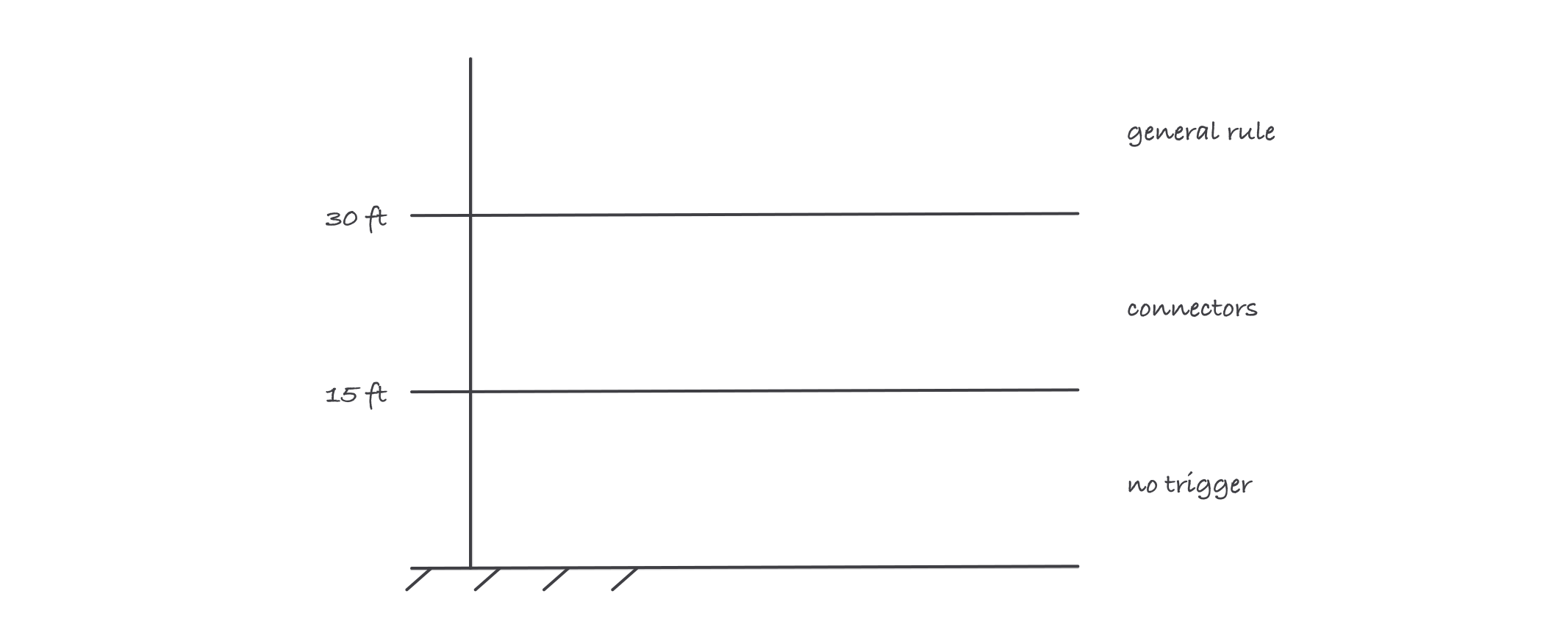
Three bands, two lines: 15 feet turns the rule on, 30 feet closes the connector carve-out
Worked example: the height that counts is the distance to the lower level
A mid-rise frame at 14 ft floor to floor. A connector is setting beams for level 5. Whether they are in the connector band depends entirely on how far the decking has chased the steel.
- Deck complete to level 4. The nearest lower level is 14 ft down. 14 ft is not more than 15 ft, so the (a)(1) trigger is not met at that lower level.
- Deck complete only to level 3. The fall is 2 × 14 = 28 ft. That is over 15 and under 30, so the connector rule in (b) governs.
- Deck complete only to level 2. The fall is 3 × 14 = 42 ft, well past 30, so the general rule applies with no carve-out.
Now check the second half of the 30-foot limit, “two stories or 30 feet, whichever is less”. At 14 ft floors, two stories is 2 × 14 = 28 ft, which is less than 30 ft, so 28 ft is the ceiling on the carve-out for this building, not 30. On a building with 16 ft floors, two stories is 32 ft, so 30 ft governs instead. Run both numbers on every job.
The practical consequence is that decking is fall protection in the schedule sense. A deck crew running two floors behind the connectors changes which rule the connectors are working under, before anyone has changed a harness.
What else 1926.760 requires
- Perimeter safety cables. On multi-story structures, they go in at the final interior and exterior perimeters of the floors as soon as the metal decking is installed. 1926.756(e) is why the holes are there, with perimeter columns extending 48 inches above the finished floor and holes at 42 to 45 inches.
- Custody of fall protection. Under 1926.760(e), the steel erector’s fall protection stays behind for other trades only where the controlling contractor directs it in writing and takes over inspection, control and responsibility. Otherwise it comes down with the erector.
- Training. 1926.761(a) requires training by a qualified person. 1926.761(b) sets the fall hazard program, and 1926.761(c)(2) adds a special training program for connectors covering the hazards of the work. A connector who has not had that training is not eligible for the carve-out that connectors get.
Where it bites
- “Connectors don’t have to tie off” is a slogan, not the rule. The band is 15 to 30 feet, capped by two stories where that is less, applies only to the defined connecting task, requires connector training, and still requires the employer to provide the system and the connector to wear usable equipment.
- Anchorage is not automatic. An open frame often has no compliant anchorage yet, which is a planning problem to solve before the pick, not an argument for skipping protection.
- The lower level moves. Fall distance is measured to the nearest lower level, and on a steel job that surface changes shift by shift as deck goes in.
- Subpart R does not repeal the rest of the site. Scaffolds, ladders, floor openings and the trades below all keep their own rules while you work under this one.