Learn · Ironworking
Crane Signals
Part of Ironworker, Steel and Rebar · step 12 of 25 · next: Rigger and Signalperson Certifications
In learning paths: Ironworker, Steel and Rebar
Assumes you know: Rigging Fundamentals
A crane is run by one person and directed by one person, and on most steel picks those are two different people who cannot see the same thing. Signals are how the person who can see the load talks to the person holding the levers. Get the channel wrong and the machine does exactly what it was told, which is the problem.
Why it matters on the job
The operator’s view of the landing is blocked more often than not on a steel job: by the frame, by the deck, by the boom itself, by distance. When the operator cannot see the load or the landing area, someone has to be their eyes, and that person’s instruction moves several tons.
1926.753 also puts the route itself under control. Routes for loads are pre-planned so employees are not required to work under suspended loads and so that loads do not pass over people. The signal person is the one enforcing that plan in real time, because they are the only one watching both the load and the ground under it.
One voice at a time
The first rule is a protocol, not a hand position: one designated signal person owns the channel for a given lift. Two people signaling is worse than none, because the operator has to decide which one to obey while a load is in the air.
That does not mean nobody else may speak. A stop is a stop, and an operator receiving a stop signal stops. The exclusive authority is over what the crane does next, not over calling a halt.
Hand signals and voice signals
Hand signals are the default on steel. When hand signals are used, 1926.1428(c)(1) requires the signal person to know and understand the Standard Method for hand signals, the standardized set of signals posted on the equipment. Learn it from the chart on the machine rather than from a coworker’s habit, because a signal that is nearly right is a signal that means something else.
The families you will use every day are hoist, lower, boom up, boom down, swing, travel, trolley, stop, emergency stop and dog everything. The last three are all about stopping and they mean different things: stop halts the current motion, emergency stop halts everything immediately, and dog everything means hold all motion and stay put.
Voice signals are used where hand signals cannot work, usually radio. The discipline is different: every transmission has to establish who is being addressed and what the crane is being asked to do, and the operator confirms before moving. Voice never mixes with hand signals mid-lift.
What OSHA requires of the signal person
1926.1428(c) lists what a signal person must know, and it is more than the signals themselves.
- Know and understand the type of signals used, and if hand signals are used, know the Standard Method.
- Be competent in applying that type of signal.
- Have a basic understanding of equipment operation and limitations, including the crane dynamics involved in swinging and stopping loads and boom deflection from hoisting loads.
- Know and understand the relevant requirements of 1926.1419 through 1926.1422 and 1926.1428.
- Demonstrate all of the above by an oral or written test and by a practical test. Both, not either.
Point 3 is the one that surprises people.
Worked example
A signal person has to understand boom deflection because the load does not stay where you pointed it.
Take a boom 100 ft from foot pin to tip, holding at 60 degrees above horizontal. The horizontal reach from the foot pin is:
100 ft × cos 60 = 100 × 0.5000 = 50.00 ft
Now hoist the load. The boom deflects under the weight, the tip drops, and the effective angle comes down. Say it settles at 58 degrees:
100 ft × cos 58 = 100 × 0.5299 = 52.99 ft
The radius grew by 52.99 − 50.00 = 2.99 ft, nearly 3 feet, without the operator swinging, booming or traveling. The load moved almost 3 feet away from the crane purely because it was picked up.
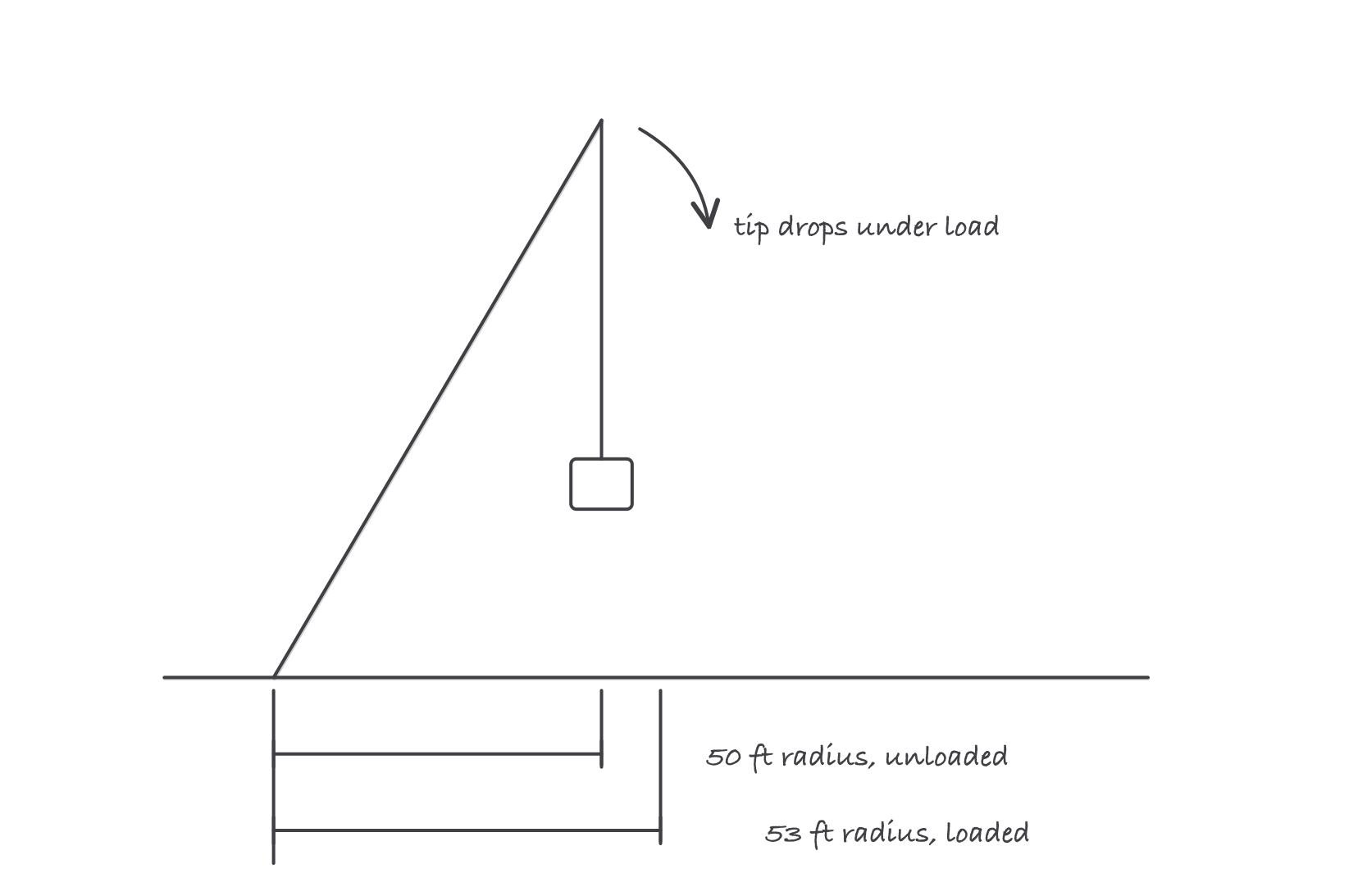
Picking the load up moves it outward, before anyone gives a signal
Two consequences for the person signaling. The load will drift out as it breaks the ground, so a landing point judged with the load still on the deck is not where the load will hang. And a larger radius is a lower rated capacity on the load chart, so deflection eats into the margin the lift was planned on. Real deflection depends on the machine, the boom length and the load, and it comes from that crane’s chart and manual rather than from this arithmetic, which only shows the shape of the effect.
Where it bites
- Line of sight is the signal person’s job to protect. If you cannot see the load and the operator cannot see you, stop the lift and reposition. Backing into a spot where you have to lean out to be seen is not a solution.
- Momentum is not in the signal. A swinging load keeps swinging after the swing stops, and a load stopped abruptly pendulums. Signal early and taper, which is what “competent in the application” in 1926.1428(c)(2) actually means in the field.
- Never signal from under the load or in its path. The route was pre-planned to keep people out from under suspended loads, and the signal person is a person.
- Radios fail. Agree what happens on a lost signal before the pick, and default to a stop. A crane that keeps moving through radio silence is a crane operating blind.