Learn · Ironworking
Rigging Fundamentals
Part of Ironworker, Steel and Rebar · step 10 of 25 · next: Sling Angles and Load Calculations
In learning paths: Ironworker, Steel and Rebar
Rigging is attaching a load to the hook so that it lifts level, cannot shift, and cannot come loose. On a steel erection job that is not a general skill anyone can offer: 1926.753(d)(3) requires that all loads be rigged by a qualified rigger, and the qualified rigger is the person who owns the outcome from the moment the choker goes on until the load is landed and released.
Why it matters on the job
A load that shifts on the way up is already an incident. It swings, it strikes the frame, it slips out of the hitch, or it lands cocked and has to be re-picked over people’s heads. Every one of those is decided on the ground in the thirty seconds before the signal to hoist, by whoever put the slings on.
1926.753 also builds the surrounding discipline. A competent person visually inspects the equipment each shift, before or during use. The route of the load is pre-planned so that employees are not required to work under suspended loads, and so that the load does not pass over people. And 1926.759(a) requires materials, equipment and tools not in use aloft to be secured against accidental displacement, because the thing that falls off the load is as dangerous as the load.
Qualified is the word that matters
OSHA requires the rigger to be qualified, and qualified has a definition. 1926.751 defines a qualified person as one who, by possession of a recognized degree, certificate or professional standing, or by extensive knowledge, training and experience, has successfully demonstrated the ability to solve or resolve problems relating to the subject matter, the work or the project.
OSHA’s qualified rigger fact sheet adds two things worth knowing early. Being qualified does not mean being qualified for every rigging job: a person can be qualified for the loads and configurations they have demonstrated ability on and not for others. And a certified crane operator does not automatically meet the qualified rigger requirement, because they are different skills assessed against different criteria. The credentials lesson later in this subject covers what a card does and does not do.
The three basic hitches
Vertical (straight) hitch: the sling runs straight from hook to load, attached to a lifting point. The load must have an attachment point that suits it.
Choker hitch: the sling passes around the load and back through its own eye, tightening as it lifts. It grips, which is what you want on a bundle or a smooth member, and it reduces the sling’s rated capacity compared with the same sling in a vertical hitch because of the sharp bend at the choke point.
Basket hitch: the sling passes under the load with both eyes on the hook. Both legs share the load, but only when the legs are near vertical. Flatten the legs and the geometry works against you, which is the whole subject of the next lesson.
The load’s own shape decides the hitch as much as the weight does. Smooth, round or bundled loads want a choker or a double wrap. Loads with engineered lifting lugs want vertical hitches at the lugs. Anything with sharp corners needs softeners, because a sling cut on an edge fails without warning.
The center of gravity decides everything
A load hangs with its center of gravity directly under the hook. Gravity settles that, and no amount of rigging opinion changes it. If you attach off the center of gravity, the load rotates as it lifts until the center of gravity is under the hook, and that rotation is the swing that hits the frame and the crew.
So the first question on any pick is not what it weighs. It is where the center of gravity sits and whether the hook is over it.
Worked example
The gang is picking a 40 ft beam that weighs 3,200 lb, with a 900 lb piece of equipment bolted to it 5 ft from the left end. Where does the hook go?
Take moments about the left end. The beam is uniform, so its weight acts at its middle, 20 ft from that end.
- Beam: 3,200 lb × 20 ft = 64,000 ft-lb
- Equipment: 900 lb × 5 ft = 4,500 ft-lb
- Total moment: 64,000 + 4,500 = 68,500 ft-lb
- Total weight: 3,200 + 900 = 4,100 lb
Center of gravity = 68,500 / 4,100 = 16.7073 ft from the left end.
Convert the fraction to inches: 0.7073 × 12 = 8.49 in, so the hook goes at roughly 16 ft 8 1/2 in from the left end.
Compare that with the bare beam, whose center of gravity is at 20 ft. Nine hundred pounds (22 percent of the gross weight) moved the pick point 20 − 16.71 = 3.29 ft toward the loaded end. Rig it at the beam’s midpoint out of habit and the load tips as it leaves the ground.
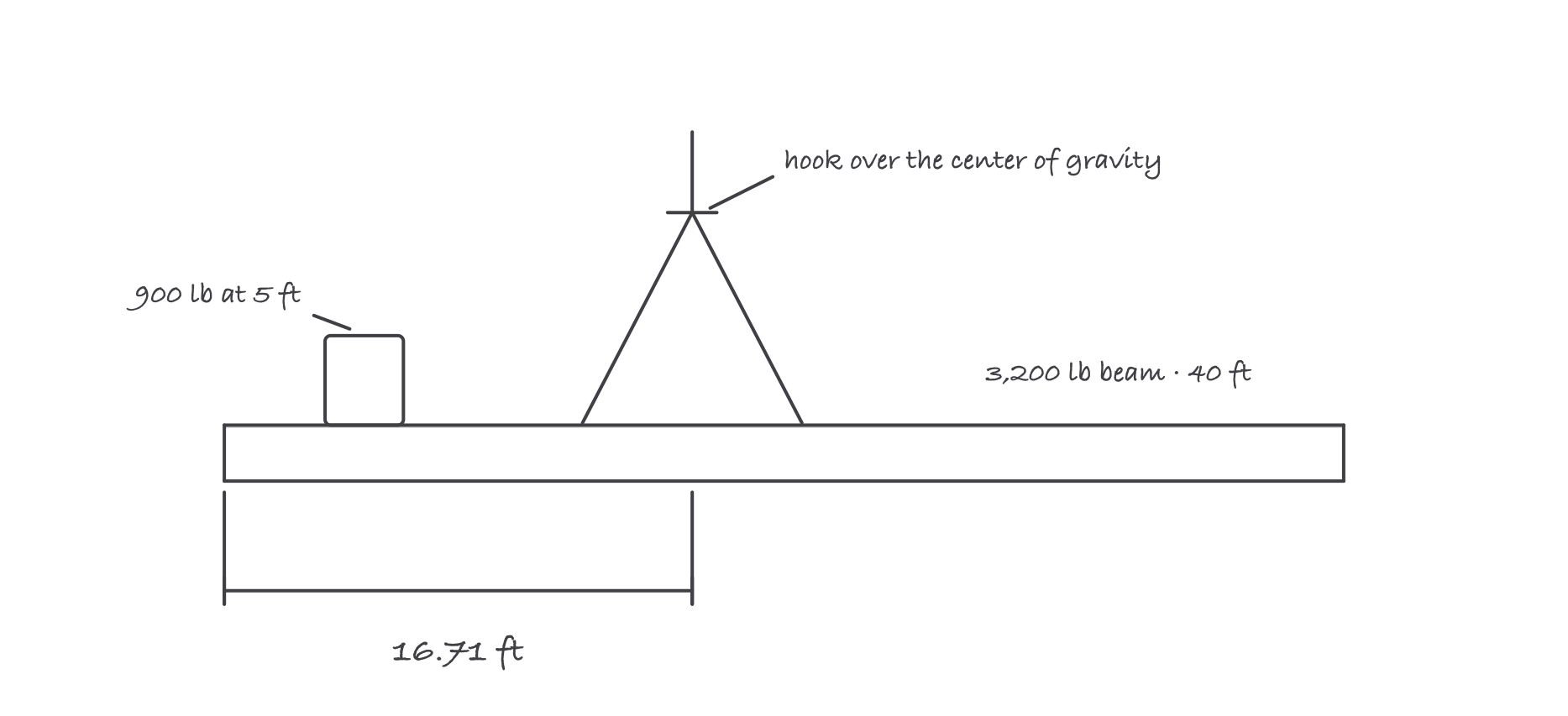
The hook goes over the center of gravity of the whole assembly, not the middle of the steel
Where it bites
- The tag line is part of the rigging. A load with no tag line is controlled by whoever grabs it, which puts hands on a suspended load. Rig the tag line before the pick, long enough to keep people clear.
- Shackles are not interchangeable. Screw pin shackles can back out under rotation; bolt-type shackles are the answer where the load may turn. Side-loading any shackle derates it.
- Nothing rides on the load. Tools, bolt bags and burning gear go up secured or they go up separately. 1926.759(a) covers items not in use aloft, and a wrench dropped from the frame is lethal.
- Weight from the drawing, not from the eye. A member’s weight per foot is on the shape designation and the advance bill. Estimating by looking at it is how a crane is overloaded by a member that happened to be a heavier section of the same nominal depth.