Learn · Ironworking
Qualified or Certified: What the Rigging Rules Require
Part of Ironworker, Steel and Rebar · step 14 of 25 · next: Multiple Lift Rigging
In learning paths: Ironworker, Steel and Rebar
Assumes you know: Rigging Fundamentals
OSHA requires riggers and signal persons to be qualified. It does not require them to be certified, and it says so in writing. Getting this distinction right protects you twice: it keeps you from believing a card you do not need, and it keeps you from believing a card is all you need.
*Learn the Trades is a free study resource. We are not a licensing body, an authorized training provider, or an exam administrator. Reading this page does not award any card, license, or certification. Always verify requirements with the issuing authority linked in the sources.*Why it matters on the job
Two failures come out of the same confusion. Crews turn away a competent hand because he has no card, and crews hand the choker to someone because he has one, without anyone assessing whether he can rig this load off this piece of equipment. The fact sheet closes that second door too, noting that being a qualified rigger “does not mean that a rigger must be qualified to do every type of rigging job”. Qualification is scoped to the work.
What “qualified” means in the standard
1926.751 defines a qualified person as one “who, by possession of a recognized degree, certificate, or professional standing, or who by extensive knowledge, training, and experience, has successfully demonstrated the ability to solve or resolve problems relating to the subject matter, the work, or the project”.
Read the structure. There are two ways in (credential or demonstrated knowledge and experience), and both end in the same requirement: successfully demonstrated ability in this subject matter. A card can be the evidence. So can a documented employer assessment. Neither substitutes for the demonstration.
This is a different test from competent person, which 1926.751 also defines. A competent person identifies existing and predictable hazards and is authorized to take prompt corrective measures to eliminate them. Authority makes the competent person; demonstrated ability makes the qualified person. They are not two rungs on the same ladder.
Where the rules put qualified riggers
- 1926.753(d)(3), steel erection: all loads are rigged by a qualified rigger.
- 1926.1404(r)(1), crane assembly and disassembly: the rigging work is done by a qualified rigger.
- 1926.1425(c), working under the load: a qualified rigger is required when employees are in the fall zone hooking, unhooking or guiding a load, or doing the initial connection of a load to a component or structure.
Three separate rules, one word in all three, and no certification requirement in any of them.
Signal persons: two documented routes
Signaling is where OSHA got most specific, and it is the clearest illustration of how qualification is documented. 1926.1428(a) gives an employer exactly two routes.
- Third-party qualified evaluator. The signal person has documentation from a third party qualified evaluator showing they meet the qualification requirements.
- Employer’s qualified evaluator. The employer’s own qualified evaluator assesses the person, determines they meet the requirements, and provides documentation of that assessment.
The difference is portability. An employer’s assessment is good on that employer’s jobs only; the rule states that this assessment “is not portable” and other employers are not permitted to use it. A third-party evaluation travels with you.
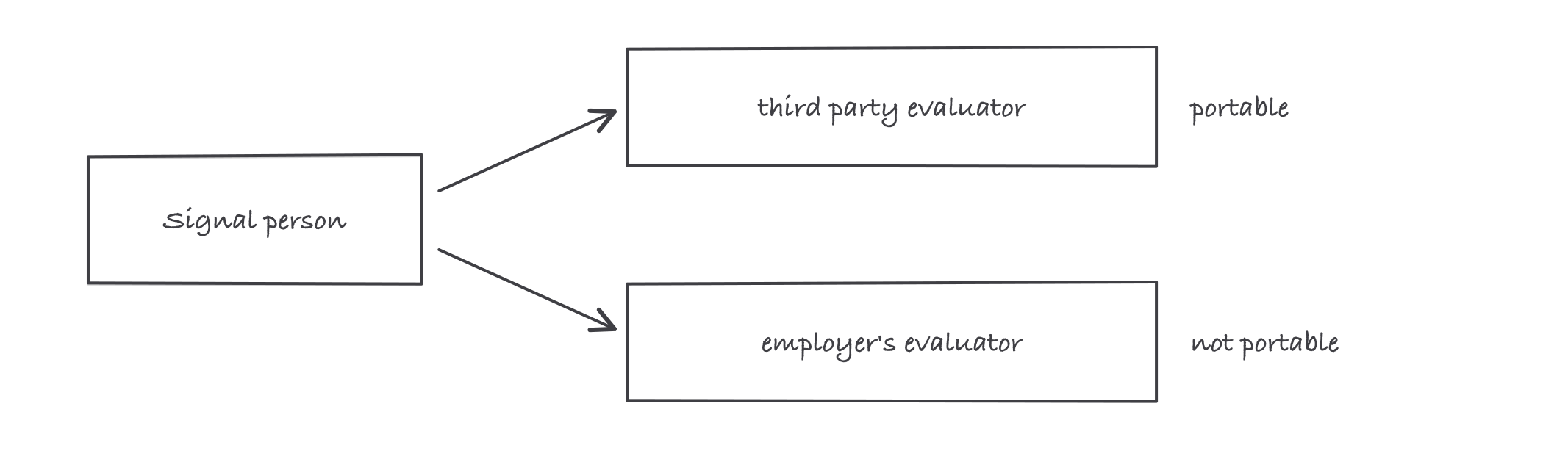
Same standard, two routes: only the third-party route travels to your next employer
Either route has to establish the substance in 1926.1428(c): knowledge of the type of signals used (including the Standard Method for hand signals), a basic understanding of equipment operation and limitations such as crane dynamics involved in swinging, raising and lowering loads and boom deflection, knowledge of 1926.1419 through 1422 and 1926.1428, and demonstrated ability to apply all of it. That demonstration is by an oral or written test and a practical test. Both, not either.
A concrete exemplar: the same hand, two jobs
An ironworker with eight years on structural steel takes a job with a new contractor.
- He rigs and signals every day at his old shop, assessed and documented by that employer’s qualified evaluator. That documentation covers him there. It does not follow him to the new contractor, who has to qualify him under one of the two routes before he signals a pick.
- He holds a current NCCCO Signalperson credential instead. That is third-party documentation, so it satisfies the first route on any job that accepts it, and it moves with him.
- He holds a crane operator certification and nothing else. Under the fact sheet’s own language, that does not by itself make him a qualified rigger. Different scope, different demonstration.
Note what changed between the three cases: not his skill, only the documentation and who owns it. That is why the trade treats cards as portable paperwork rather than as competence.
Exam relevance
The third-party credentials ironworkers meet here are the NCCCO Rigger Level I and Level II and the NCCCO Signalperson, each assessed by a written and a practical exam. NCCCO certifications are valid for five years. What examiners test in this area is the substance the rules name: load weight estimation, center of gravity, sling angle effects, hitch selection, hardware inspection criteria, the Standard Method hand signals, and the crane dynamics a signal person has to anticipate. Study the mechanics rather than the card, because the mechanics are what qualification actually requires.
Where it bites
- “Certified rigger” is not a legal category. Writing it into a job description or a toolbox talk teaches people the wrong rule. Say qualified, then explain that certification is one way to document it.
- Employer assessments do not travel. Ironworkers move between contractors constantly, and every move restarts the documentation question for anyone qualified through their employer’s evaluator.
- Qualification is scoped. Qualified for a straightforward two-leg pick is not qualified for a critical lift with an engineered rigging plan.
- A card can expire while your skill does not. NCCCO certifications run five years. Track your own dates; nobody else will.
Verified requirements
| Where | Expires | Renewal | Continuing education |
|---|---|---|---|
| United States (federal) | Yes | 5 years | Confirm with issuer |
| United States (federal) | Yes | 5 years | Confirm with issuer |
| United States (federal) | No | Confirm with issuer | Confirm with issuer |
Information comes from issuing-authority sources. Confirm current rules, fees and eligibility with the authority before acting.