Learn · Ironworking
Structural Bolting
Part of Ironworker, Steel and Rebar · step 3 of 25 · next: Plumbing and Aligning Steel
In learning paths: Ironworker, Steel and Rebar
Assumes you know: Structural Steel Basics
Wrench-tight is a condition, not a torque value. It means the bolt has been brought up snug with a spud wrench or an impact until the plies of the connection are in firm contact, and it is what OSHA requires before a member can be cut loose from the crane. 1926.756(a)(1) sets the rule: at least two bolts per connection, of the same size and strength as shown in the erection drawings, drawn up wrench-tight before the load is released from the hoisting line.
Why it matters on the job
Everything the raising gang does is temporary. A beam held by two snug bolts is stable enough to stand on and nowhere near finished. The gap between those two states is where people get hurt and schedules get lost. Knowing exactly which bolts make a member safe to release, and which operation makes the connection final, is the difference between a connector and someone holding a wrench.
Two operations, two different moments
Erection bolting happens at the hook. Its job is stability: hold the member in position against wind, crew weight and the next pick until the frame is complete enough to stand on its own. Wrench-tight is the standard, the count comes off the drawings, and the whole thing takes seconds.
Final installation happens later, usually a floor or more behind. Its job is strength: bring the joint to the condition the structural engineer designed, which for pretensioned and slip-critical joints means a controlled installation procedure with verification. That procedure comes from the project specification and the bolt standard it references, not from Subpart R and not from the connector’s judgment.
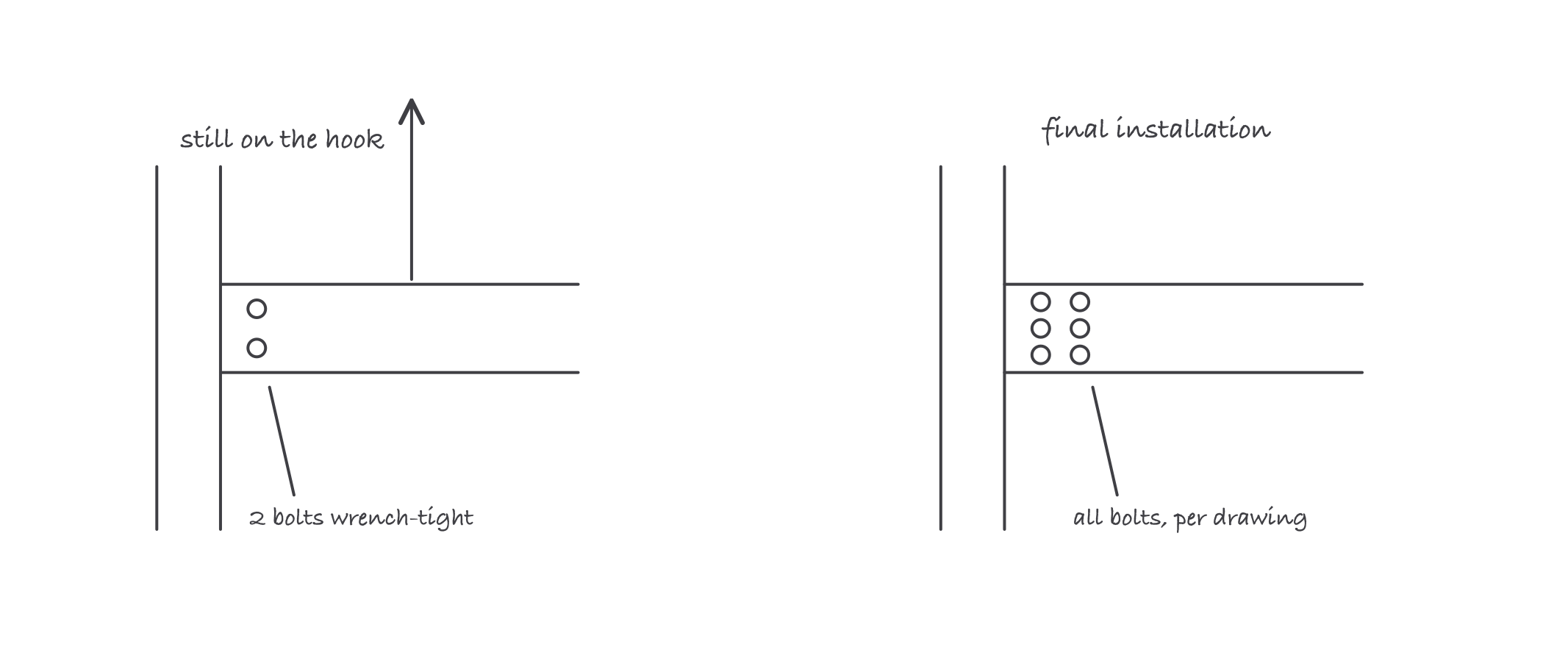
Wrench-tight buys stability at the hook; final installation buys the designed strength
Calling erection bolting “torquing the connection” invites someone to think the joint is finished.
The minimums, and where they change
- Beams and columns: two bolts per connection, wrench-tight, before the load is released (1926.756(a)(1)).
- Cantilevered members: a competent person decides. 1926.756(a)(2) requires a competent person to determine whether more than two bolts are needed for stability, and that call is made before the pick, not after.
- Diagonal bracing: one bolt wrench-tight is the minimum (1926.756(b)).
- Double connections: never fully unbolt the first member. Under 1926.756(c), when a member lands on the opposite side of a column web or beam web from a member already connected, at least one bolt with its wrench-tight nut has to remain on the first member unless a seat or equivalent device supports it while the second member is landed. Pulling every bolt to slip the second piece in is how the first piece falls.
The tools, and the line they must not cross
The spud wrench is a box or open-end wrench with a long tapered handle. The handle goes in a hole to draw the plies into register; the head turns the nut. The drift pin (bull pin) is a solid tapered pin driven for the same alignment job, with no turning function.
Both align holes. Neither enlarges them. Reaming or burning a hole to make a piece fit changes the connection the engineer designed, and it is a request for information rather than a field decision. The spud wrench handle is also not a pry bar and not a hammer.
Bolted or welded: joists show both
Open web steel joists are the clearest place to see the drawings decide the fastener. 1926.757 gives the attachment minimums by joist series.
- K-series joists: two 1/8 inch fillet welds 1 inch long, or two 1/2 inch bolts, or the equivalent.
- LH and DLH series joists: two 1/4 inch fillet welds 2 inches long, or two 3/4 inch bolts, or the equivalent.
Notice that the rule names the weld size and length as precisely as it names the bolt diameter. Field welding on structural connections is done to a welding procedure, and the American Welding Society has authored more than 350 standards covering welding practice, including D1.1, the structural welding code for steel.
Worked example
1926.756(d) requires column splices to be capable of resisting a 300-pound eccentric gravity load located 18 inches from the extreme outer face of the column, in each direction at the top of the column shaft. That is OSHA writing down a person: a connector standing or sitting on the top of a column shaft before the next tier lands.
Work out what the splice is being asked to hold.
Moment at the splice = 300 lb × 18 in = 5,400 inch-pounds.
Convert to foot-pounds: 5,400 / 12 = 450 foot-pounds.
Now feel the sensitivity. Move the same 300 pounds out to 24 inches and the moment goes to 300 × 24 = 7,200 inch-pounds, or 600 foot-pounds, a 33 percent increase from stepping 6 inches further out. The lever arm, not the weight, is what climbs. That is why the rule fixes the distance as well as the load, and why “it is only me up here” is never the right way to think about a column top.
Where it bites
- Two bolts is the beam-and-column number only. It is too many for diagonal bracing and potentially too few for a cantilever. Read the detail, then check whether the competent person has called for more.
- Same size and strength as shown on the drawings. A bolt of the right diameter but the wrong grade does not satisfy 1926.756(a)(1). Bolt grade is marked on the head, and mixed boxes on a deck are a real hazard.
- Wrench-tight is judged by the plies, not by the wrench. The plies of the connection have to be brought into firm contact. An impact gun rattling on a bolt that is bearing on a misaligned hole is not a wrench-tight connection.
- The hook comes off last. Bolts in, then the load released, then the rigging. Reversing that order on a windy day is how a member ends up hanging on one bolt.