Learn · Ironworking
Rebar Impalement and Placement Safety
Part of Ironworker, Steel and Rebar · step 9 of 25 · next: Rigging Fundamentals
In learning paths: Ironworker, Steel and Rebar
Assumes you know: Rebar: Grades, Sizes, Placement
The rule that governs the rodbuster’s signature hazard is one sentence long. 1926.701(b): “All protruding reinforcing steel, onto and into which employees could fall, shall be guarded to eliminate the hazard of impalement.” Read it twice, because almost every field failure comes from reading it once.
Why it matters on the job
Impalement is one of the few construction injuries that turns a trip into a fatality. A worker who catches a toe on a chair and goes down at grade has almost no fall energy by fall-protection standards, and a #5 bar sticking up 30 inches does not need fall energy to do its damage. That is the reason the rule carries no height threshold and no exposure duration. Bar you could fall onto is guarded, full stop.
Reading the sentence
“All protruding reinforcing steel.” Not only the vertical dowels waiting for the next pour. Bar sticking out horizontally from a wall, bar cantilevered off a mat, bar in a stockpile: if it protrudes and a person could fall onto it, the rule reaches it.
“Onto and into which employees could fall.” The test is exposure, not height. A dowel field on a slab on grade is squarely inside the rule. So is a mat at the second-floor deck edge.
“Guarded to eliminate the hazard.” The verb is eliminate. Covering a sharp end so nobody scratches an arm on it is not the same thing as preventing the bar from penetrating a body under a person’s falling weight. When you pick a guarding method, the question to answer is whether it eliminates impalement, and if the answer is “it makes it less likely,” the method has not met the rule.
There is more than one way to satisfy it. Guarding the bar is the usual method. Removing the exposure works too: bend the bar over, cover the field with troughs or timber, or guard the area so nobody can fall onto it in the first place. The rule specifies the outcome and leaves the means open.
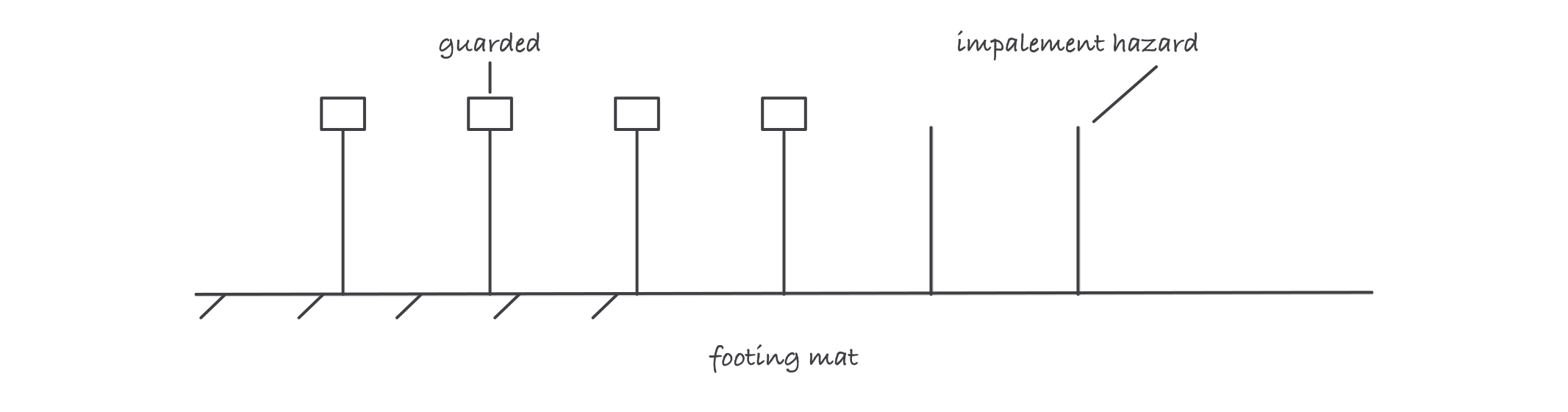
Every protruding bar someone could fall onto, not most of them
Worked example: counting the exposure
A footing mat 20 ft by 30 ft with vertical dowels at 12 in on center in both directions.
- Along the 20 ft dimension: 20 / 1 = 20 spaces, so 20 + 1 = 21 rows of dowels.
- Along the 30 ft dimension: 30 spaces, so 31 columns.
- Total dowels: 21 × 31 = 651.
Now suppose the crew caps 621 of them and 30 get missed behind the formwork where the caps ran out.
- Coverage: 621 / 651 = 0.954, so 95.4 percent guarded.
That number reads like a good day and it is a violation, because the rule says all protruding bar and says eliminate. It is also a fair description of how people get hurt: the missed 30 are always the ones in the awkward corner nobody walks past, right up until somebody does. Count the dowels when you plan the pour, order caps against that count with a margin, and walk the mat before the crew goes home rather than before the inspector arrives.
The rest of Subpart Q around the pour
Reinforcing work lives inside 1926 Subpart Q, and the sections next to the impalement rule matter as much on a placement day.
- 1926.701(a): no construction loads are placed on a concrete structure or portion of a structure unless the employer determines, based on information from a person who is qualified in structural design, that the structure or portion is capable of supporting the loads. Stockpiling bar on a fresh deck is a construction load.
- 1926.701(c): during post-tensioning, signs and barriers keep employees out of the area behind the jack, and no employee is permitted behind the jack during tensioning operations.
- 1926.701(d): no riding concrete buckets.
- 1926.701(e): elevated concrete buckets are routed so that no employee is exposed to the loads passing overhead.
Alongside those, two exposures do most of the cumulative damage in this discipline. Cutting and grinding bar and concrete generates respirable crystalline silica, and thousands of bends and ties a day is the ergonomic load that ends rodbusting careers long before any single incident does.
Where it bites
- A cap is a method, not compliance. The question is always whether the guarding eliminates the impalement hazard for the fall that could actually happen there.
- The rule has no height. Waiting for a fall-protection trigger before guarding bar misreads which subpart you are in. Subpart Q’s impalement duty is unconditional.
- Horizontal bar is protruding bar. Wall dowels and cantilevered mat bar catch people who were watching the ground.
- Caps disappear. They get kicked off, blown off and taken for the next pour. Guarding is a condition to maintain, not a task to complete.
- Reinforcing work is outside Subpart R. 1926.750 puts placement of reinforcing steel for concrete outside the steel erection standard, so the 15-foot trigger and the connector rules do not govern a rebar mat.