Learn · Ironworking
Sling Angles and Load Calculations
Part of Ironworker, Steel and Rebar · step 11 of 25 · next: Crane Signals
In learning paths: Ironworker, Steel and Rebar
Assumes you know: Rigging Fundamentals
The weight of a load never changes, but the tension in the slings holding it does. Flatten the legs of a bridle and each leg carries more than its share of the weight, until at a shallow enough angle a single leg is carrying the entire load. Nothing about the load changed. The geometry did.
Why it matters on the job
This is the calculation that overloads rigging without anyone noticing. The load is the same load it was yesterday, the slings are the same slings, and the pick fails because someone shortened the legs to keep the hook lower. Sling tags are rated for a vertical hitch, so reading a tag and stopping there tells you nothing about what the sling is actually seeing on a two-leg bridle.
Where the angle is measured
The sling angle is the angle between the sling leg and the horizontal (between the leg and the top surface of the load). A leg standing straight up is 90 degrees. A leg pulled out flat is approaching 0.
Some charts state the included angle at the hook instead, which is the angle between the two legs. Two legs at 60 degrees from horizontal give an included angle of 60 degrees as well, so the two conventions can agree by coincidence and then diverge. Check which one a chart is using before you trust a number off it.
The relationship, in words then symbols
Each leg of a symmetric two-leg bridle carries half the weight vertically. The leg itself is not vertical, so the tension along the leg has to be larger than that vertical share by exactly the amount the geometry demands.
Tension in a leg = vertical share ÷ sin(sling angle)
The multiplier 1 ÷ sin(angle) is the load factor, and it is the only number you need to memorize:
- 90 degrees: 1.000
- 60 degrees: 1.155
- 45 degrees: 1.414
- 30 degrees: 2.000
There is a field version that needs no trigonometry at all. Measure the length of a sling leg and the vertical height from the pick point to the hook, and divide:
Load factor = leg length ÷ vertical height
The two methods give the same answer because the vertical height divided by the leg length is the sine of the angle.
Worked example
A 4,000 lb beam on a symmetric two-leg bridle. Each leg carries a vertical share of 4,000 / 2 = 2,000 lb. Now run the same pick at three angles.
At 60 degrees: sin 60 = 0.8660, so tension = 2,000 / 0.8660 = 2,309 lb per leg.
At 45 degrees: sin 45 = 0.7071, so tension = 2,000 / 0.7071 = 2,828 lb per leg.
At 30 degrees: sin 30 = 0.5000, so tension = 2,000 / 0.5000 = 4,000 lb per leg.
Read that last line again. At 30 degrees each individual leg is carrying the full 4,000 lb weight of the load, which is why 30 degrees is treated as the practical floor in almost every rigging procedure.
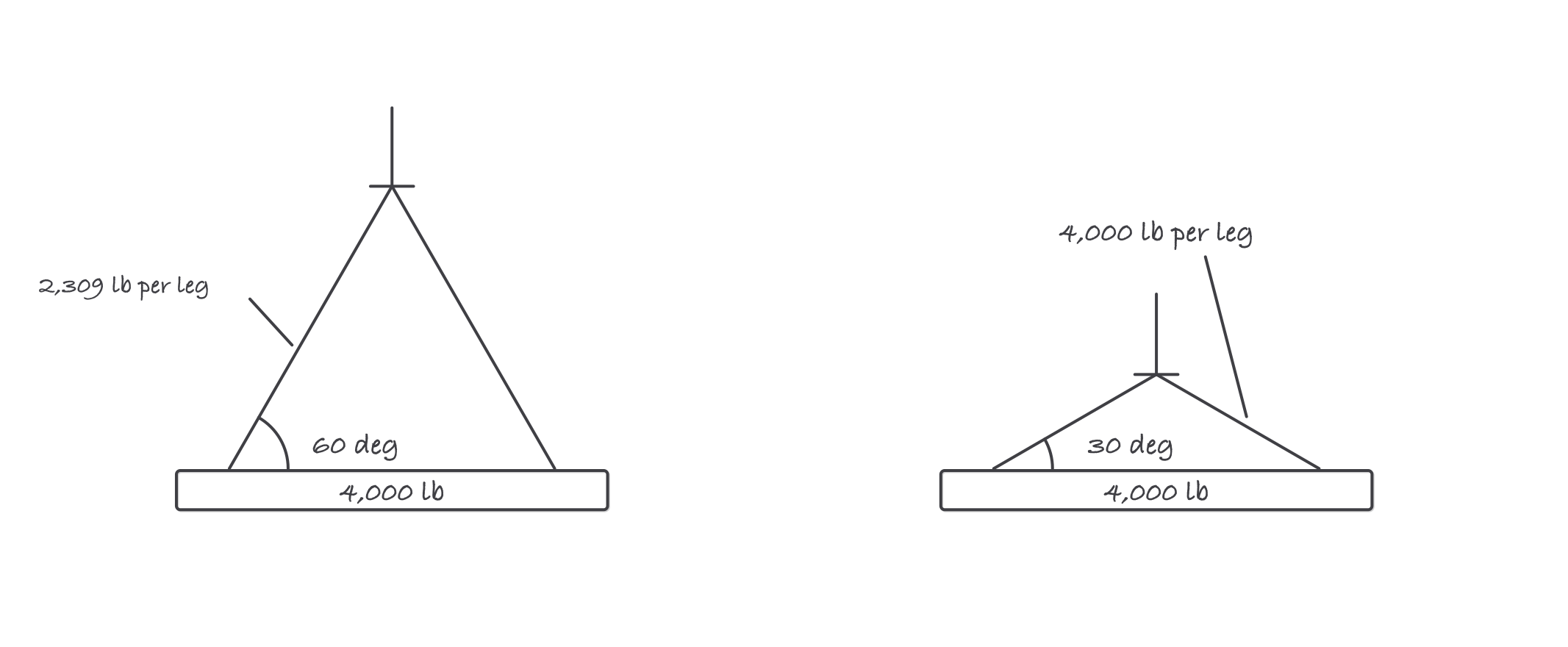
Same beam, same weight, same slings: only the angle changed
Now check the slings. Suppose each sling is rated 3,000 lb in a vertical hitch.
- At 60 degrees, 2,309 lb against a 3,000 lb rating: 77 percent of capacity, fine.
- At 45 degrees, 2,828 lb: 94 percent, inside the rating and with nothing left over.
- At 30 degrees, 4,000 lb: 4,000 / 3,000 = 1.33, so the sling is loaded to 133 percent of its rating, a third over, with no warning at the tag.
The load never got heavier. Somebody shortened the slings.
The squeeze nobody counts
The same geometry that raises the tension also drives the legs inward against the load. The horizontal component in each leg is:
Horizontal force = vertical share ÷ tan(sling angle)
For the same 4,000 lb beam: at 60 degrees it is 2,000 / 1.7321 = 1,155 lb inward per leg; at 45 degrees it is 2,000 / 1.0000 = 2,000 lb; at 30 degrees it is 2,000 / 0.5774 = 3,464 lb.
That inward force is real and it crushes things: bundles collapse, thin-walled sections dent, and equipment cabinets deform. On a crushable load a spreader bar removes the problem entirely by taking the horizontal component into the bar instead of into the load.
Where it bites
- A sling tag is a vertical-hitch rating. It is a starting number. The working tension is the tag rating compared against the calculated leg tension, and a choker hitch derates the sling again on top of that.
- Three and four leg slings do not share equally. On a rigid load, manufacturing tolerance and an imperfect center of gravity mean two legs commonly take nearly everything while the others hang along. Calculate a four-leg sling on a rigid load as though only two legs are working unless the rigging is engineered to equalize.
- Unequal leg lengths change everything. The relationships above assume a symmetric bridle with the hook over the center of gravity. If the legs differ, the angles differ, and the shorter leg takes the larger share.
- Shallow slings get adjusted inside the fall zone. 1926.1425(c) requires a qualified rigger for employees engaged in hooking, unhooking or guiding a load, or doing the initial connection of a load to a component or structure, while they are within the fall zone. Adjusting a shallow sling under a tensioned load is exactly the moment that paragraph is written about.