Learn · Ironworking
How OSHA Subpart R Governs Steel Erection
Part of Ironworker, Steel and Rebar · step 16 of 25 · next: Site Layout and the Site-Specific Erection Plan
In learning paths: Ironworker, Steel and Rebar
Subpart R is the OSHA standard that governs steel erection, 29 CFR 1926.750 through 1926.761. It is to ironworking what the National Electrical Code is to electrical work: the document that decides how the job is sequenced, who is allowed to make which call, and at what height the rules change. Twelve sections, published in 2001, and almost every argument on a steel job traces back to one of them.
Why it matters on the job
OSHA’s own steel erection eTool states the problem in one line: “America’s 56,000 steel erectors continue to suffer 35 fatal accidents per year, a rate of one death per 1,600 workers.” OSHA estimates that 30 of those deaths and nearly 1,150 lost-workday injuries each year are preventable through compliance with this subpart. Steel erection puts people at height, next to moving loads, on structures that are not yet stable.
That is the reason Subpart R reads the way it does. It is unusually specific for an OSHA standard, full of counts and distances and named roles, because vagueness in this trade kills people.
What counts as steel erection
1926.750 draws the boundary, and it is wide. Steel erection means “rigging, hoisting, laying out, placing, connecting, guying, bracing, dismantling, burning, welding, bolting, grinding, sealing, caulking, and all related activities”. If you are putting structural steel up or taking it down, you are inside the subpart from the first pick.
Three things sit outside it: electrical transmission towers, communication and broadcast towers, and tanks. Placing reinforcing steel for concrete is also outside, which is why rodbusters work to Subpart Q instead.
The twelve sections, in the order the job happens
The subpart is laid out roughly the way a steel job unfolds, so reading it front to back is reading a schedule.
- 1926.750 Scope and 1926.751 Definitions set the boundary and the vocabulary.
- 1926.752 Site layout, site-specific erection plan and construction sequence covers what has to be true before steel starts.
- 1926.753 Hoisting and rigging pulls in all of Subpart CC (cranes) and adds steel-specific rules.
- 1926.754 Structural steel assembly, 1926.755 Column anchorage and 1926.756 Beams and columns govern the frame going up.
- 1926.757 Open web steel joists and 1926.758 Systems-engineered metal buildings handle the two structure types with their own instability problems.
- 1926.759 Falling object protection and 1926.760 Fall protection protect the people under the steel and the people on it.
- 1926.761 Training says who may teach and what has to be taught.
Definitions are not preamble. 1926.751 is where the operative numbers hide: a decking hole is a gap more than 2 inches and less than 12 inches in its least dimension, an opening is 12 inches or more, and a leading edge is an edge “which changes location as additional floor, roof, decking or formwork sections are placed”. Copy that says “cover the holes” without those sizes teaches nothing you can enforce.
Trace one beam through the subpart
Follow a single member from the truck to the deck and watch the sections hand off.
- It arrives on a laydown area that has to be “a firm, properly graded, drained area, readily accessible to the work with adequate space for the safe storage of materials” (1926.752(c)(2)). The crew shakes it out in erection sequence.
- A qualified rigger chokes it, because 1926.753(d)(3) requires that all loads be rigged by a qualified rigger. Subpart CC governs the crane itself.
- It swings to the connectors, who land it and put in at least two bolts per connection, of the size and strength shown on the erection drawings, drawn up wrench-tight before the load leaves the hook (1926.756(a)(1)).
- The columns it lands on already carry a minimum of four anchor rods each (1926.755(a)(1)).
- Bolting up chases the erection floor, and 1926.754(b) caps the gap: no more than four floors or 48 feet of unfinished bolting or welding, whichever is less, above the last permanently secured floor.
- Deck goes on, and only then do the shear studs, because 1926.754(c)(1) prohibits shear connectors from projecting vertically until after the decking is installed.
- Nobody works underneath unless the controlling contractor has barred that work or provided overhead protection (1926.759(b)), and tools not in use aloft are secured against accidental displacement (1926.759(a)).
Seven steps, six sections. That is what it means to say the subpart is the job.
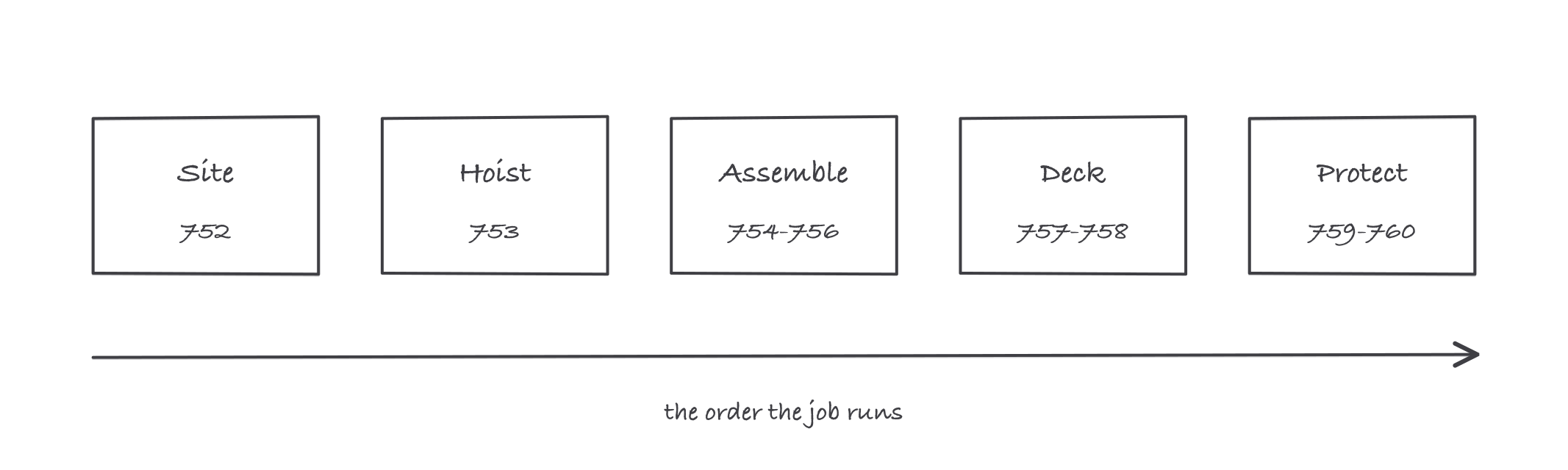
Subpart R laid out the way the job runs, section by section
Where it bites
- The fall-protection trigger is 15 feet, not 6. 1926.760(a)(1) sets the general steel erection trigger at more than 15 feet above a lower level. Most construction workers carry the Subpart M number of 6 feet in their heads, and bringing it onto a steel job is a common and costly error.
- Subpart R does not replace the rest of 1926. It layers on top. 1926.753 imports all of Subpart CC except 1926.1431(a), and general industry-wide rules on PPE, housekeeping and electrical still apply.
- Named roles carry legal weight. Qualified person and competent person are defined in 1926.751 and they are not seniority labels. The competent person is the one with authority to take prompt corrective action, which is why that role, and not the most experienced hand, makes the stop-work calls.
- Rebar work is not in here. Reinforcing ironworkers are governed by Subpart Q, concrete and masonry. Reaching for Subpart R on a rebar mat gives you the wrong rulebook.