Learn · Ironworking
Column Anchorage and Structural Stability
Part of Ironworker, Steel and Rebar · step 18 of 25 · next: Fall Protection for Connectors
In learning paths: Ironworker, Steel and Rebar
Assumes you know: How OSHA Subpart R Governs Steel Erection
A column is a lever with a hinge at the bottom until something holds it down, and the thing that holds it down is four anchor rods. 1926.755(a)(1) sets that as the floor: every column is anchored by a minimum of four anchor rods, called anchor bolts in the field and anchor rods in the standard. From there, structural stability is a duty that never lapses, because 1926.754(a) requires it to be maintained at all times during erection.
Why it matters on the job
Steel is at its weakest the day it goes up. The frame that will carry a building for 60 years spends its first week as a collection of pinned members leaning on temporary connections, and the loads it sees during erection (a crane swinging, wind on bare frame, a bundle of deck landed off center) are loads the finished structure would never feel. Nearly every rule in this part of Subpart R is about the gap between erected and finished.
Four rods, and who owns them
Four is a minimum, not a design. The engineer specifies the assembly; the standard forbids going below four. What matters day to day is the second half of the rule.
1926.755(b)(1) states that anchor rods “shall not be repaired, replaced or field-modified without the approval of the project structural engineer of record”. That covers straightening a bent rod, burning one off, welding an extension, or moving a hole. Every one of those is an engineering change, and the authority sits with the structural engineer of record, not with the foreman, the GC or the detailer.
This is where apprentices go wrong, and the field pressure behind it is real: the column will not go on, the crane is hanging, and a rod is 3/4 inch out. The answer is a phone call, not a cheater bar.
Setting the column
1926.755(a)(3) lists what a column may be set on: level finished floors, pre-grouted leveling plates, leveling nuts or shim packs, each adequate to transfer the construction loads. Anything else, including a stack of whatever was on the truck, is not a setting surface.
Then 1926.755(a)(4) puts a judgment call in one named pair of hands: all columns are evaluated by a competent person to determine whether guying or bracing is needed, and where it is needed it gets installed. A competent person under 1926.751 is someone capable of identifying existing and predictable hazards and authorized to take prompt corrective measures. The authority is what makes the role, which is why the guying call cannot be delegated to the most experienced hand on the crew if that hand cannot stop the work.
Two bolts before the load comes off
1926.756(a)(1) is the erection-stability rule people misquote. Before the load is released from the hoisting line, a beam or column needs at least two bolts per connection, of the same size and strength shown on the erection drawings, drawn up wrench-tight.
Three things people get wrong about it:
- Two is a floor. 1926.756(a)(2) requires a competent person to determine whether more than two bolts are needed for stability on cantilevered members, and to have them installed.
- Diagonal bracing has its own lower minimum: one bolt wrench-tight, under 1926.756(b).
- Wrench-tight is a snug condition reached with a spud wrench, not a torque value, and it does not finish the joint. Final installation of pretensioned and slip-critical joints is a separate operation run to the project specification.
Double connections get their own rule at 1926.756(c): when two members share the same bolts at a column web or flange, at least one bolt with its wrench-tight nut has to stay on the first member, or a seat or equivalent connection device has to hold it, so the first beam cannot be knocked loose while the second is landed. Perimeter columns are handled at 1926.756(e), extending 48 inches above the finished floor with holes at 42 to 45 inches to take perimeter safety cables.
Worked example: how far ahead can bolting run
1926.754(b) caps how much unfinished frame is allowed to stand above secured floor: no more than four floors or 48 feet of unfinished bolting or welding, whichever is less, above the last permanently secured floor. The section also limits the erection floor to no more than eight stories above the uppermost permanent floor.
Take an office frame at 13 ft 6 in floor to floor.
- Four floors would be 4 × 13.5 ft = 54 ft. That is over the 48 ft limit, so 48 ft governs.
- 48 / 13.5 = 3.56 floors, and you cannot leave a partial floor unfinished, so the crew may run three floors of unfinished bolting above the last permanently secured floor.
- Bolting-up has 48 - (3 × 13.5) = 48 - 40.5 = 7.5 ft of slack before the fourth floor of steel puts the job over.
Now change the building to a 12 ft parking structure.
- Four floors is 4 × 12 = 48 ft exactly, so the two limits land in the same place and the crew may run four floors.
The lesson in the arithmetic: the distance governs on a tall-floor building and the floor count governs on a short-floor building, so you check both every time rather than remembering one.
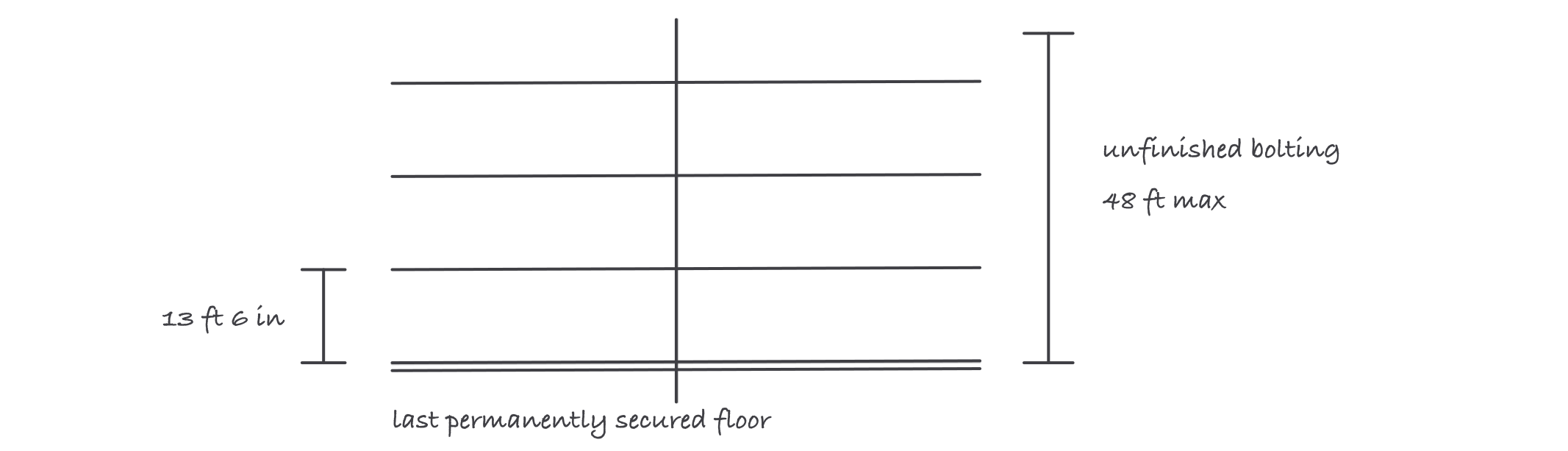
At 13 ft 6 in floors, the 48 ft limit runs out before the fourth floor does
Where it bites
- “Always two bolts” is wrong in both directions. Cantilevers can need more, diagonal bracing needs one, and the size and strength come off the erection drawings rather than out of the bolt bag.
- Snugging is not torquing. Calling wrench-tight a torque value invites someone to treat the erection bolts as finished, and invites someone else to think the final crew already came through.
- Anchor rods get “adjusted” quietly. If it was bent, burned, moved or replaced, the structural engineer of record signs off and the controlling contractor owes the erector written notification under 1926.752(a)(2).
- Plumbing-up equipment stays until the competent person says otherwise. 1926.754(d) puts removal of plumbing-up guys under a competent person’s approval, because the frame can be plumb and still not be stable.