Learn · Ironworking
The Controlled Decking Zone
Part of Ironworker, Steel and Rebar · step 20 of 25 · next: Erecting Open Web Steel Joists
In learning paths: Ironworker, Steel and Rebar
Assumes you know: Fall Protection for Connectors
A controlled decking zone is a bounded area where the crew installing metal deck may work without guardrails, personal fall arrest, fall restraint or safety nets, because access control is doing the protecting instead. 1926.760(c) defines it, and every one of its limits is a number you can check with a tape.
Why it matters on the job
Initial decking is the one operation where conventional fall protection genuinely fights the work. The leading edge moves with every panel, there is nothing overhead to tie to, and a lanyard trailing across loose sheets creates a trip hazard on the exact surface that is not yet fastened down. OSHA’s answer was not to waive protection. It was to draw a small box, put a number on everything inside it, and let nobody else in.
That framing matters when you describe a CDZ to anyone. Control of access is the fall protection, which is why the limits are not negotiable.
Every limit in the rule
- Height band. Over 15 and up to 30 feet above a lower level. Below 15 feet the general trigger has not fired; above 30 feet, or two stories where that is less, a CDZ cannot exist.
- Size. No more than 90 feet wide and 90 feet deep from any leading edge.
- Unsecured decking. No more than 3,000 square feet at any time.
- Attachment. Safety deck attachments go in from the leading edge back to the control line, with at least two attachments per metal decking panel.
- Access. Limited to employees engaged in leading edge work. Nobody else, for any reason.
- Marking. Boundaries designated and clearly marked with control lines or the equivalent.
- Training. CDZ-specific training under 1926.761(c)(3), on top of the general fall hazard training in 1926.761(b).
- What may not happen inside it. Final deck attachments and installation of shear connectors are not performed in the CDZ.
That last one links back to 1926.754(c)(1), which prohibits shear connectors from projecting vertically until after the decking is installed. Studs are a separate operation, after the zone has been released.
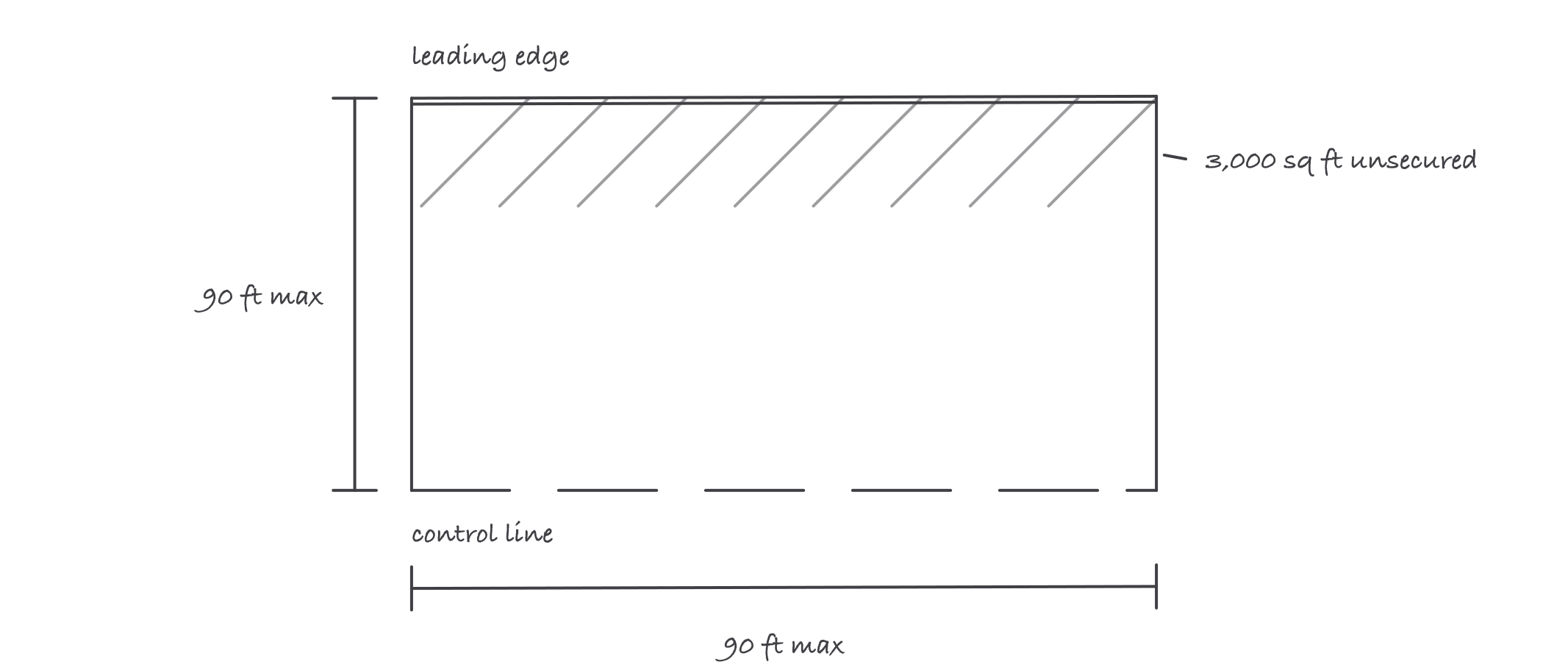
The zone is 90 by 90 feet at most, and only part of it may hold unsecured deck
Worked example: the size limit is not the decking limit
Take a CDZ at its full permitted size, 90 ft wide by 90 ft deep.
- Area of the zone: 90 × 90 = 8,100 sq ft.
- Unsecured decking allowed: 3,000 sq ft, which is 3,000 / 8,100 = 0.370, so 37 percent of the zone.
- Spread across the full 90 ft width, 3,000 sq ft is a strip 3,000 / 90 = 33.33 ft deep, or 33 ft 4 in behind the leading edge.
So a maximum-size CDZ can never be full of loose deck. The crew lays about 33 feet of sheet, then the attachments have to catch up before the leading edge moves further.
Put panel counts on it. Deck panels 3 ft wide by 30 ft long cover 3 × 30 = 90 sq ft each.
- 33 panels: 33 × 90 = 2,970 sq ft unsecured, still inside the limit.
- 34 panels: 34 × 90 = 3,060 sq ft, over 3,000, so the 34th panel cannot go down until earlier sheets are secured.
- At a minimum of two safety deck attachments per panel, those 33 panels carry at least 33 × 2 = 66 attachments before the crew runs out of room.
Two attachments per panel is the floor for the temporary condition, not the finished fastening pattern, and the finished pattern gets installed after the zone is released.
Where it bites
- A CDZ is not a controlled access zone. A CAZ is the Subpart M concept used in masonry and residential work. Different subpart, different rules, different trades. The names are close and the requirements are not.
- A leading edge is defined, and a perimeter is not one. 1926.751 defines a leading edge as an edge “which changes location as additional floor, roof, decking or formwork sections are placed”. A fixed building perimeter never changes location, so it is not a leading edge and it cannot anchor a CDZ.
- The 3,000 sq ft is a running total, not a daily allowance. It is the amount unsecured at any moment. Nobody gets to be over it at lunch and under it by quitting time.
- Access control fails through kindness. The welder who steps in for one tack, the surveyor grabbing a shot, the foreman crossing to save a walk: each is an access violation and each one is how the zone stops being a zone.
- Deck holes have defined sizes. Under 1926.751, a decking hole is more than 2 inches and less than 12 inches in its least dimension, and an opening is 12 inches or more. 1926.754(e) governs the covers and how they are marked.