Qualifications · Ironworking
Rigger and Signalperson Certifications
Part of Ironworker, Steel and Rebar · step 13 of 25 · next: Qualified or Certified: What the Rigging Rules Require
In learning paths: Ironworker, Steel and Rebar
Assumes you know: Sling Angles and Load Calculations
OSHA requires riggers and signal persons to be qualified. It does not require them to hold a card. That single distinction explains most of the confusion on steel jobs about who is allowed to rig a load, and it is worth getting exactly right before you spend money on an exam.
*Learn the Trades is a free study resource. We are not a licensing body, an authorized training provider, or an exam administrator. Reading this page does not award any card, license, or certification. Always verify requirements with the issuing authority linked in the sources.*Why it matters on the job
The practical stakes are money and mobility. If a card were an OSHA requirement, everyone would need one and the question would end there. Because it is not, two things follow: an employer can qualify you without a card, and a general contractor can still require a card on their site as a condition of the contract. Both are true at once, and knowing which one you are dealing with tells you whether to test.
What OSHA actually requires of a rigger
The word “qualified” is defined. 1926.751 describes a qualified person as one who, by possession of a recognized degree, certificate or professional standing, or by extensive knowledge, training and experience, has successfully demonstrated the ability to solve or resolve problems relating to the subject matter, the work or the project.
Three paragraphs put that person on the job.
- 1926.753(d)(3): during steel erection, all loads shall be rigged by a qualified rigger.
- 1926.1404(r)(1): during crane assembly and disassembly, the rigging work is done by a qualified rigger.
- 1926.1425(c): a qualified rigger is required for employees engaged in hooking, unhooking or guiding a load, or doing the initial connection of a load to a component or structure, while within the fall zone.
Note what none of them say. There is no test, no issuing body and no expiry date in the rigger requirement. The fact sheet also makes clear that qualification is not global: a person can be qualified for the loads and configurations they have demonstrated ability on and not qualified for others. “Qualified rigger” is a statement about a person and a kind of work, not a permanent status.
Signal persons have two defined routes
Signal person qualification is more structured, and 1926.1428(a) sets out exactly two ways to get there.
Route one, third party qualified evaluator. The signal person is assessed by a qualified evaluator who is not the employer, and provided with documentation showing they meet the requirements in 1926.1428(c). The employer keeps that documentation available.
Route two, the employer’s qualified evaluator. The employer’s own qualified evaluator assesses the person, determines they meet 1926.1428(c), and documents it. The rule adds a condition that decides careers: this assessment is not portable. Other employers are not permitted to use it.
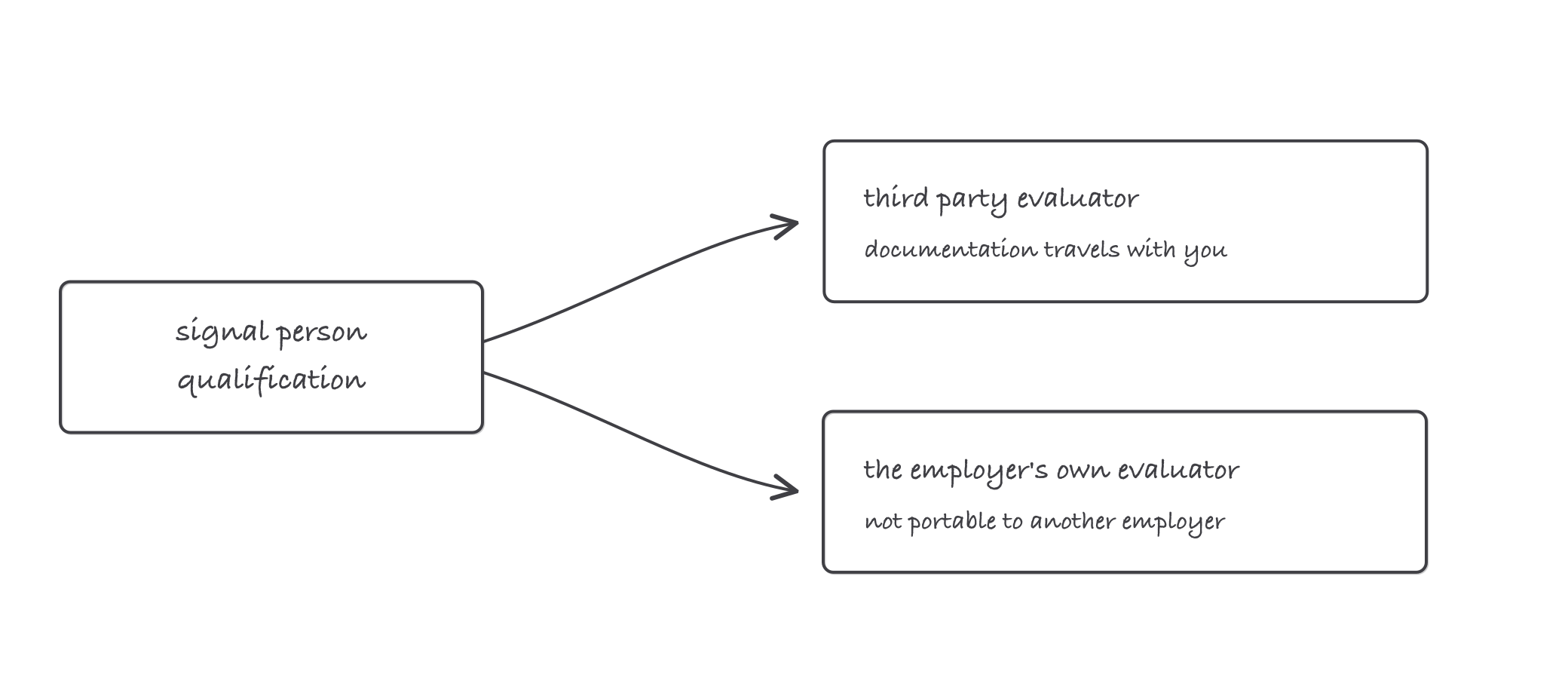
Both routes are legal; only one of them follows you off the job
Either route has to establish the same content, listed in 1926.1428(c): knowing the type of signals used and, for hand signals, the Standard Method; competence in applying them; a basic understanding of equipment operation and limitations including crane dynamics and boom deflection; knowledge of the relevant requirements of 1926.1419 through 1926.1422 and 1926.1428; demonstrated by an oral or written test and a practical test.
What the cards are, and what they buy
NCCCO issues the credentials most commonly asked for on steel jobs.
- Rigger Level I and Rigger Level II: each has a written examination and a practical examination, and each is valid for five years.
- Signalperson: also a written examination plus a practical examination.
What they buy is documentation and portability. Third party assessment is one accepted way to satisfy 1926.1428(a)(1), so a signal person card travels between employers where an in-house assessment does not. For riggers, the card is evidence an employer can point to when they designate you as qualified, which is administratively much easier than assembling a file of demonstrated experience. Many owners and general contractors write a card requirement into their site rules whether or not OSHA does.
Worked example
Follow one hand through a job change and watch which piece of paper survives.
A rigger and signal person works for Employer A on a steel job. Employer A’s qualified evaluator assesses her for both roles, tests her orally and practically, and documents it. She is properly qualified as a rigger and, under 1926.1428(a)(2), properly qualified as a signal person. Everything is in order.
She takes a job with Employer B six months later.
- As a rigger: nothing is automatically void, because there is no certificate to expire. Employer B still has to satisfy itself that she is a qualified rigger for the loads it will put in front of her, which means the new employer makes its own determination.
- As a signal person: Employer A’s assessment cannot be used. It is not portable, and 1926.1428(a)(2) says so directly. Employer B must either run its own evaluator’s assessment or she must be assessed by a third party evaluator.
Now change one detail. Suppose she had instead been assessed by a third party evaluator and held that documentation herself. Employer B could accept it on day one. That is the entire practical argument for testing with a third party, and it has nothing to do with OSHA requiring it.
Exam relevance
The rigger and signalperson examinations are practical trade tests rather than code recitals. The legal framework above still shows up in the written papers, because a rigger who does not know who is responsible for what is a hazard regardless of hitch skill. Expect written questions on load weight determination, center of gravity, sling angle and load factors, hitch selection and capacity derating, hardware inspection and removal criteria, and the roles of the qualified rigger, competent person, signal person and operator. The practical requires you to actually rig and direct picks under observation, which is why the calculations in the previous two lessons need to be automatic rather than looked up.
Where it bites
- A crane operator card is not a rigger qualification. OSHA’s fact sheet says so in as many words. The two roles are assessed against different criteria and both are needed on the pick.
- Qualification is job-specific. Being a qualified rigger for structural steel members does not make someone a qualified rigger for a tandem lift of a transformer. The fact sheet is explicit that a rigger need not be qualified for every type of rigging job.
- Site rules can be stricter than OSHA. A general contractor requiring cards on their project is entirely allowed to do that. Argue the regulation all you like; the site rule is a contract term.
- Five years is the card, not the competence. The card carries an expiry; the underlying qualification is a continuous judgment by your employer. Letting a card lapse does not automatically make you unqualified, and holding a current card does not automatically make you qualified for the load in front of you.
Verified requirements
| Where | Expires | Renewal | Continuing education |
|---|---|---|---|
| United States (federal) | Yes | 5 years | Confirm with issuer |
| United States (federal) | Yes | 5 years | Confirm with issuer |
| United States (federal) | Yes | 5 years | Confirm with issuer |
| United States (federal) | No | Confirm with issuer | Confirm with issuer |
Information comes from issuing-authority sources. Confirm current rules, fees and eligibility with the authority before acting.