Learn · Ironworking
Rebar: Grades, Sizes, Placement
Part of Ironworker, Steel and Rebar · step 5 of 25 · next: Reading Placing Drawings
In learning paths: Ironworker, Steel and Rebar
Concrete is strong in compression and weak in tension, so every place a concrete member would be pulled apart rather than squeezed, steel bar goes in to carry the tension instead. Reinforcing ironwork, rodbusting, is the trade of getting the right bar to the right place at the right depth before the pour. Get it wrong and the concrete looks perfect and behaves like a stone slab.
Why it matters on the job
BLS counts about 85,100 US ironworkers in 2024, of whom roughly 19,400 are reinforcing iron and rebar workers. They share a name and often a union with structural erectors and almost nothing else about the day. Rodbusters work at grade or on mats over formwork instead of at 200 feet, and their governing rule is Subpart Q (concrete and masonry), not Subpart R, because 1926.750 puts placement of reinforcing steel for concrete outside the steel erection subpart.
The work is also invisible once it is done. Nobody inspects your mat after the pour, which is why the inspection before the pour is the whole quality system.
Bar sizes are eighths of an inch
US bar sizes use a single number, and that number is the nominal diameter in eighths of an inch. Divide by 8 and you have the diameter.
- #4 = 4/8 = 0.500 in
- #5 = 5/8 = 0.625 in
- #6 = 6/8 = 0.750 in
- #8 = 8/8 = 1.000 in
The rule holds cleanly through #8. Above that, the larger bars carry the same numbering but the relationship to a plain diameter stops being exact, so read the bar list rather than doing arithmetic on a #14.
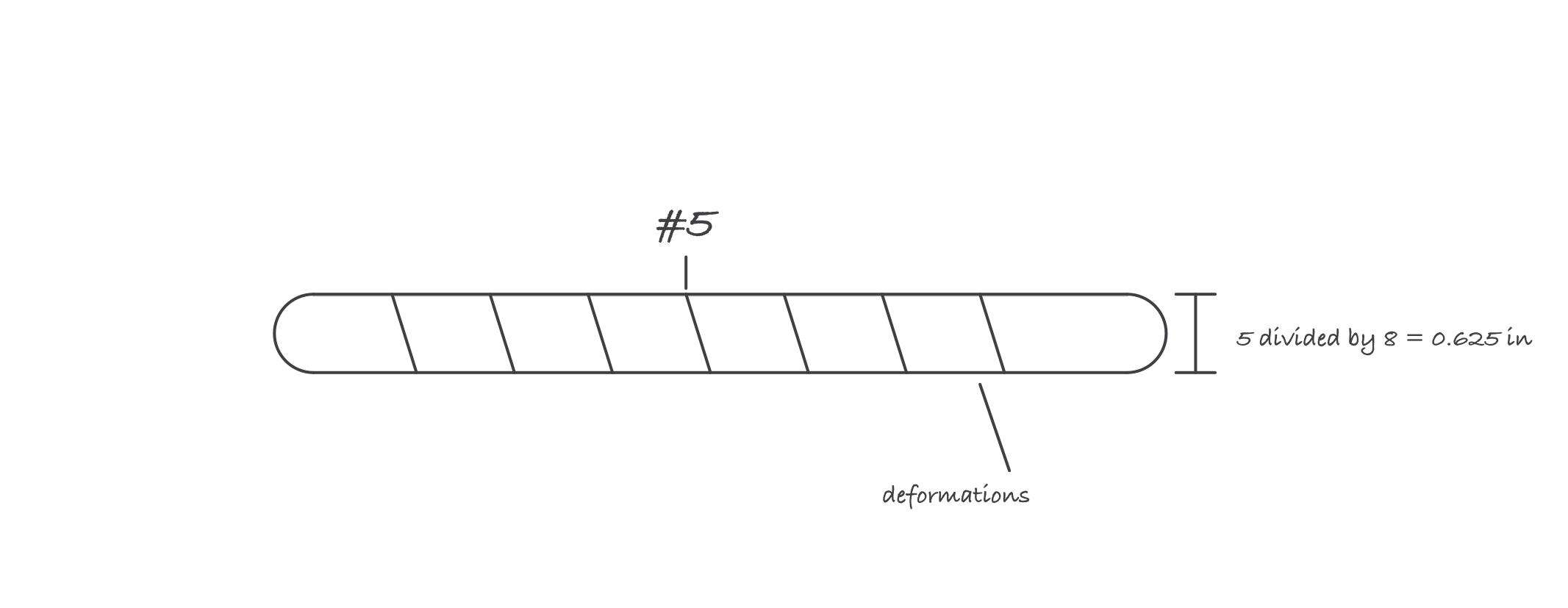
The bar size number is a fraction with the denominator left off
The ribs rolled into the surface are deformations. They are what makes the bar bond to the concrete, and that bond is the only thing transferring force between the two materials. A smooth bar in concrete is close to useless, which is also why heavy rust scale, form oil and mud on a bar are quality problems rather than cosmetic ones.
Grades are yield strength
The grade number is the specified minimum yield strength in thousands of pounds per square inch. Grade 60 bar has a minimum yield of 60,000 psi. Higher grades exist and are used where the design calls for them.
Grade is not something the crew chooses. It comes off the structural drawings and the bar list, and bars of different grades can look nearly identical on the ground. Mill markings rolled into the bar identify the producing mill, the size, the type of steel and the grade, and they are how you tell a bundle apart when the tags come off.
Placement is three separate dimensions
A bar is in the right place only when all three of these are right.
- Position on plan: which line of bars, running which direction.
- Spacing: the center-to-center distance between bars, given on the drawing as an on-center dimension.
- Cover: the thickness of concrete between the face of the bar and the face of the finished concrete.
Cover is the one that gets treated as approximate and should not be. It is what protects the steel from corrosion and what gives the bar the lever arm the engineer designed. Required cover varies with the member, the exposure and the governing code, so it comes from the drawings for that job rather than from a number you carry in your head. Chairs, bolsters and wheels are what hold it, and they are placed to a schedule, not by feel.
Worked example
A slab on grade measures 20 ft by 30 ft, reinforced with #5 bar at 12 inches on center each way. Take out how much steel is on the truck.
Bars running the 30 ft direction, spaced across the 20 ft width: 20 ft = 240 in; 240 / 12 = 20 spaces; 20 spaces means 21 bars. 21 bars × 30 ft = 630 linear feet.
Bars running the 20 ft direction, spaced along the 30 ft length: 30 ft = 360 in; 360 / 12 = 30 spaces; 30 spaces means 31 bars. 31 bars × 20 ft = 620 linear feet.
Total in the mat before laps and waste: 630 + 620 = 1,250 linear feet of #5.
The count that catches people is spaces versus bars. Twenty spaces at 12 inches gives 21 bars, not 20, because both ends carry a bar. Order to the space count and you are one bar short in each direction on every mat you build.
Where it bites
- Protruding bar is the trade’s signature hazard. 1926.701(b) is one sentence: “All protruding reinforcing steel, onto and into which employees could fall, shall be guarded to eliminate the hazard of impalement.” Caps that only cover the point are not the same as a guard rated to stop a fall.
- The real injuries are ergonomic. Repetitive bending and tying, carrying bundles and working stooped over a mat cause far more lost time in this discipline than anything dramatic. Rebar-tying tools and bar carts exist for a reason.
- Light rust is fine; scale and oil are not. Light surface rust is normal and does not hurt the bond. Loose scale, oil, paint and dried mud do, and they are the crew’s problem to fix before the pour.
- Cutting and bending in the field changes the design. Bars come cut and bent to a bar list. Heating a bar to bend it on the mat can change its properties, and it is a question for the engineer rather than a technique.