Learn · Solar
Electrical Hazards in PV Work
Part of NABCEP PV Associate Prep · step 17 of 21 · next: OSHA 10 and OSHA 30 for Solar Work
In learning paths: NABCEP PV Associate Prep
Assumes you know: How Solar PV Works
A PV array is an electrical source you cannot switch off. As long as light reaches the modules, they produce voltage, and the DC conductors between the array and the inverter can be live even when every breaker and disconnect in the building is open. That single fact separates solar electrical safety from every other trade’s version of it, and it drives the shock, arc flash, and burn hazards OSHA calls out for solar work.
Why it matters on the job
You learned in How PV Works that a module generates whenever photons hit the cells. On the roof, that physics becomes a safety rule: opening the inverter’s AC breaker stops export to the building, but the string conductors upstream are still at full array voltage in daylight. OSHA’s solar-hazard guidance lists electric shock, arc flash, and thermal burns among the trade’s principal dangers, alongside falls, and it points employers at lockout/tagout practices and, for work on grid-connected systems, the electric power generation, transmission and distribution rules in 29 CFR 1910.269.
The source you cannot de-energize
Think of the array as a generator with no off switch:
- Strings stack voltage. Modules wired in series add their voltages, so a residential string reaches hundreds of volts DC in daylight, whether or not anything is connected downstream.
- Disconnects isolate; they do not de-energize. Opening a DC disconnect separates circuits; the conductors on the array side remain live. Every point between module terminals and the open disconnect is still a source.
- Covering the array is the only true off. Fully opaque covering stops production, which is why real de-energizing during service work means covering modules, not flipping switches.
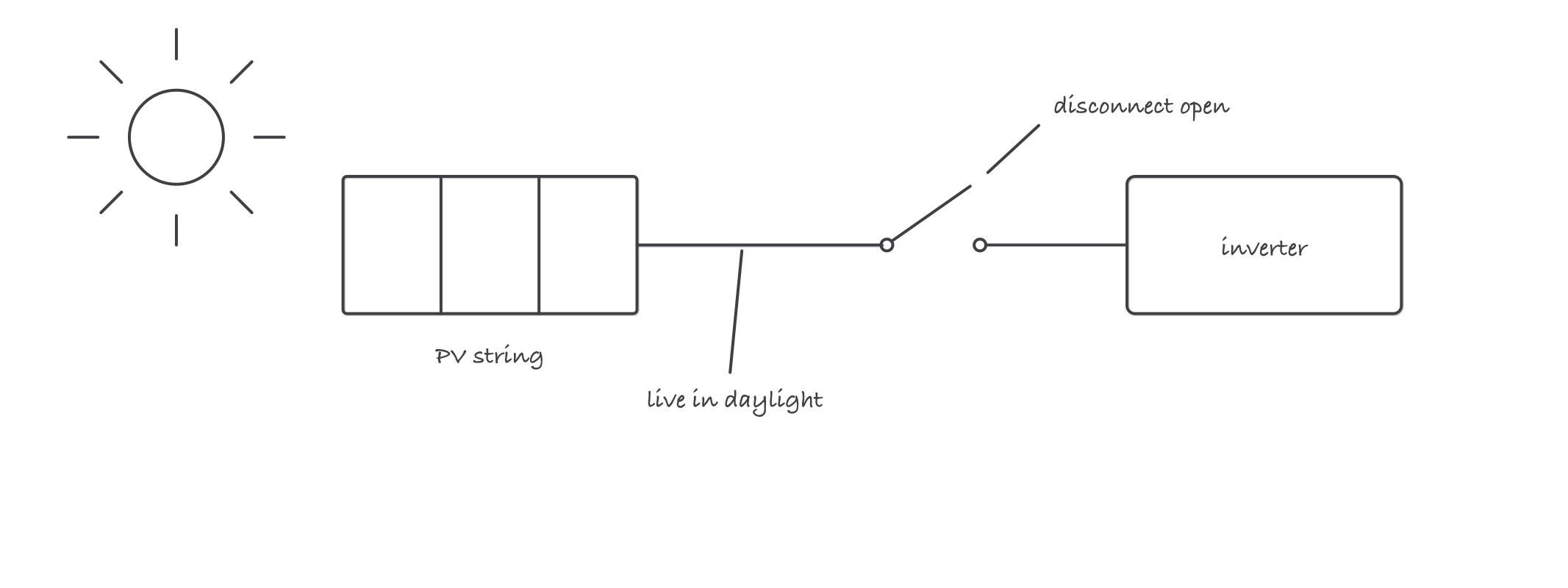
Opening the disconnect does not de-energize the array side: light in, volts out
The three electrical injuries
Shock comes from contact with live conductors or from damaged insulation, and DC contact tends to hold a muscle contraction. Treat every conductor as live until verified with a meter; verification, not assumption, is the habit.
Arc flash happens when current jumps a gap, and DC arcs are notoriously persistent: with no zero-crossing in the waveform, a DC arc does not snuff itself the way an AC arc can. Never open a connector or a circuit under load. Interrupt current first, then separate.
Thermal burns come from arc events and from hot surfaces: module frames, conductors, and metal racking on a summer roof all store heat. Gloves are working PPE, not formality.
Lockout, tagout, and the PV twist
Lockout/tagout on a PV job means controlling every source, and a solar site has at least two: the utility and the array itself. The AC side locks out conventionally. The DC side requires the sequence above: interrupt, isolate, verify with a meter, and remember that the array side of any open point remains live. On grid-connected work, OSHA’s expectations come from the utility-work rulebook (1910.269), which assumes exactly this kind of multi-source environment.
Worked example: where is it still live
A service call: the inverter shows a ground-fault warning, and the tech’s plan is to open the rooftop DC disconnect, then check the string wiring. Walk the circuit in daylight. Array to disconnect: live, full string voltage. Disconnect to inverter: isolated once the disconnect is open, but verify with a meter before touching, because a failed disconnect is a real failure mode. Inside the array itself, every connector between modules: live, always. The only segments the switch made safe are downstream of it; the fault he is hunting is most likely in the segment that cannot be switched off. His controls are covering the affected string, insulated tools, gloves, and never separating a connector under load.
Where it bites
- “The inverter is off, so it’s dead.” The AC side is off. The DC side is a daylight-powered source with no off switch. This is the defining misconception of solar electrical safety.
- Opening connectors under load. PV connectors are not load-break devices. Pulling one on a producing string draws a DC arc that can destroy the connector and burn the hand holding it.
- Trusting a switch you have not verified. Meters, not labels, establish dead. A disconnect that failed closed looks identical to one that worked.
- Forgetting the second source. Battery systems add a third source with its own lockout needs. Multi-source thinking is the transferable skill.