Learn · Solar
Interconnection and Net Metering
Part of NABCEP PV Associate Prep · step 12 of 21 · next: Commissioning and Testing
In learning paths: NABCEP PV Associate Prep
Assumes you know: PV Wiring and Rapid Shutdown
Interconnection is the utility’s permission process for operating your PV system in parallel with its grid. It is paperwork, engineering review, and a meter change that ends in Permission to Operate (PTO). It is not the same thing as net metering, which is merely how the utility pays for exported energy, and it is not the same thing as the NEC rules for connecting a second power source to a building. A finished job needs all three handled.
Why it matters on the job
A flawless install that skips interconnection is an expensive ornament: the system stays off, or worse, backfeeds without authorization. And the most common plan-review rejection in solar is electrical: a proposed connection that overloads the service panel’s busbar on paper. The installer who can run the busbar math at the site visit quotes accurately; the one who cannot discovers a main panel upgrade after contract signing.
Three words, three processes
- Interconnection is the utility’s application, review, and approval to operate in parallel. It ends with PTO. Nothing exports before it.
- Net metering and net billing are compensation schemes: how exported kWh are credited. A system can be interconnected under any compensation regime, and the regime can change while the interconnection stands.
- NEC Article 705 (in recent editions) governs the physical connection of interconnected power sources: where the inverter output may land and what the busbar must tolerate.
The code side: where the inverter lands
The common residential connection is load-side: a backfed breaker in the service panel. The busbar then carries two sources, the main breaker and the PV breaker, and recent editions’ 705.12 rules cap the combination. The widely used allowance: the sum of the main breaker and 125 percent of the inverter’s output current may not exceed 120 percent of the busbar rating, with the PV breaker at the opposite end of the bus from the main.
The logic is physical: loads sit between the two sources, so the bus section between them can never see more than each source feeds from its own end. The opposite-end rule is what makes the 120 percent allowance safe.
Worked example
A 200 A busbar with a 200 A main breaker:
- Allowance: 200 A × 1.20 = 240 A
- Room for PV: 240 − 200 = 40 A of backfed breaker
- Maximum inverter continuous output: 40 ÷ 1.25 = 32 A
- At 240 V: 32 A × 240 V = 7,680 W of inverter AC output
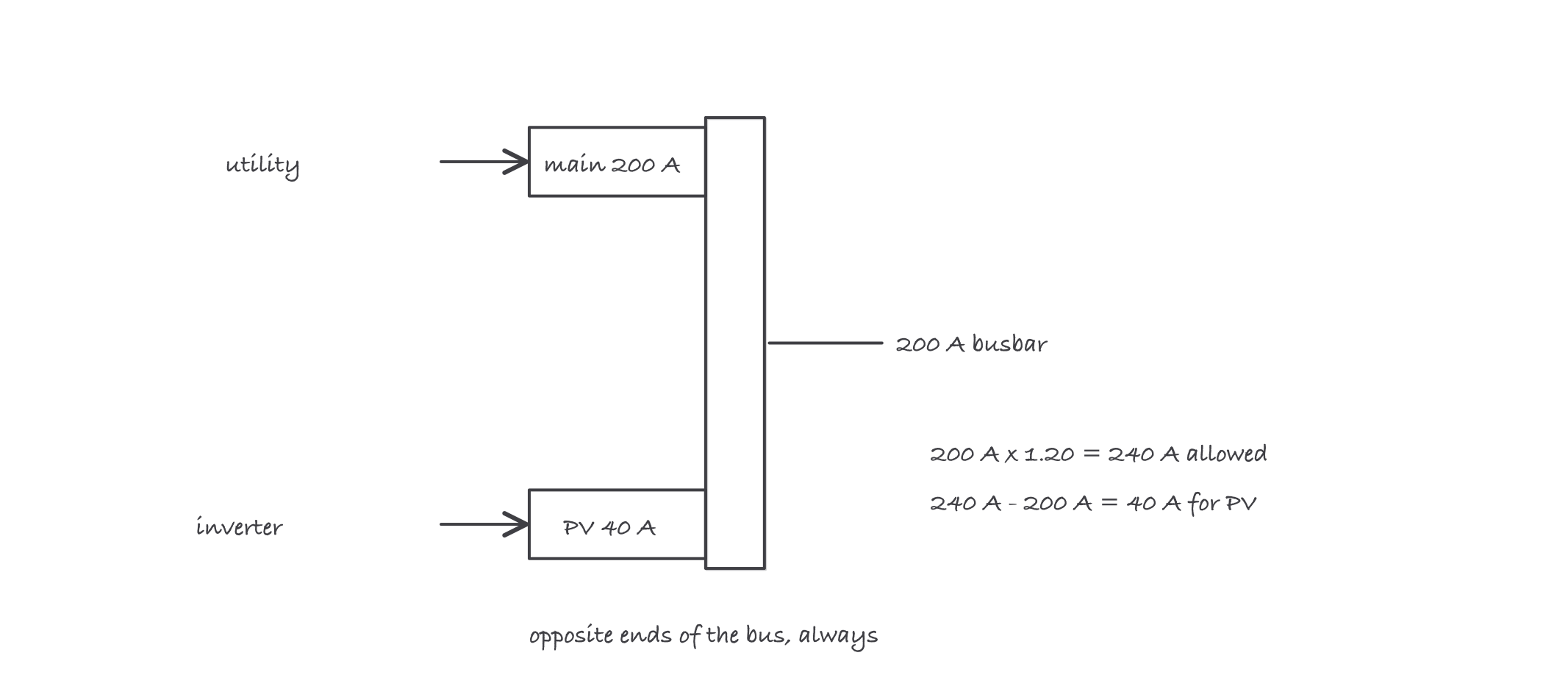
Main at one end, PV at the other: 200 × 1.20 gives 240, leaving room for 40 A of backfed breaker
For a bigger inverter on this panel, the options are a supply-side connection, a main-breaker downsize, or a busbar upgrade: all real design paths, all with their own rules.
Where it bites
- PTO is the finish line, not the final inspection. AHJ sign-off and utility permission are separate approvals from separate authorities. Energizing exports after inspection but before PTO violates the interconnection agreement.
- Interconnection is not net metering. One is permission to operate; the other is a payment scheme. Customers merge them constantly; contracts and sales conversations should not.
- The 120 percent allowance has conditions. Opposite-end placement and the breaker sums are requirements, not suggestions, and other connection methods carry different limits. Check the edition your AHJ enforces before promising a panel can take the system.