Learn · Solar
System Sizing
Part of NABCEP PV Associate Prep · step 7 of 21 · next: NEC Article 690 Compliance
In learning paths: NABCEP PV Associate Prep
Assumes you know: Site Assessment and Shading
System sizing works backward: from the energy the customer needs, through the site’s solar resource and losses, to an array in kW DC, a module count, and a matched inverter in kW AC. Site assessment gathered the inputs. Sizing turns them into an equipment list.
Why it matters on the job
Sizing is the designer’s core deliverable and the number every other party checks: the customer’s bill offset, the utility’s interconnection screen, the incentive program’s capacity form. It is also where the kW DC versus kW AC distinction stops being pedantry: the same system has two sizes, different forms ask for different ones, and quoting the wrong one misstates the project.
The sizing chain
- Energy target. Start from 12 months of utility bills, in kWh. A year matters: summer air conditioning and winter heating make any single month a lie.
- Daily target. Annual kWh ÷ 365.
- Divide by peak sun hours for the site (from the assessment, shade included or applied separately).
- Divide by the system derate to get from ideal DC to delivered AC: inverter efficiency, wiring losses, soiling, temperature. The result is the required array size in kW DC.
- Convert to hardware. Divide by the module rating for a module count; round to a whole number, and to a stringable layout.
- Match the inverter. Pick an AC rating that gives a sensible DC-to-AC ratio (the inverter lesson covered why oversized DC is deliberate).
Worked example
Target: 10,800 kWh per year. Site: 4.8 peak sun hours, derate 0.8. Modules: 410 W.
- Daily target: 10,800 ÷ 365 = 29.589, carry 29.6 kWh per day
- Ideal array hours: 29.6 ÷ 4.8 = 6.167, carry 6.17 kW
- Required DC: 6.17 ÷ 0.8 = 7.7125, carry 7.71 kW DC
- Module count: 7,710 ÷ 410 = 18.8, round up to 19 modules
- Actual array: 19 × 410 W = 7,790 W = 7.79 kW DC
- Inverter: a 6.5 kW AC unit gives 7.79 ÷ 6.5 = 1.198, a DC-to-AC ratio of 1.20
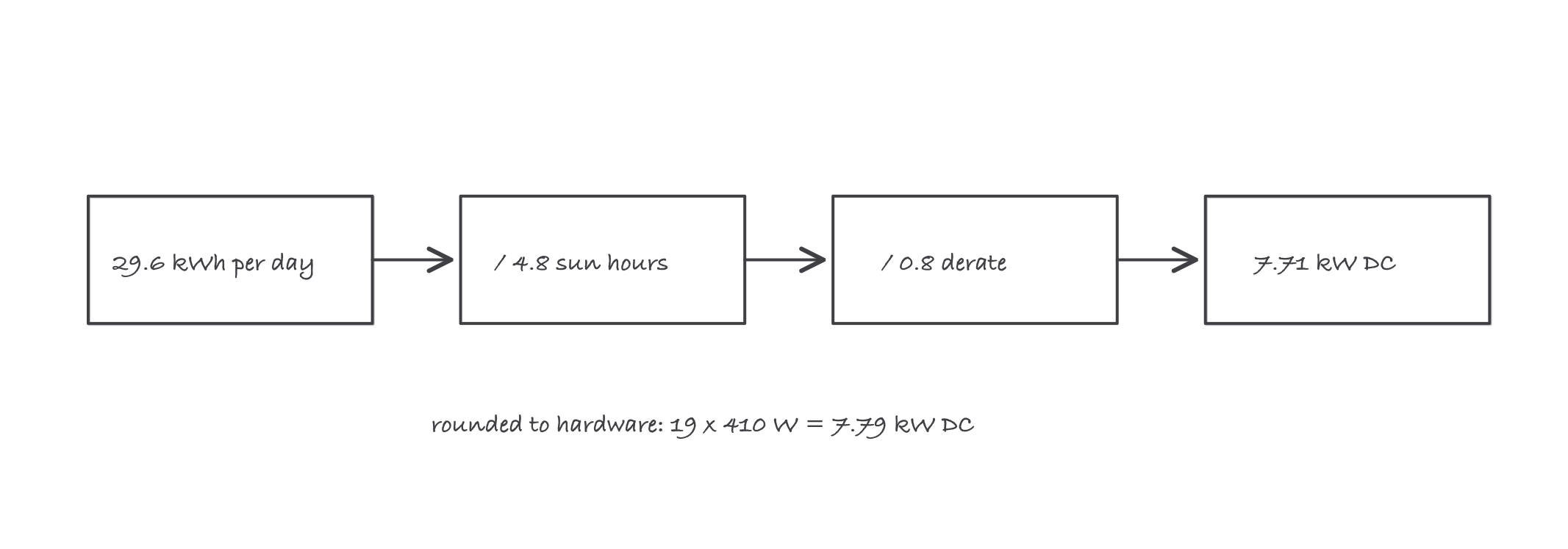
Energy to power in three divisions: the day’s kWh, the site’s sun, the system’s losses
The deliverable reads: 7.79 kW DC / 6.5 kW AC, 19 modules. Both sizes stated, because both will be asked for.
Where it bites
- kW DC and kW AC are both “the system size.” Interconnection forms typically want AC; incentive and NABCEP paperwork often counts DC. State which you mean, every time.
- Rounding happens in hardware, not arithmetic. Carry the intermediate values (29.6, 6.17, 7.71) and round once, at the module count. Rounding every step compounds into a mis-sized array.
- A 100 percent offset is not always allowed or wise. Utilities screen system size against history, roofs impose their own ceiling, and the busbar math from the interconnection lesson can cap the inverter regardless of what the roof fits.
- Derate is a model, not a constant. The 0.8 here is illustrative. Real designs build the loss stack from the actual equipment and site; production software does this line by line, and the designer still sanity-checks it by hand, exactly as above.
Exam relevance
NABCEP’s PV Design Specialist (PVDS) is the Board Certification for this work: individual, voluntary, separate from any state license. Design-track exam questions live in this chain: given consumption, sun hours, and losses, size the array; given module and inverter ratings, compute the DC-to-AC ratio. Master the arithmetic order and the units and these become free points.