Learn · Solar
Inverters: String, Micro, Optimizers
Part of NABCEP PV Associate Prep · step 4 of 21 · next: Battery Storage Systems
In learning paths: NABCEP PV Associate Prep
Assumes you know: PV System Components
An inverter converts the array’s DC into grid-quality AC, and where that conversion happens defines the three architectures you will install: one central string inverter, a microinverter on every module, or DC optimizers feeding a string inverter. Same physics, very different wiring, service, and failure behavior.
Why it matters on the job
The inverter choice is made at design time but lived with on the roof: it decides the conductor types you pull, where rapid-shutdown electronics sit, what a troubleshooting visit looks like, and what dies first. Lead installers get asked “why did we spec this one” by customers and crew alike, and the answer should be architecture, not brand loyalty.
Three ways to convert
String inverters take one or more series strings of DC at hundreds of volts and convert centrally, usually at a wall near the service equipment. Fewest electronics, one point of service, lowest cost per watt. The trade-off: a string behaves as one series circuit, so shade or a fault on one module drags the whole string, and module-level data does not exist.
Microinverters convert at each module. Every module becomes its own small AC source, wired to an AC branch circuit on the roof. Shade on one module costs only that module’s output, monitoring is per module, and there is no high-voltage DC on the building. Trade-off: the electronics count equals the module count, and every one of them lives under the array.
DC optimizers are the middle path: a DC-to-DC converter at each module conditions its output, but the power still flows as DC to a string inverter for the actual AC conversion. You get module-level control and data while keeping a central inverter to service.
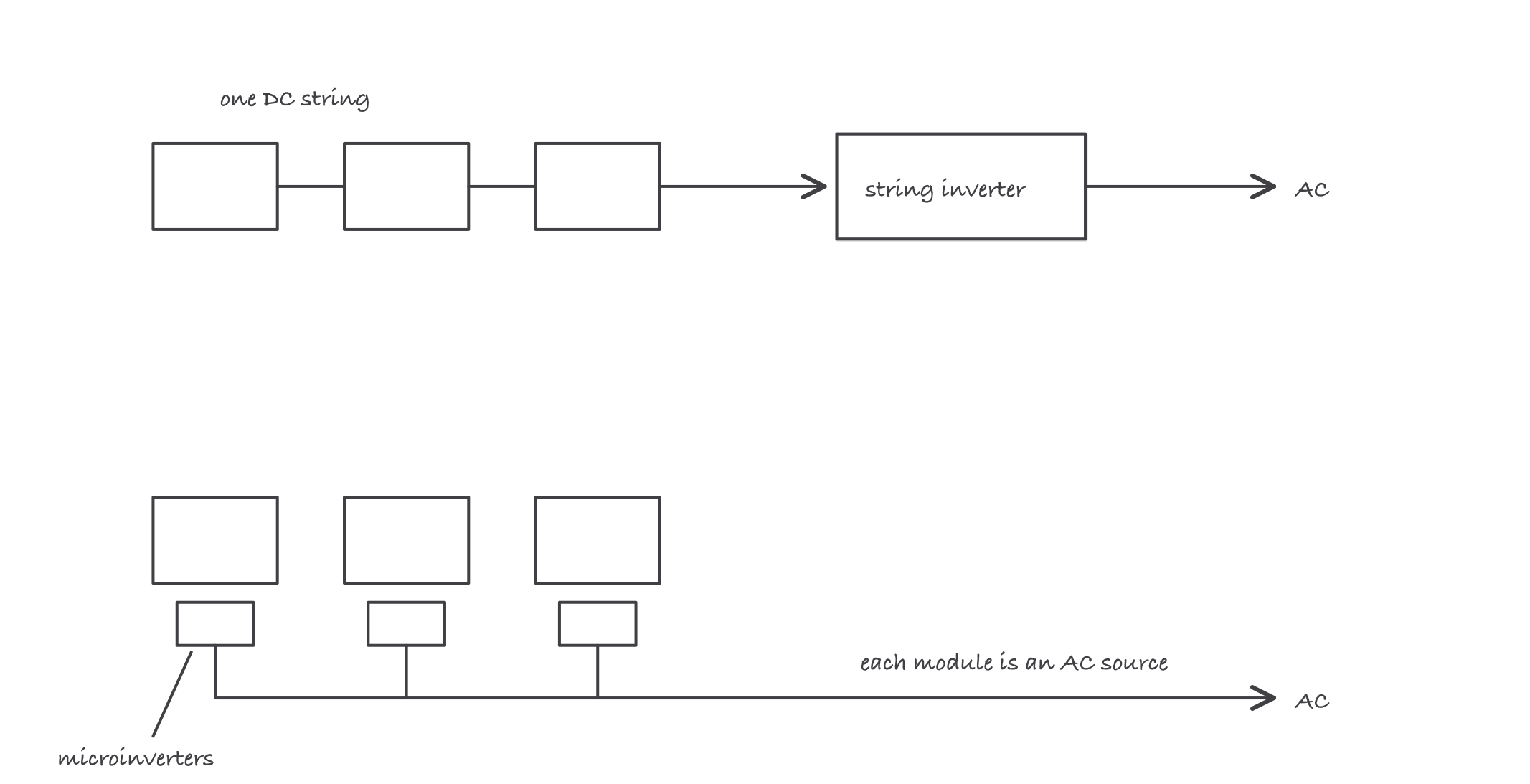
Where the DC becomes AC: once at the wall, or at every module
Worked example
A design pairs an 8.2 kW DC array with a 6.8 kW AC string inverter. The DC-to-AC ratio:
8.2 kW ÷ 6.8 kW = 1.21
That is deliberate, not a mistake. An array rarely produces its full STC nameplate on a real roof, so designers oversize the DC side to fill the inverter more hours of the day. On the rare perfect noon the array could exceed 6.8 kW, and the inverter caps output at its rating: clipping. The design bet is that the small clipped sliver is worth the fuller morning and afternoon production. Ratios in this range are common; the exact number is a design decision from the sizing lessons.
Where it bites
- Optimizers are not small microinverters. An optimizer system is still a DC string architecture with a string inverter doing the conversion. The distinction changes the wiring method, the rapid-shutdown approach, and the answer on an exam.
- MLPE is the umbrella term. Microinverters and optimizers are both module-level power electronics. When a spec or code discussion says MLPE, it means either.
- Clipping is not a defect. A flat-topped production curve at solar noon on a bright day is the DC-to-AC ratio doing its job. Investigate when the flat top is lower than the inverter rating, not when it exists.
- A grid-tied inverter shuts down when the grid fails. That anti-islanding behavior is required and applies to all three architectures. Backup power needs storage and a hybrid design, covered in the battery lesson.