Learn · Solar
PV Wiring and Rapid Shutdown
Part of NABCEP PV Associate Prep · step 11 of 21 · next: Interconnection and Net Metering
In learning paths: NABCEP PV Associate Prep
Assumes you know: Racking and Mounting
PV wiring is two electrical systems on one building: a DC side from the modules to the inverter, and an AC side from the inverter to the service. Between them sits a code requirement unique to this trade: rapid shutdown, the function that collapses the array’s conductor voltage so a firefighter can work a roof without being met by hundreds of DC volts.
Why it matters on the job
Wiring is where solar stops being carpentry and becomes electrical work. It is also where inspections are won or lost: conductor types, connector matching, wire management, and the rapid-shutdown sticker set are the items an AHJ checks line by line. A crew that wires clean passes on the first visit; a crew that drapes cable across shingles buys everyone a return trip.
The DC side
Module leads and string wiring live outdoors for decades, so the conductors are sunlight-resistant, wet-rated types made for the job (PV wire is the common answer), landed with listed mating connectors. Two rules dominate:
- Connectors must match. Mating connectors from different manufacturers, even ones that click together, is a documented fire origin and an inspection failure. Same series, same maker, crimped with the right tool.
- Wire management is not cosmetic. Conductors are secured off the roof surface, protected from edges, with no drip loops sitting in debris zones. A cable that chafes through its jacket on a rail edge becomes a ground fault years later.
Inside the building, DC circuits run in metal raceway where recent NEC editions require it for protection. The equipment-grounding conductor bonds every module frame and rail: modern transformerless inverters run the array functionally ungrounded, and the EGC is still mandatory. “Ungrounded array” never means “no grounding.”
Rapid shutdown
Rapid shutdown (NEC 690.12 in recent editions) is a function, not a switch: initiate it, and the conductors within and leaving the array drop to a touch-safe voltage within seconds. The pieces:
- An initiation device at a ready location (commonly the service disconnect) that first responders can operate.
- Module-level or string-level electronics that actually collapse the voltage when initiated. Microinverters and optimizers typically provide this natively; string-only systems add listed shutdown hardware.
- Labeling that tells a firefighter the function exists and where to initiate it.
The exact voltage limits, timing, and array-boundary details are edition-specific and have changed across code cycles, so verify against the edition your AHJ enforces. The function’s purpose is stable: de-energize the roof.
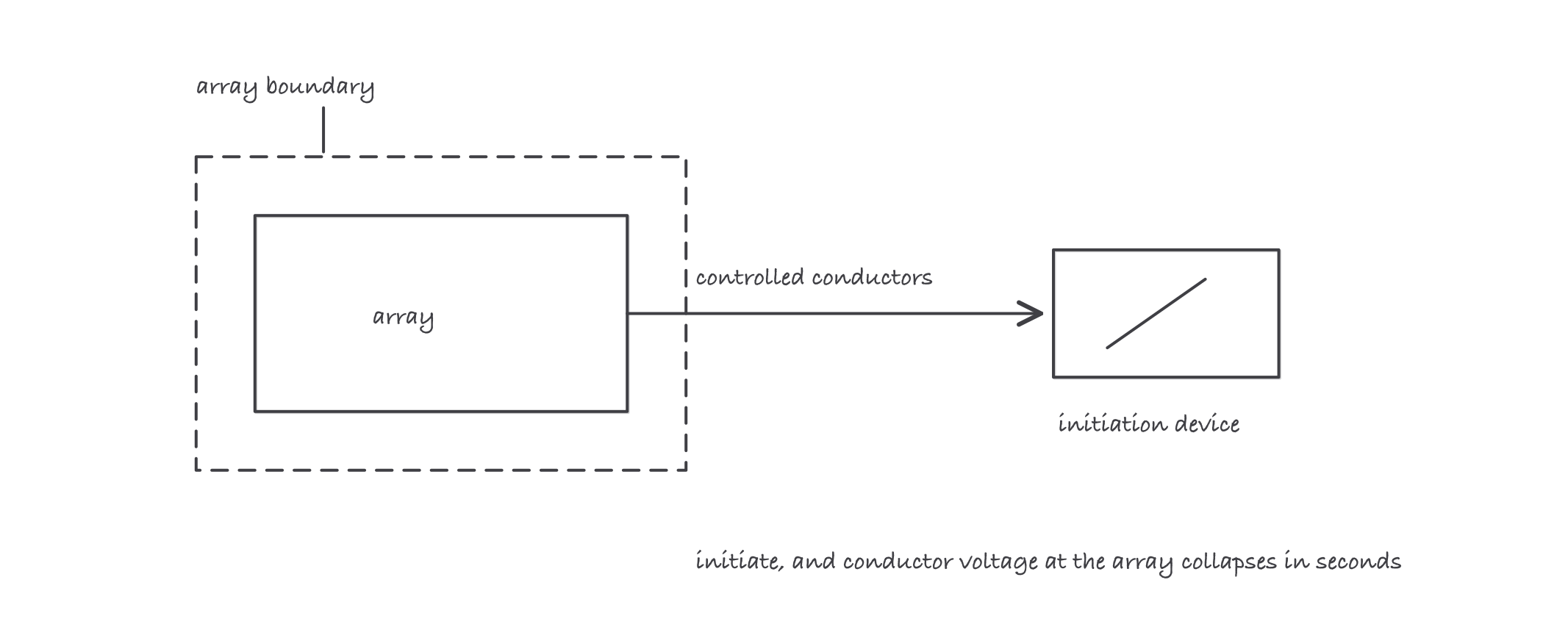
One action at the initiation device and the conductors at the array drop to a touch-safe voltage: a function for firefighters, not a maintenance disconnect
Worked example
A string operates at 400 V and 10 A, with a 60 ft one-way run of #10 copper (about 1.24 ohms per 1,000 ft). Voltage drop:
- Circuit resistance: 2 × 60 ft × 1.24 ÷ 1,000 = 0.1488 ohms
- Drop: 0.1488 × 10 A = 1.488 V
- Percentage: 1.488 ÷ 400 = 0.37 percent
High-voltage DC strings drop very little, which is one quiet advantage of string architectures. Run the same power at low voltage and high current and the percentage balloons: voltage drop math rewards volts.
Where it bites
- Rapid shutdown is not a disconnect. A disconnecting means isolates equipment for service; rapid shutdown collapses conductor voltage for first responders. Exams bait the swap, and so do jobsite conversations.
- The initiation device is for emergencies, not troubleshooting. Cycling it does not isolate equipment for safe work. Lockout and verification procedures live in the safety lessons.
- Arc-fault protection is also in play. Recent editions require DC arc-fault protection for most rooftop PV circuits; it usually lives in the inverter or MLPE. Know that the listing, not an add-on gadget, provides it.