Qualifications · Solar
OSHA 10 and OSHA 30 for Solar Work
Part of NABCEP PV Associate Prep · step 18 of 21 · next: NABCEP PV Associate
In learning paths: NABCEP PV Associate Prep
OSHA 10 and OSHA 30 are the wallet cards of American construction safety: completion cards for 10-hour and 30-hour safety courses delivered through OSHA’s Outreach Training Program by authorized trainers. In solar they carry a specific extra weight: NABCEP builds them into its certification requirements, with the 10-hour card for installer-track certifications and the 30-hour card for the storage and maintenance tracks.
*Learn the Trades is a free study resource. We are not a licensing body, an authorized training provider, or an exam administrator. Reading this page does not award any card, license, or certification. Always verify requirements with the issuing authority linked in the sources.*Why it matters on the job
The outreach card is usually the first credential a solar worker ever holds, and often a condition of stepping onto a site at all: employers and general contractors routinely require it even though the federal program itself is voluntary. For a solar career it is also a prerequisite with a long shadow: the card you earn in your first month is the same one you will submit years later inside a NABCEP application.
What the courses are
The Outreach Training Program is OSHA’s basic hazard-awareness training, delivered by OSHA-authorized trainers rather than by OSHA itself:
- The 10-hour construction course is aimed at entry-level workers: recognizing and avoiding the common hazards of a construction site, falls chief among them.
- The 30-hour construction course goes deeper and wider, covering hazard recognition at supervisor depth along with employer responsibilities, which is why it maps to roles that carry oversight duties.
Completion earns the Department of Labor card, and the federal card does not expire.
Which card for which NABCEP certification
NABCEP’s certification handbook assigns the cards by role depth. The installer-track certifications, PVIP among them, require the OSHA 10 construction card. The storage and maintenance certifications, ESIP and the commissioning and maintenance specialist track, require the OSHA 30. The logic is visible in the course designs: storage and maintenance roles carry more independent and supervisory responsibility, so NABCEP asks for the supervisor-depth card.
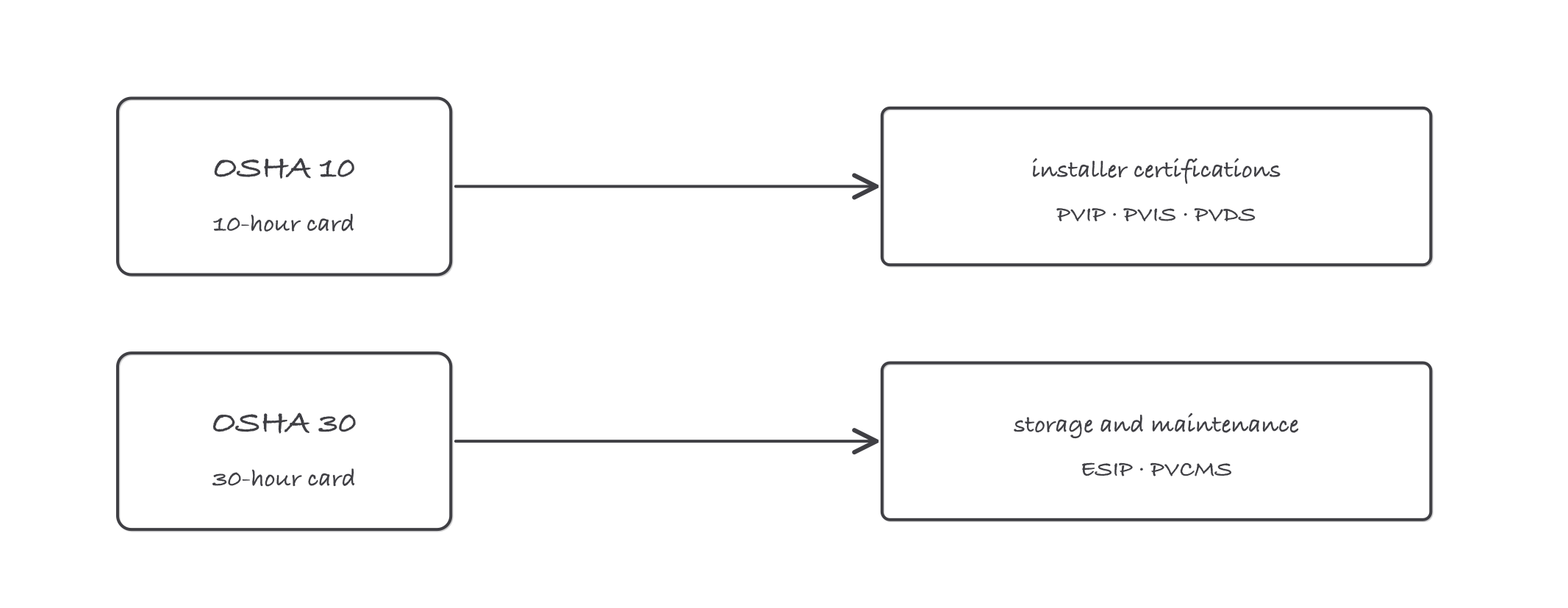
NABCEP’s mapping: 10-hour card for installer tracks, 30-hour for storage and maintenance
Worked example: choosing which course to take
An installer is planning a NABCEP path. If her target is PVIP, the 10-hour card meets the requirement. But she expects to move into battery storage work within a couple of years, and the ESIP certification requires the 30-hour card. The 30-hour course contains the 10-hour material and more, so taking OSHA 30 once covers both futures, at the cost of two extra training days now. Since the federal card does not expire, that single decision holds for her whole career. The arithmetic: one 30-hour course now, versus a 10-hour course now plus a 30-hour course later (40 combined hours) when the storage move happens.
Where it bites
- “OSHA certified” on a resume. The program awards completion cards, not certifications, and OSHA says so explicitly. Sloppy language here undermines a solar resume that will later be judged by a certification body that polices exactly this distinction.
- Taking the general industry course by mistake. Solar installation is construction work, and NABCEP’s requirements reference the construction courses. Confirm the course type before you book.
- Assuming the card substitutes for site-specific training. Outreach training is basic awareness. Employers still owe you training on the actual hazards and equipment of your site.
- Losing the card. It does not expire, and it will be wanted years later for certification applications. Store a copy the day it arrives.
Exam relevance
For NABCEP purposes the cards are eligibility requirements, not exam content, but outreach-course material overlaps heavily with the safety questions on solar exams: fall-protection triggers, hazard recognition, and the lockout thinking covered in the previous two lessons. The 10 or 30 hours you spend in the course is also exam prep, whether or not it was labeled that way.
Verified requirements
| Where | Expires | Renewal | Continuing education |
|---|---|---|---|
| United States (federal) | Confirm with issuer | Confirm with issuer | Confirm with issuer |
| United States (federal) | Confirm with issuer | Confirm with issuer | Confirm with issuer |
Information comes from issuing-authority sources. Confirm current rules, fees and eligibility with the authority before acting.