Learn · Solar
Commissioning and Testing
Part of NABCEP PV Associate Prep · step 13 of 21 · next: Rapid Shutdown Under NEC 690.12
In learning paths: NABCEP PV Associate Prep
Assumes you know: Interconnection and Net Metering
Commissioning is the proof stage: the ordered set of checks, measurements, and documents that demonstrate a finished PV system is built as designed, safe to energize, and producing what the design promised. An installed system is an assertion. A commissioned system is evidence.
Why it matters on the job
Commissioning is what separates “we finished the roof” from “the customer is generating and the paperwork will survive an audit.” It catches the reversed string and the loose lug while the crew and the ladder are still on site, when a fix costs minutes. The same measurements become the baseline every future service visit compares against, and the records feed everything downstream: the AHJ final, the utility’s Permission to Operate, and warranty claims years later.
The sequence
1. Visual and mechanical. Walk the whole system against the plans: module count and layout, torque marks on structural and electrical connections, wire management, labels, flashing. Cheap to check now, expensive to discover later.
2. Pre-energization electrical tests, DC side de-energized and verified. Polarity of every string (a reversed string is the classic assembly error), open-circuit voltage per string, and insulation resistance where the design calls for it. Each string’s Voc should sit near the calculated value and, more tellingly, the strings should agree with each other.
3. Energize in the manufacturer’s order. Close disconnects and start the inverter per its manual. Confirm it synchronizes, exports, and reports.
4. Operational verification. Compare live production against expectation for the conditions on the meter’s face, not against the STC nameplate. Confirm monitoring is registering every module or string it should.
5. Documentation. Record every measurement with date and conditions, deliver the as-built package, and file what the AHJ and utility need. In NABCEP applications, permits and final approved inspection records are exactly the paperwork that counts, so the habit pays twice.
Worked example
A string of 10 modules, each with a datasheet Voc of 40.2 V, is measured before energization.
- Expected: 10 × 40.2 V = 402 V (a cool morning reads a few volts higher; cold raises Voc)
- Measured: 361 V
- Difference: 402 − 361 = 41 V, almost exactly one module’s Voc
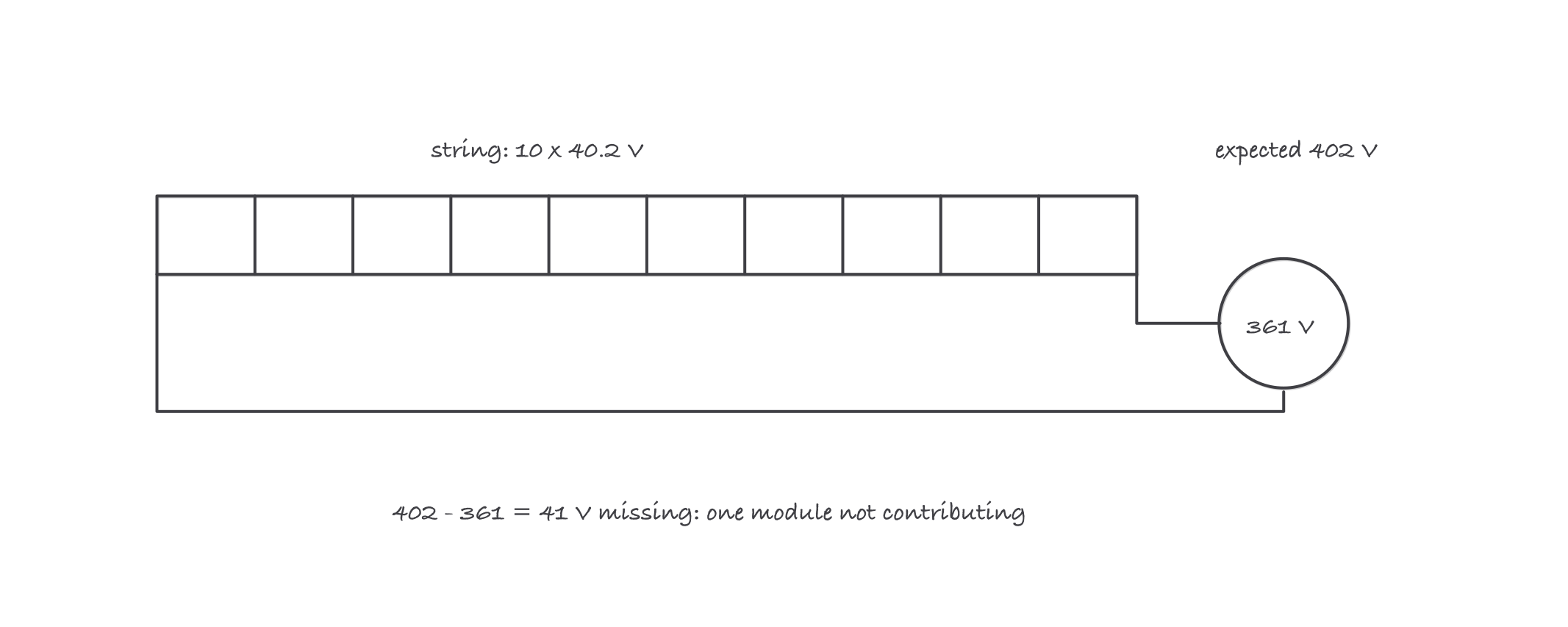
String Voc arithmetic turns a meter reading into a diagnosis: the missing 41 V is one module not contributing
One module is not contributing: bypassed by a connector fault, skipped in wiring, or damaged. The meter found in thirty seconds what monitoring might have taken weeks to flag as underperformance.
Where it bites
- A working inverter is not a commissioned system. Green lights prove synchronization, not that string 2 is wired to the design or that torque marks exist. The checklist is the product.
- Comparing production to nameplate creates false alarms. An 8 kW DC array producing 5.5 kW under autumn haze may be exactly right. Compare against expected output for measured conditions.
- Undocumented measurements are wasted measurements. A Voc reading nobody wrote down cannot baseline a warranty claim. If it is not recorded with date and conditions, it did not happen.
- DC measurement has its own hazards. Strings cannot be switched off by daylight; they are always live in sun. Measurement procedure and PPE come from the safety lessons, before the meter comes out.
Exam relevance
NABCEP’s PV Commissioning and Maintenance Specialist (PVCMS) is the Board Certification centered on exactly this work: individuals, voluntary, alongside state licensing. Its exam expects the measurement logic above: what each test proves, the order of the sequence, and how expected values are computed from datasheet numbers, precisely the arithmetic in the worked example.