Learn · Solar
Fall Protection on Solar Roofs
Part of NABCEP PV Associate Prep · step 16 of 21 · next: Electrical Hazards in PV Work
In learning paths: NABCEP PV Associate Prep
Falls are the hazard that kills solar installers, and OSHA’s construction rule draws the line at 6 feet: work at or above that height above a lower level requires fall protection. Almost no rooftop PV job is under the line. The 6-foot trigger, the anchor, the harness system, and the ladder that got you up there are the safety spine of every install day.
Why it matters on the job
OSHA identifies falls as a leading hazard of solar work, and the geometry of the job explains why: sloped surfaces, roof edges on every side, skylights, and hands that are usually full of module or racking. Fall protection is also a gateway competency for the career: safety training is where every solar credential path starts, and a crew’s fall-protection discipline is the first thing an experienced foreman reads about a new installer.
The 6-foot trigger
OSHA sets different fall-protection trigger heights by industry: 4 feet in general industry, 5 feet in shipyards, 6 feet in construction, 8 feet in longshoring. Solar installation is construction work, so 6 feet is your number. A single-story eave already clears it. The practical consequence: assume every roof job requires fall protection, and treat any claim otherwise as the exception that has to prove itself.
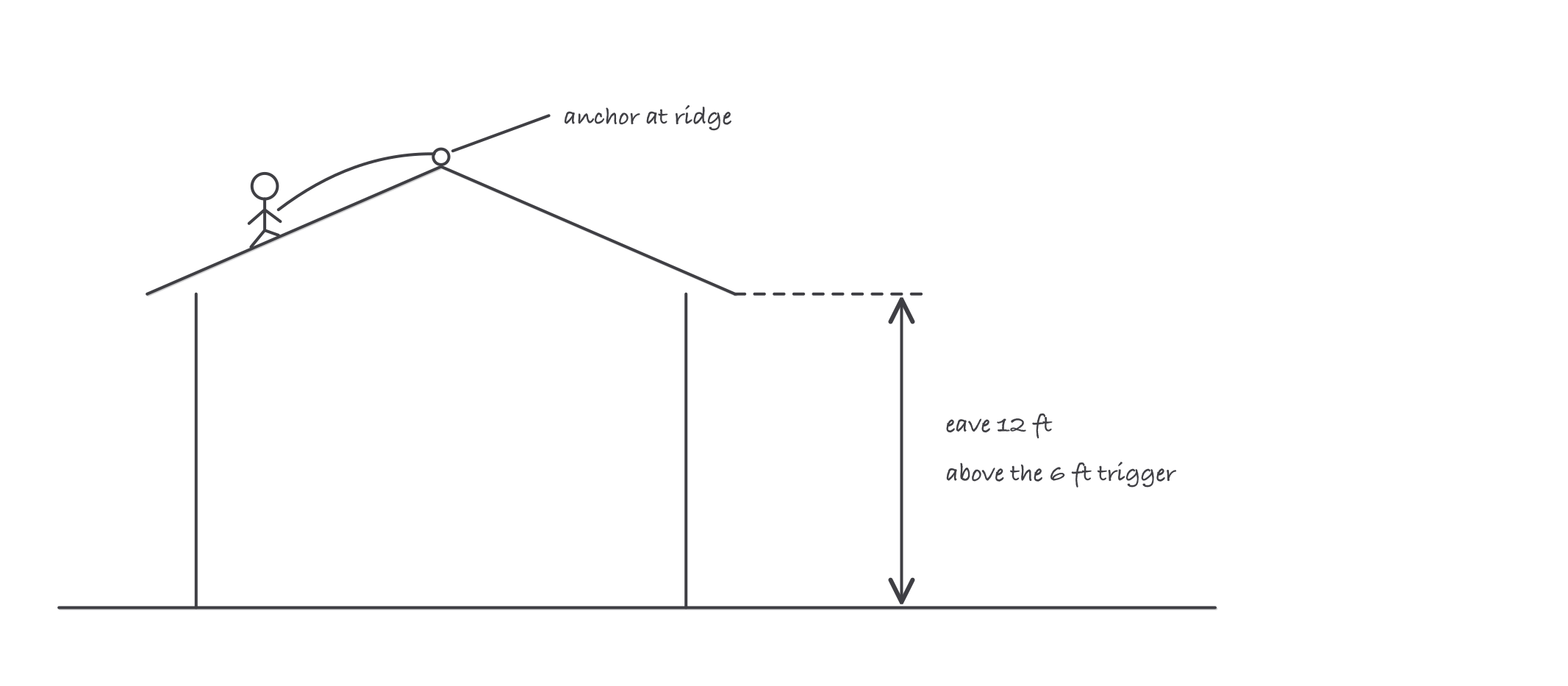
Construction work at or above 6 feet requires fall protection; a rooftop array almost always qualifies
The personal fall arrest system
A personal fall arrest system has three parts that must work together: an anchor secured to the structure, a full-body harness worn correctly, and the connecting means (lanyard or lifeline) between them. The system only works as a system:
- The anchor must be attached to structure that can take the load of an arrested fall, not to whatever is convenient. On a PV job, anchor placement is planned with the layout, before modules cover the roof plane.
- The harness distributes arrest forces across the body. A loose harness or one worn with the D-ring in the wrong position turns an arrested fall into an injury of its own.
- The connection must be short enough that you cannot reach the point where a fall becomes a swing into the building or a drop over the edge. Rig to prevent the fall, not to survive it.
Guardrail systems and other engineered protections do the same job collectively where the site allows them; the arrest system is the installer’s personal, portable answer.
Ladders are part of fall protection
Most solar falls do not start on the roof plane; they start at the transition, getting on and off the ladder at the eave. Set the ladder on firm, level ground, secure it against movement, and keep your hands free by hoisting material instead of carrying it up. The gear-hauling habit, climbing with a module or a drill bag in one hand, is the single most tempting shortcut on a residential job and one of the most dangerous.
Worked example: reading a job against the trigger
A crew arrives at a single-story ranch house. The eave measures 12 feet above grade: double the 6-foot construction trigger, so fall protection is required for the roof work, full stop. The crew plans anchors at the ridge before loading the roof, stages modules so no one climbs the ladder loaded, and identifies the one place the lifelines will not reach, a corner over a concrete patio, as the zone where work gets re-sequenced rather than improvised. The measurement took one minute; it settled every argument before it started.
Where it bites
- “It’s a quick job” is not an exemption. The 6-foot trigger has no minimum duration. The two-minute fix at the eave is governed exactly like the full install.
- Anchoring to racking or convenience points. The anchor holds a falling human. It goes into structure, per the anchor manufacturer’s instructions, not into whatever was in reach.
- Slack in the system. A lanyard long enough to let you reach the edge is a fall waiting for a place to happen. Rig for restraint first, arrest second.
- The transition is the trap. Eave and ladder transitions produce falls on jobs where the roof-plane work was fully protected. Protect the boring part.