Qualifications · Solar
Solar Licensing by State
Part of NABCEP PV Associate Prep · step 21 of 21
In learning paths: NABCEP PV Associate Prep
Who may legally install solar is a state licensing question, and the states answer it in three different shapes: a dedicated solar contractor classification, a solar category inside a general contracting statute, or a solar-scoped license issued through the electrical licensing system. There is no such thing as a single national “solar license,” and no NABCEP credential substitutes for any of these.
*Learn the Trades is a free study resource. We are not a licensing body, an authorized training provider, or an exam administrator. Reading this page does not award any card, license, or certification. Always verify requirements with the issuing authority linked in the sources.*Why it matters on the job
The license decides whose name goes on the permit, who can contract directly with a customer, and whose career path runs through an apprenticeship versus a contractor exam. An installer planning a move between states can find the rules completely reshuffled at the border: the same work that needed a solar-specific contractor license in one state may require an electrician’s license, or fall under a general electrical contractor, in the next. Knowing which model your state uses tells you which door to walk through.
The three models
Model 1: a dedicated solar classification. California is the anchor example. The Contractors State License Board (CSLB) issues the C-46 Solar classification, which covers installing, modifying, maintaining, and repairing both thermal and photovoltaic solar systems. The scope is deliberately narrow: a C-46 contractor may not perform work in other trades except where it is required to complete the solar installation. The live policy issue in California is the boundary with the C-10 electrical classification, especially as battery storage rules develop under CSLB rulemaking.
Model 2: a statutory solar contractor category. Florida defines “solar contractor” directly in statute, section 489.105, under the Construction Industry Licensing Board. The statute also shows the other side of the coin: contractors certified in other categories may perform solar work that falls within their existing scope. In Florida, solar is both its own license and a subset of several others.
Model 3: an electrician-track solar license. Oregon’s Limited Renewable Energy Technician (LRT) license is the clean example. It is issued by the Building Codes Division, the same authority that runs electrical licensing. It is apprenticeship-gated; the holder must work for a limited renewable energy or electrical contractor; and the license renews on a 3-year cycle. Here solar is treated as a branch of electrical work, with the training pipeline to match.
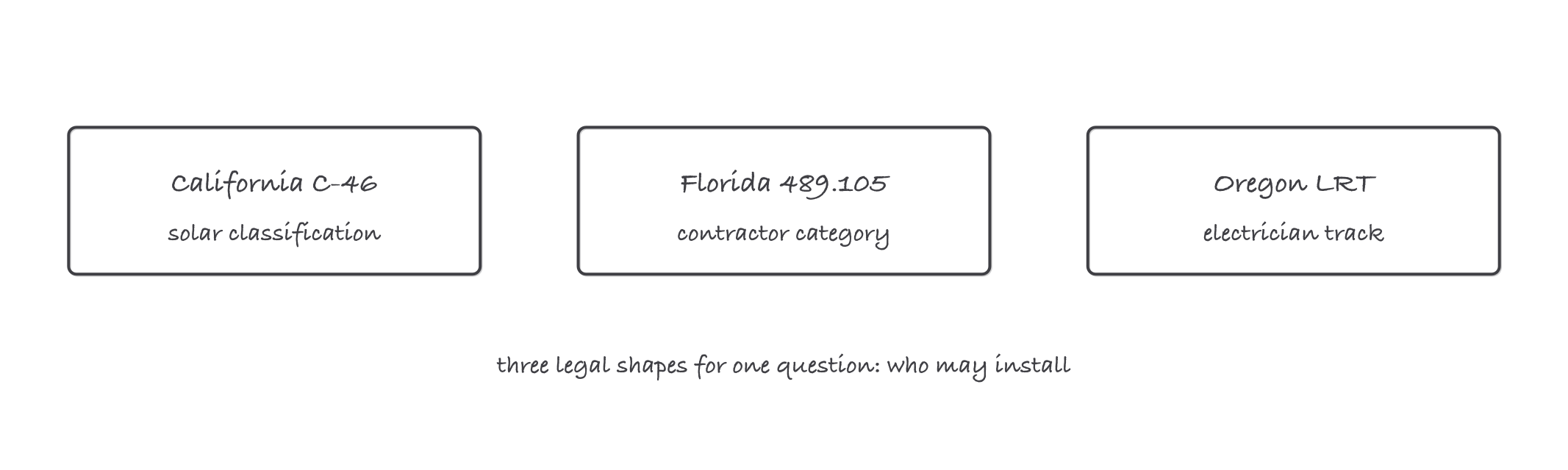
Three states, three shapes of the same question: who may install
Worked example: one move, two systems
An installer holds a California C-46 and wants to relocate to Oregon. In California she could contract for complete PV installations under her own classification. In Oregon the equivalent hands-on work runs through the electrical licensing system: the LRT license is apprenticeship-gated and requires employment with a limited renewable energy or electrical contractor. Her C-46 does not transfer; her practical experience helps, but the door she must enter is Oregon’s, on Oregon’s terms. Same trade, different legal machinery.
Where it bites
- “I’m NABCEP certified, so I can install.” Certification is voluntary and market-driven; the state license is the legal requirement. The two answer different questions.
- Assuming the electrical license is always the path. In some states it is; in others a solar classification exists precisely so that it is not. Check the model before you plan the career.
- Scope limits cut both ways. A narrow solar license may bar you from adjacent work; conversely, contractors licensed in other categories may be allowed to do solar inside their existing scope, which shapes who your competition is.
- Storage is moving the boundaries. Battery systems are forcing states to redraw the line between solar and electrical scopes. Rules that were stable for a decade are changing; verify with the state board, not with a forum post.
Exam relevance
State contractor and electrician exams test their own state’s rules, so the transferable knowledge is the pattern: which authority issues the license, what scope it grants, and what documentation it demands. For NABCEP exams, the tested fact is the relationship itself: certification never replaces state licensing, and licensing requirements vary by state.