Learn · Solar
NEC Article 705: Parallel Power Sources
Part of NABCEP PV Associate Prep · step 15 of 21 · next: Fall Protection on Solar Roofs
In learning paths: NABCEP PV Associate Prep
Assumes you know: NEC Article 690 Compliance, Interconnection and Net Metering
Article 705 of the National Electrical Code governs any electric power source that operates in parallel with the utility: solar inverters, battery inverters, generators with paralleling gear, all of them. Where Article 690 rules the PV system itself, 705 rules the meeting point, the place your inverter’s output lands on wiring that the utility also feeds. Its central question is blunt: can every conductor and busbar at that meeting point survive being fed from two directions at once?
Why it matters on the job
The interconnection lesson covered the utility process; code compliance under Article 690 covered the PV side. Article 705 is the piece an inspector reads when your output breaker lands in a customer’s panel. Get it wrong and the failure mode is not an abstraction: a busbar fed by the utility main at one end and a PV breaker at the other can carry more current than its rating in the section between them. The article exists to make that overload impossible by design.
Supply side or load side
Every interconnection is one of two kinds, defined by where it lands relative to the service disconnecting means:
- Load-side connections land downstream of the main disconnect, most commonly as a breaker in a panelboard. This is the standard residential pattern, and it is where the busbar arithmetic below applies.
- Supply-side connections land upstream of the main disconnect, between the meter and the service equipment. The panel’s busbar never sees the PV current, so the busbar limits do not constrain the system; in exchange you are working on service conductors, with the workmanship and utility coordination that implies.
When a design bumps into the load-side limits, moving to a supply-side connection is the usual escape.
The 120 percent rule
For a load-side breaker on a panelboard busbar, recent editions allow the sum of the utility main breaker and the PV breaker to reach 120 percent of the busbar rating, on the condition that the PV breaker sits at the opposite end of the busbar from the main. The physics behind the allowance: with sources at both ends, no point on the bus can see both full feeds stacked; loads along the bus draw the currents toward each other. Verify the exact conditions in your adopted edition; the principle has been stable in recent cycles but the details belong to the code text.
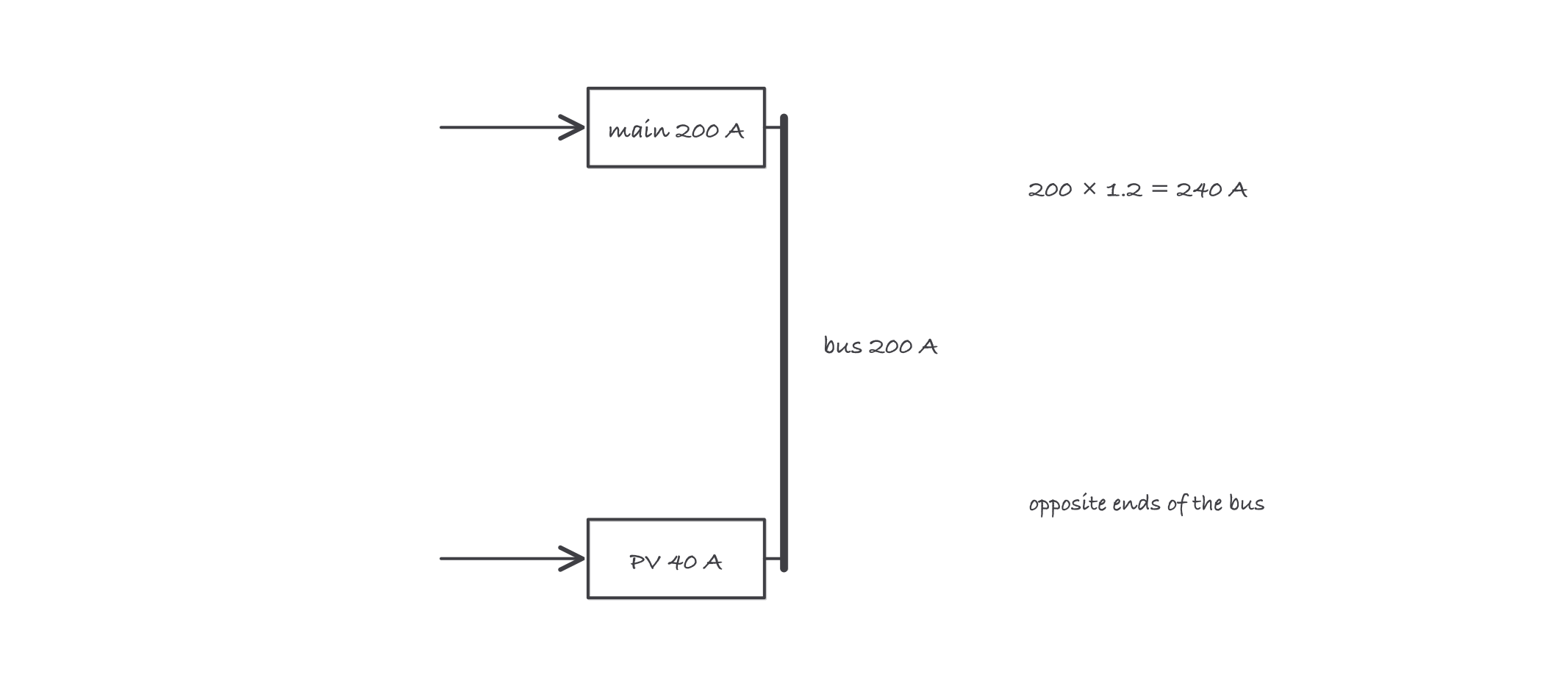
The 120 percent rule: 200 A bus × 1.2 = 240 A of combined supply, main at one end, PV at the other
Worked example: sizing the backfeed on a 200 A panel
A house has a 200 A busbar with a 200 A main breaker. The allowance: 200 A × 1.2 = 240 A of combined supply. Subtract the main: 240 − 200 = 40 A available for the backfed PV breaker, installed at the opposite end of the bus.
Now test two systems against it. A 40 A PV breaker: 200 + 40 = 240 A, exactly at the limit, compliant with the opposite-end placement. A 60 A breaker for a larger array: 200 + 60 = 260 A, over the 240 A allowance, not compliant on this bus. The fixes, in the order designers usually try them: downsize the main breaker (a 175 A main frees 240 − 175 = 65 A of backfeed room), move to a supply-side connection, or upgrade the panel. The PV breaker itself is sized from the inverter’s output current with the continuous-load factor, as covered in the interconnection lesson; the 120 percent check is the panel’s side of the negotiation.
Where it bites
- The busbar rating is not the main-breaker rating. The rule runs on the busbar’s rating. Panels routinely carry a 200 A bus with a lower main, and that gap is free backfeed capacity; read the label, not the breaker.
- Opposite-end placement is part of the rule. A compliant sum with the PV breaker landed mid-bus is not a compliant installation. The geometry is the physics.
- 705 covers more than solar. Add a battery inverter later and its output joins the same arithmetic. A panel maxed out by PV has no room left for storage without redesign.
- Article numbers and conditions drift by edition. States adopt different editions on different schedules. The 120 percent principle is long-standing; the exact section numbering and conditions come from the edition on your permit.