Learn · Solar
Rapid Shutdown Under NEC 690.12
Part of NABCEP PV Associate Prep · step 14 of 21 · next: NEC Article 705: Parallel Power Sources
In learning paths: NABCEP PV Associate Prep
Assumes you know: PV Wiring and Rapid Shutdown
Rapid shutdown is the NEC’s answer to a firefighter’s problem: a burning building with a PV array on it is covered in conductors that stay live in daylight. Section 690.12 of the National Electrical Code requires PV systems on buildings to include a rapid-shutdown function: an initiation device that, when operated, quickly reduces the voltage on the array’s conductors so that emergency responders can work on and around the building. It is a function, not a switch, and that distinction runs through everything in this lesson.
Why it matters on the job
You wired the strings in PV Wiring and know the array is a source with no off switch. Rapid shutdown is how the code makes that source controllable from outside: one deliberate action, by someone who has never seen the system before, has to bring conductor voltages inside the array boundary down to the code’s limits within the code’s time window. Inspectors test it, fire marshals rely on it, and a system that fails it does not pass final inspection.
The pieces of the requirement
The initiation device is the thing a responder operates: typically at the service equipment or another readily visible location, marked so that one action starts the shutdown. Operating it must set the shutdown in motion for the whole system.
Controlled conductors are the conductors the rule governs: the wiring from the array that must fall to a limited voltage after initiation. The code addresses conductors inside the array boundary, the zone at and around the array itself, and conductors that leave that boundary, with tighter limits for what remains energized in each zone.
The limits themselves are edition-specific. The exact voltage thresholds, time windows, and boundary distances have changed across recent code editions, and 690.12’s wording is actively evolving in the current cycle. Design and inspect to the edition your state has adopted, from the code text, not from memory of a previous cycle.
Module-level power electronics as the compliance route
Bringing voltage down inside the array means controlling it module by module, which is why module-level power electronics (MLPE) dominate rooftop compliance. Microinverters convert to AC at each module, so DC string voltage never exists in the first place. Optimizers respond to a shutdown signal by dropping their output to a safe level, collapsing the string voltage. A plain string-inverter system with no MLPE can readily de-energize conductors outside the boundary with a contactor, but reducing voltage inside the array is what forces the electronics onto the roof. Listed rapid-shutdown equipment, matched combinations of inverter and MLPE, is how real systems certify the function.
Worked example: what the initiation switch changes
A rooftop string of 12 modules runs at about 40 V each, roughly 480 V DC across the string in operation (12 × 40 = 480). The responder operates the initiation device at the service equipment. The optimizers stop passing power and each module’s contribution collapses to the low per-module output the listing provides, so the string conductors inside the array boundary fall from about 480 V to a small fraction of it, within the code’s time limit. The conductors leaving the array boundary are de-energized to the code’s outside-the-boundary limit. What the inspector verifies: one action, the labeled device, measured voltages inside and outside the boundary within the allowed time, per the adopted edition.
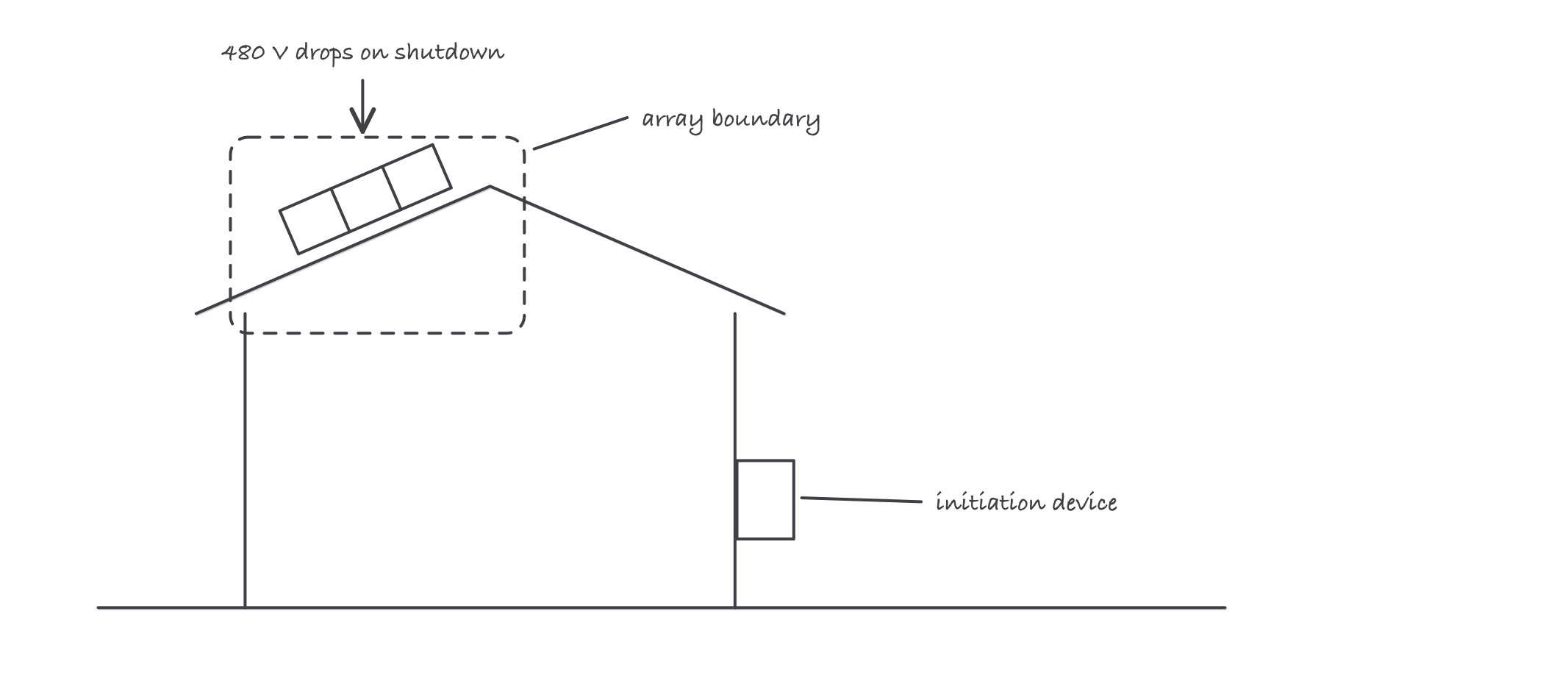
One action at the initiation device, and voltage inside the array boundary collapses to the adopted edition’s limits
Where it bites
- Rapid shutdown is not a disconnect. A disconnecting means isolates equipment for service; rapid shutdown is a voltage-reduction function for emergency responders. One never substitutes for the other, and exams bait the swap relentlessly.
- Shut down is not dead. After initiation, limited voltage remains inside the array boundary, and modules still produce in daylight. Service work still means the full electrical-hazards discipline from the safety group.
- Mixed equipment breaks listings. The shutdown function is certified for specific combinations of MLPE and inverter. Substituting a component mid-job can silently void the listed function the permit was approved on.
- Edition drift. Requirements differ across code editions and states adopt on different schedules. The system that passed in one jurisdiction can fail across the county line; the adopted edition is the only authority.