Learn · Solar
How Solar PV Works
Part of NABCEP PV Associate Prep · step 1 of 21 · next: PV System Components
In learning paths: NABCEP PV Associate Prep
A photovoltaic cell turns light directly into DC electricity. No moving parts, no heat engine, no combustion: photons strike a silicon wafer, knock electrons loose, and a built-in electric field sweeps those electrons out through a circuit. Every array you will ever install is this one effect, repeated a few thousand cells at a time.
Why it matters on the job
Everything downstream makes sense once this layer does. Why modules produce DC and need an inverter, why shade on one cell can choke a whole string, why a cold clear morning reads higher voltage than a hot afternoon: all of it traces back to what the cell is doing. The Bureau of Labor Statistics projects 42 percent growth for solar photovoltaic installers from 2024 to 2034, with about 4,100 openings a year, and the installers who advance fastest are the ones who understand the physics they are bolting down.
From photon to current
Silicon in a PV cell is built as two layers with deliberately different chemistry. Where the layers meet, a permanent electric field forms: the p-n junction. When a photon with enough energy is absorbed, it frees an electron. The junction’s field pushes freed electrons toward one face of the cell, so one face accumulates negative charge and the other positive: a voltage. Connect the two faces through a circuit and current flows for as long as light lands.
One crystalline silicon cell produces a small, fairly fixed voltage. To get useful numbers, manufacturers wire cells in series inside a glass-and-frame package: the module. Series connections add voltage. Modules are wired together on the roof into an array, and the same series rule applies to them.
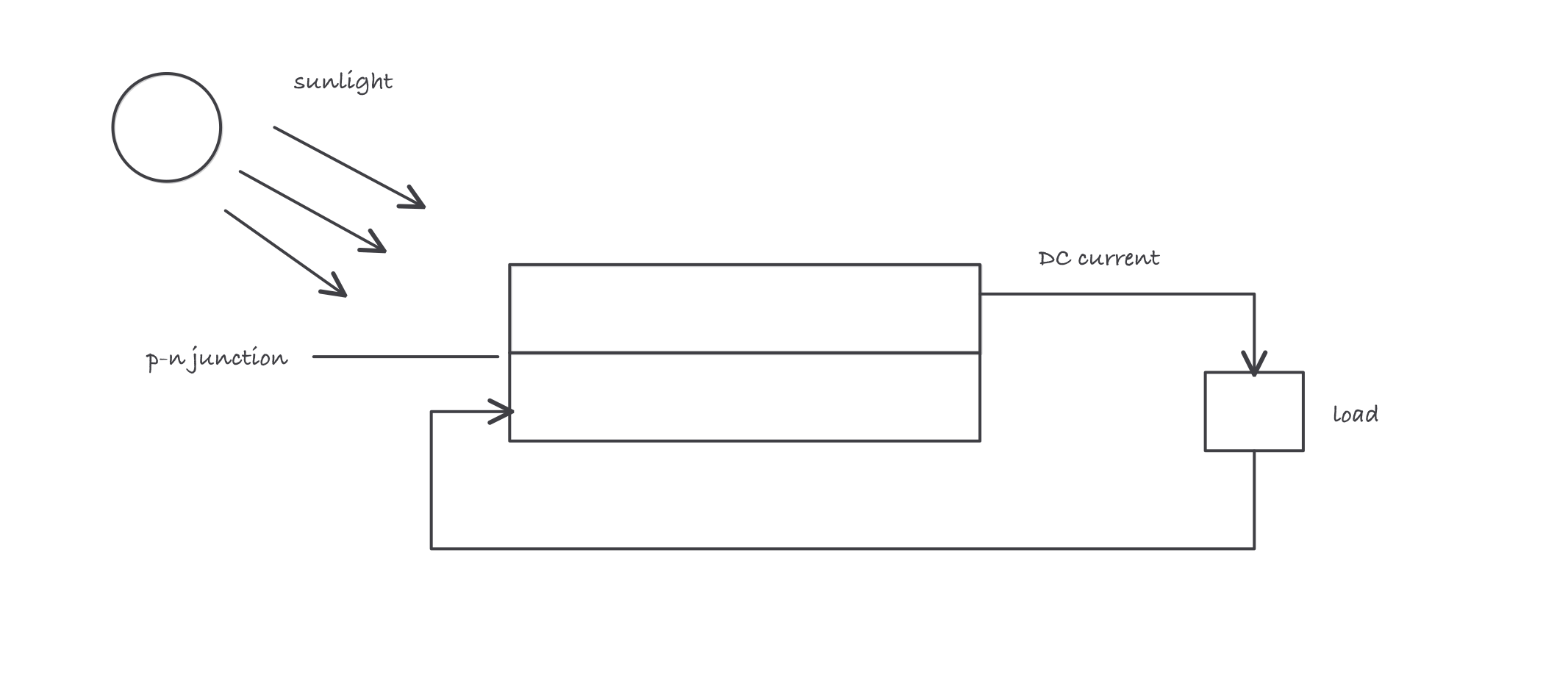
Light in, electrons pushed one way by the junction, DC out through the circuit
What the ratings mean
Module output moves with conditions, so the industry rates everything at Standard Test Conditions (STC): 1,000 watts of light per square meter, 25 degrees C cell temperature. A “400 W module” means 400 W at STC. Two facts to lock in now:
- Irradiance drives current. More light, more freed electrons, more amps, in nearly direct proportion.
- Temperature drives voltage, backwards. Hotter cells produce lower voltage. Cold, bright conditions push voltage up, which is why winter mornings, not summer afternoons, set the voltage limits in system design.
Worked example
A module has 2.0 square meters of area and converts 20 percent of the light hitting it. At STC irradiance of 1,000 W per square meter:
2.0 m² × 1,000 W/m² × 0.20 = 400 W
On a real roof at mid-morning the irradiance might be 800 W per square meter:
2.0 m² × 800 W/m² × 0.20 = 320 W
Same module, same sun angle math you will do in site assessment: output tracks the light, not the nameplate.
Where it bites
- Panel, module, array are not interchangeable. The module is the product on the spec sheet; the array is the whole roof assembly. Say “panel” to a customer if you like, but write “module” on anything an inspector or engineer reads.
- Hot is not better. Customers assume a scorching roof means peak output. Heat raises current slightly and cuts voltage more, so net production drops as cells overheat.
- PV makes DC. Nothing in the module makes AC. Any AC on the roof came from electronics, which is the subject of the inverter lessons.
Exam relevance
The NABCEP PV Associate exam opens with a PV Application domain, and this is its core: the photovoltaic effect, cell versus module versus array, STC ratings, and how irradiance and temperature each move current and voltage. Expect questions that give you conditions and ask which direction output moves. The exam is 70 multiple-choice questions, 60 of them scored, in 2 hours.