Qualifications · Solar
NABCEP PVIP: The Gold Standard
Part of NABCEP PV Associate Prep · step 20 of 21 · next: Solar Licensing by State
In learning paths: NABCEP PV Associate Prep
Assumes you know: NABCEP PV Associate
The NABCEP PV Installation Professional, PVIP, is the certification the US solar industry treats as its gold standard: a Board Certification that combines documented safety training, formal PV education, and verified experience running real installations, capped by a 4-hour exam. Where the PV Associate says you understand solar, PVIP says you have led solar work and can prove it.
*Learn the Trades is a free study resource. We are not a licensing body, an authorized training provider, or an exam administrator. Reading this page does not award any card, license, or certification. Always verify requirements with the issuing authority linked in the sources.*Why it matters on the job
PVIP is the credential that shows up in job postings for lead installer, foreman, and project manager roles, and in some incentive programs and utility installer lists. It signals a specific thing: this person has been the decision-maker on multiple installed, inspected systems. That is a different claim from “has worked on a crew,” and employers and customers price the difference.
The four requirements
To sit for PVIP you assemble four things:
- OSHA 10 construction card. The 10-hour outreach course, covered in its own lesson in the safety group.
- 58 hours of PV training. Formal coursework meeting the handbook’s advanced-training requirements.
- 6 project credits in a decision-making role. Installed PV systems where you were responsible for the install, documented through the authority having jurisdiction (AHJ): permits plus the final approved inspection. Site plans and permit applications are explicitly not accepted.
- The application itself, with the documentation above verified before you are approved to test.
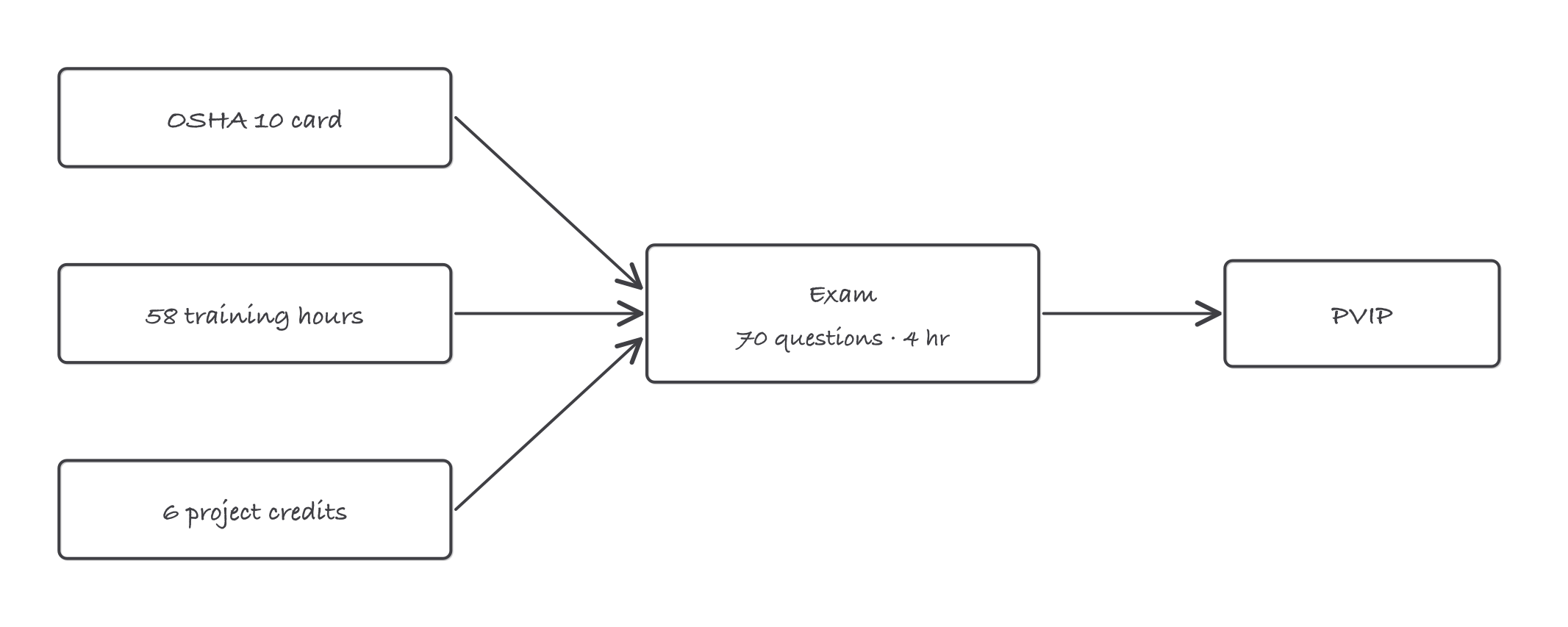
Three requirements feed one 4-hour exam
Project credits are not project counts
NABCEP measures experience in credits, not installations. A PV system from 1 kW up to 999 kW earns 2 credits; a system of 1 MW or more earns 3. So “6 project credits” typically means three complete systems where you held the decision-making role, not six. This is one of the most misreported facts about PVIP in competitor content, and getting it wrong on an application wastes months.
The exam
70 multiple-choice questions, 60 scored and 10 unscored, in a 4-hour sitting: the standard NABCEP Board Certification format. Approval opens a 1-year eligibility window with up to 4 attempts inside it. Compare the Associate’s gentler terms (2-year window, 6 attempts per year) and you can read NABCEP’s intent: board-level candidates are expected to arrive prepared.
Certification runs on a 3-year cycle, renewed with 30 hours of continuing education; the handbook sets how those hours must be split.
Worked example: counting the credits
A lead installer has run four residential jobs as the responsible decision-maker: 6 kW, 8 kW, 10 kW, and 12 kW. Every one falls in the 1 to 999 kW tier, so each earns 2 credits: 4 × 2 = 8 credits, comfortably over the 6 required. But her employer pulled the permits on one job and the AHJ file for another shows no final inspection. Only the two fully documented systems count for now: 2 × 2 = 4 credits. She needs one more documented system to reach 6. The lesson: the paperwork trail is the requirement, not the memory of the work.
Where it bites
- Decision-making role means what it says. Crew hours under someone else’s direction do not become credits, no matter how many systems you touched.
- AHJ paperwork rules the application. Permits and final approved inspections. Start collecting them from your first lead job, not at application time.
- “NABCEP-certified company” is always wrong. Individuals hold the certification. Companies employ certificants.
- The 1-year window is short. Four attempts sounds like slack; a failed first attempt plus a busy season can spend the window fast.
Exam relevance
The PVIP exam reaches across this entire curriculum: system design and sizing, code compliance under NEC Article 690, rapid shutdown, interconnection under Article 705, commissioning, and safety. The lessons in the design and codes groups map directly onto the exam’s technical core, and the worked examples there are the kind of calculation the 4-hour sitting expects you to do cold.