Learn · Solar
NEC Article 690 Compliance
Part of NABCEP PV Associate Prep · step 8 of 21 · next: Racking and Mounting
In learning paths: NABCEP PV Associate Prep
Assumes you know: System Sizing
NEC Article 690 is the National Electrical Code’s chapter for PV systems: how to compute the array’s worst-case voltage and current, size conductors and overcurrent protection from them, ground the system, and provide the disconnects and labels an inspector expects. The AHJ inspects against it, so a designer who cannot show the 690 math is asking the inspector to take the design on faith.
Why it matters on the job
Two calculations from this article gate every plan set: maximum system voltage and maximum circuit current. Both are worst-case numbers, computed from limit values (Voc and Isc), not operating values (Vmp and Imp). Miss the distinction and the design under-sizes exactly the components that exist for the bad day: cold-morning voltage and irradiance spikes.
Maximum system voltage
Cold raises voltage, so the check uses the site’s lowest expected temperature. Recent editions of 690.7 let you correct the datasheet Voc with the manufacturer’s temperature coefficient: for each degree below the STC reference of 25 degrees C, Voc rises by the coefficient. The corrected string voltage must stay under the system’s voltage cap; recent editions hold one- and two-family dwellings to 600 V.
Maximum circuit current
Recent editions of 690.8 define maximum circuit current as 125 percent of Isc, covering irradiance above STC (reflection, cloud-edge focusing, altitude). Conductor sizing then applies the standard 125 percent continuous-load factor on top, before conditions of use like rooftop temperature. The compounding is deliberate: one factor is physics headroom, the other is the continuous-duty rule.
Worked example
A string of 10 modules on a site with a record low of −15 degrees C. Datasheet: Voc 40.5 V, Isc 10.2 A, Voc temperature coefficient −0.29 percent per degree C.
Voltage check:
- Temperature swing below STC: 25 − (−15) = 40 degrees
- Voc rise: 40 × 0.29 = 11.6 percent, factor 1.116
- Cold Voc per module: 40.5 × 1.116 = 45.198, carry 45.2 V
- String maximum: 10 × 45.2 = 452 V, under the 600 V dwelling cap
Current chain:
- Maximum circuit current: 10.2 × 1.25 = 12.75 A
- Continuous factor: 12.75 × 1.25 = 15.9375, so conductors start from 15.94 A before conditions of use
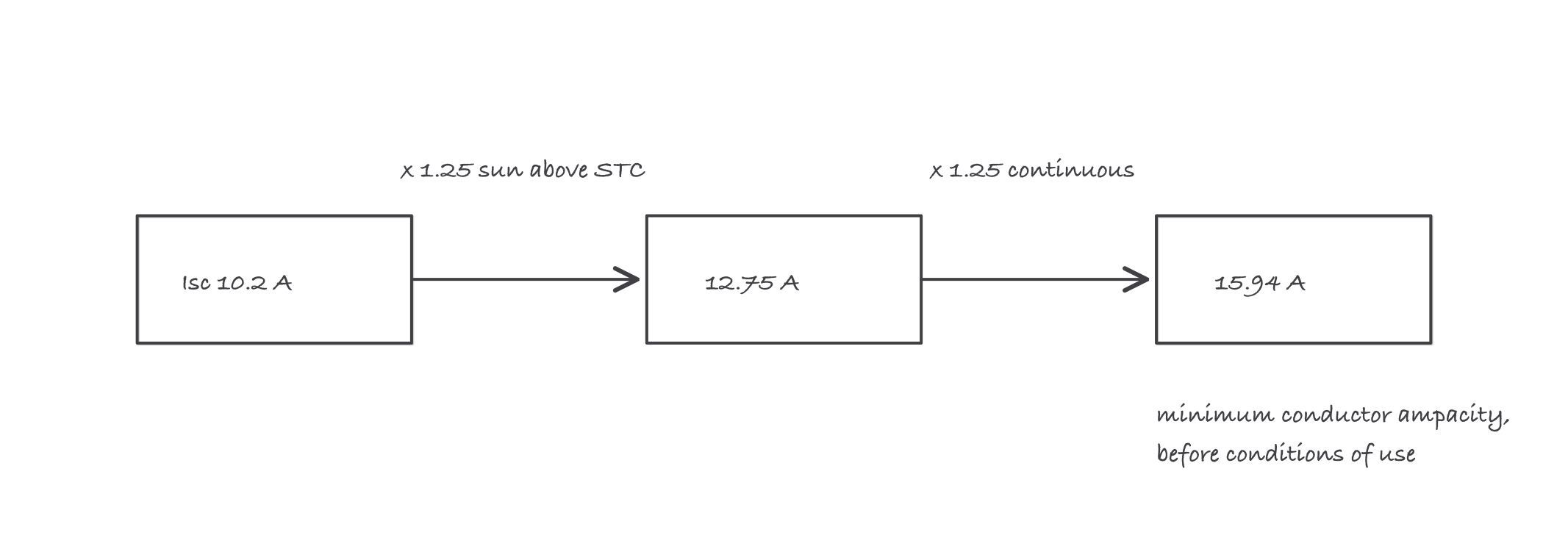
Two deliberate 125 percent factors: one for sun above STC, one for continuous duty
The rest of the inspection
- Overcurrent protection where strings can backfeed each other (typically three or more in parallel), rated from the same 690.8 current.
- Grounding. Every module frame and rail bonds to the equipment-grounding conductor with listed hardware. Functionally ungrounded arrays still require the EGC, always.
- Disconnects so the inverter and other equipment can be isolated, distinct from the rapid-shutdown function of 690.12 covered in the wiring lesson.
- Labels. Article 690 and related articles specify a family of placards (voltage, current, source locations, shutdown instructions). Inspectors read labels first; a missing placard is the easiest correction notice there is.
Where it bites
- Hot roofs are not the voltage worry. Cold mornings are. Heat is a current, derate, and production concern; the maximum-voltage check runs on the record low. Exams and plan reviewers both probe this inversion.
- Limit values versus operating values. Voc and Isc size the code checks; Vmp and Imp predict production. Swapping them fails quietly, because the system works right up until the extreme day it was supposed to be sized for.
- Editions move. Section numbers, the rapid-shutdown details, and allowable methods shift between code cycles, and states adopt different editions. The math patterns above are stable; verify section text against the edition your AHJ enforces.