Learn · Solar
PV System Components
Part of NABCEP PV Associate Prep · step 2 of 21 · next: Grid-Tied, Hybrid and Off-Grid Systems
In learning paths: NABCEP PV Associate Prep
Assumes you know: How Solar PV Works
A PV system is a chain: modules make DC power, conductors and combiners collect it, an inverter converts it to AC, and switchgear delivers it to the building and the grid. Everything that is not a module or an inverter is called balance of system (BOS), and BOS is where most of an installer’s day goes.
Why it matters on the job
You will rarely be asked “how does a cell work” on a jobsite. You will constantly be asked where a circuit lands, which disconnect isolates what, and why a string reads the voltage it does. Knowing each component’s one job, and the order they connect in, is the map for every install, service call, and inspection walk.
The chain, in order
Modules produce DC. Wired in series they form a string: voltages add, current stays the module’s current. Strings land in parallel at a combiner or at the inverter’s inputs: currents add, voltage stays the string’s voltage.
The inverter converts DC to AC at grid voltage and frequency. It is also the brain: it tracks the array’s best operating point and shuts down when the grid drops. String inverters, microinverters, and optimizers split this job differently, which is its own lesson.
Racking is the structure: rails, clamps, and roof attachments that carry the array’s weight and wind loads into the building frame.
Balance of system is everything else: DC and AC conductors, connectors, disconnects that let a worker isolate each piece of equipment, overcurrent protection, grounding hardware, meters, and monitoring. On the plans it is small print. In the truck it is most of the parts.
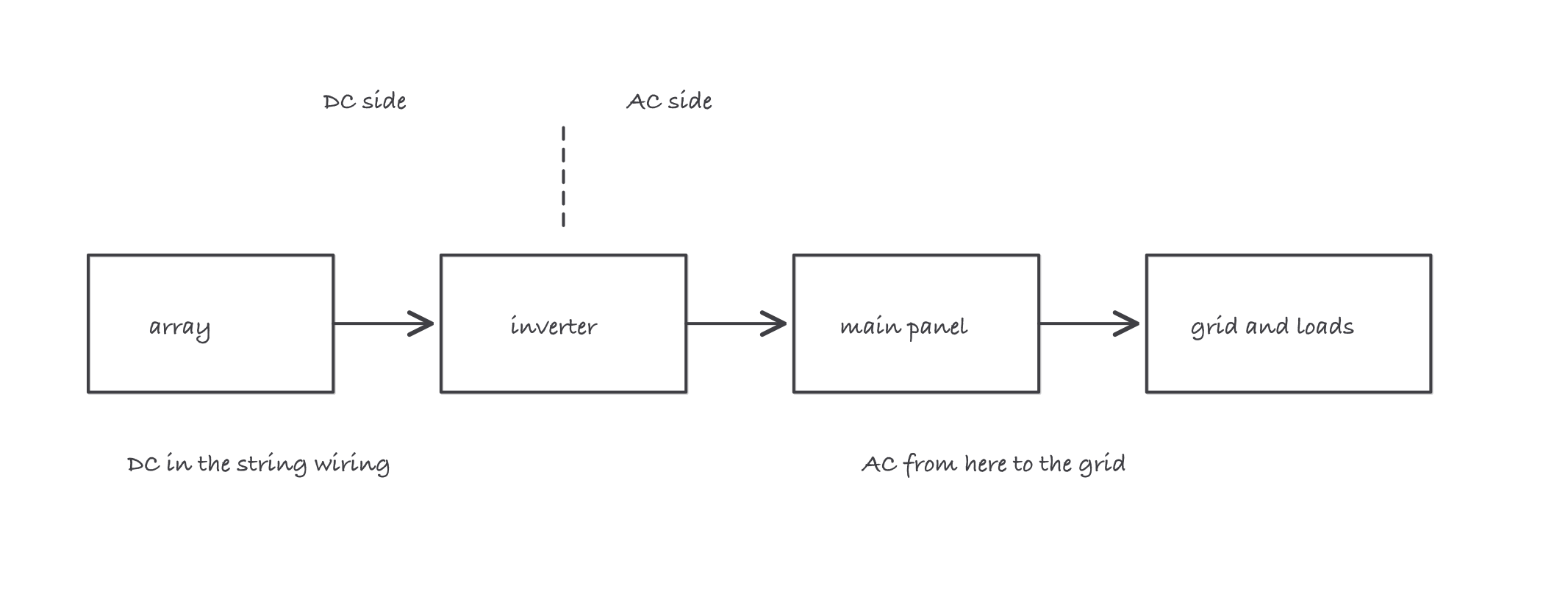
One power path: DC from the array to the inverter, AC from the inverter to the panel, grid, and loads
Worked example
Ten modules, each rated Vmp 34 V and Imp 10 A, wired in one series string:
- String voltage: 10 × 34 V = 340 V
- String current: stays 10 A
- String power: 340 V × 10 A = 3,400 W
Add a second identical string in parallel at the inverter:
- Voltage stays 340 V, current becomes 10 A + 10 A = 20 A
- Array power: 340 V × 20 A = 6,800 W
Series adds volts, parallel adds amps. That one rule explains nearly every string label you will ever land.
Where it bites
- kW and kWh are different quantities. The array is rated in kW (power). The energy it produces over time is kWh. Mixing them up scrambles sales conversations, incentive forms, and exam questions alike.
- A system has two sizes. The DC nameplate (sum of module ratings at STC) and the AC rating (inverter output) are both “the system size” on different forms. Always state which one you mean.
- Disconnects are for isolation, not protection. A disconnect switch lets a person de-energize equipment to work on it. Overcurrent protection is a separate function with separate hardware, even when both live in one enclosure.
Exam relevance
The PV Associate exam expects you to name every block in this chain, put the blocks in order, and do exactly the series-parallel arithmetic in the worked example. If a question gives module Vmp and Imp and asks for string values, it is testing whether you know which quantity adds in which direction.