Learn · Boilermaking
Welding, Cutting and Hot Work Safety
Part of Boilermaker and the Code · step 11 of 22 · next: The ASME BPVC Sections
In learning paths: Boilermaker and the Code
Hot work inside a vessel concentrates every welding hazard you already know into a space with one exit and no air movement. The arc is the same arc. What changes is that the fume has nowhere to go, the sparks have nowhere to fall that is not also inside, and the person who would notice a fire starting is outside looking through a manway.
Why it matters on the job
Boilermakers do much of their cutting and welding inside pressure equipment. The controls that feel like overhead on an open shop floor are the difference between a routine shift and a fatality once you are through the manway, and the crews who treat hot work permits as bureaucracy are the crews that eventually find out why they exist.
Two subparts, split the same way as confined space
Which OSHA rules govern your hot work depends on the character of the work, exactly as it does for confined space entry:
- Construction welding and cutting falls under 29 CFR 1926 Subpart J, standards 1926.350 through 1926.354.
- General industry welding, cutting and brazing falls under 29 CFR 1910 Subpart Q, standards 1910.251 through 1910.255.
Learn the pair together with the confined space pair, because on a boilermaking job the two questions arrive at the same moment and get answered the same way. You will frequently be doing hot work inside a permit space, which means both sets of requirements apply to the same shift.
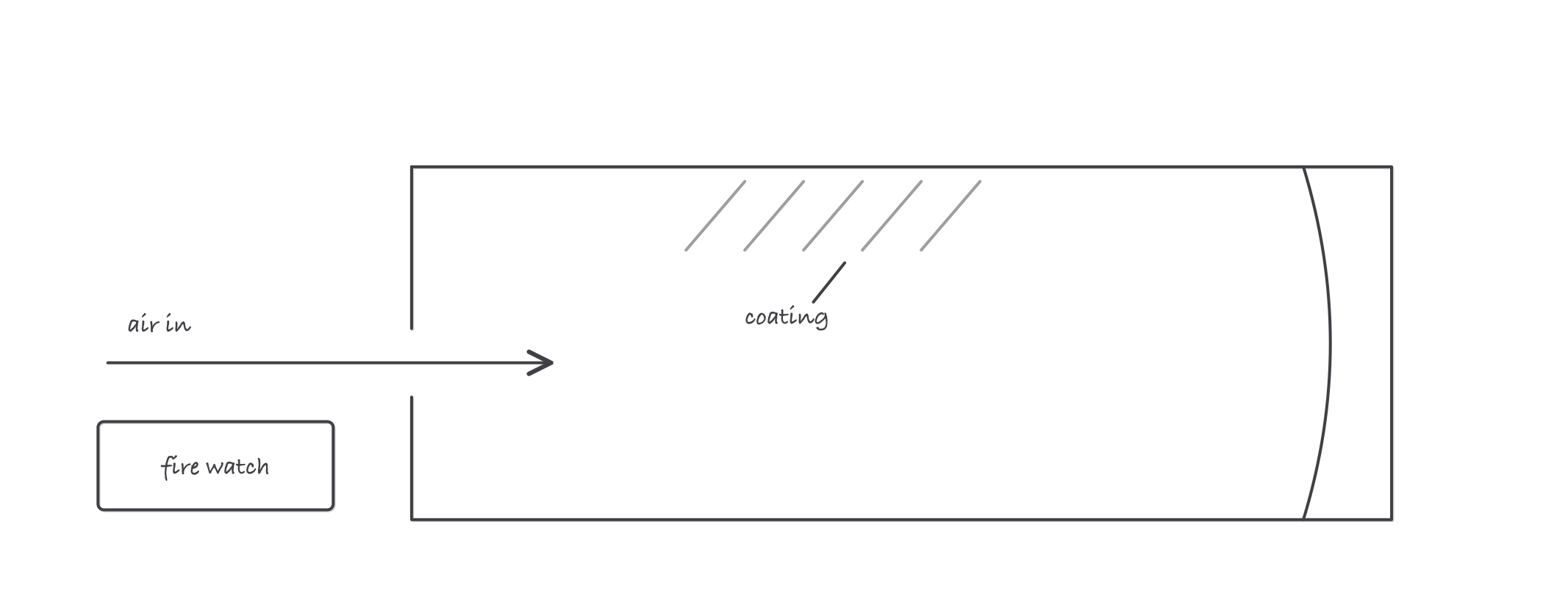
Hot work inside a vessel: air in through the opening, coating on the wall, and the watch outside
The four hazards that come with the space
Ventilation. A vessel does not breathe. Welding fume, cutting fume and shielding gas accumulate where they are made, and the interior geometry means they accumulate unevenly. Ventilation inside pressure equipment is engineered for the job rather than assumed from the size of the opening.
Preservative coatings. Pressure equipment and the steel around it are painted, galvanized, lined or otherwise coated, and heating a coating drives off whatever it is made of into the air you are breathing. OSHA has a standard specifically for this situation in the construction subpart, 1926.354, welding, cutting and heating in the way of preservative coatings. The requirements are in that standard text; the habit to build is noticing that a surface is coated before you put heat into it, because the coating rarely announces itself once you are inside and the light is bad.
Fire watch. Sparks and slag from cutting inside a vessel land inside the vessel, and they land on scaffold boards, tarps, hoses and insulation that were brought in for the job. A fire watch is a person whose task is watching for exactly that, positioned to see it and equipped to act, and staying in place after the arc stops rather than leaving with the crew.
Fuel gas. Oxy-fuel equipment inside a confined space brings its own problem: hoses and torches leak, and a leak inside a vessel changes the atmosphere in that vessel rather than dispersing into a shop. Never leave a torch inside a space during a break, and treat the gas supply as something managed from outside the space.
Where it bites
- Hot work inside a permit space is two jobs at once. The hot work controls do not replace the entry controls, and the entry controls do not cover the fire. Both sets apply.
- The fire watch is the first thing sacrificed on a busy outage. It looks like an idle person to anyone in a hurry. So does an attendant, and for the same reason both roles get quietly eroded.
- Coatings on the far side of the plate still burn. Heat conducts through. A clean-looking interior surface says nothing about what is painted on the outside of the same steel.
- The subpart depends on the work, not the equipment. The same vessel, the same torch, and a different governing standard on a different job. Ask which one applies before the permit is written rather than after.
- Leads and hoses through a manway are the exit route. Everything you drag in narrows the way out. Route them deliberately, and know what you would trip on if the lights went out.