Learn · Boilermaking
Nondestructive Examination of Pressure Welds
Part of Boilermaker and the Code · step 9 of 22 · next: Confined Space Entry in Boilers and Vessels
In learning paths: Boilermaker and the Code
Assumes you know: ASME Welding Qualifications for Boiler Work
Nondestructive examination is how a pressure weld is judged without cutting it up. Four methods do almost all of the work, and they split into two families answering two different questions. Penetrant and magnetic particle look at the surface. Radiography and ultrasonics look inside. Choosing the wrong family is how a real flaw gets a clean report.
Why it matters on the job
You will not usually be the one shooting the film, but you will be the one whose weld is being examined, and increasingly the one deciding what to call for on a repair. Knowing what each method can and cannot see tells you which flaws your technique has to eliminate rather than hide. It also stops the crew from arguing with a result the method was never capable of producing.
Visual is a method, not a warm-up
Visual examination is the first and cheapest examination and it catches an enormous share of real defects: undercut, overlap, poor profile, arc strikes, unfilled craters, obvious cracking. It has formal acceptance criteria the same as any other method. Treat it as an examination with rules rather than as glancing at the weld before the real testing starts.
Surface methods
Liquid penetrant (PT) floods the surface with a penetrating liquid, wipes the excess off, and applies a developer that draws the liquid back out of anything open to the surface. What was invisible becomes a visible indication. It works on essentially any nonporous material, including austenitic stainless and aluminum, which is exactly why it is the go-to on stainless tube work.
Its limit is absolute: if the discontinuity does not break the surface, penetrant cannot find it. There is nothing for the liquid to get into.
Magnetic particle (MT) magnetizes the part and dusts it with fine iron particles. Where a discontinuity interrupts the magnetic field, flux leaks out at the surface and the particles pile up along it. It is fast, cheap and very good on carbon and low alloy steel, and it can reveal flaws slightly below the surface as well as those breaking it.
Its limit is the material. Magnetic particle needs a ferromagnetic material, so it does not work on austenitic stainless steel, and a technician who reaches for it there will find nothing and report nothing.
Volumetric methods
Radiography (RT) passes radiation through the weld onto film or a digital detector. Anything less dense than sound metal absorbs less radiation and shows darker. That makes it excellent at volumetric flaws: porosity, slag inclusions, incomplete fill, burn-through.
Its weakness is planar flaws lying across the beam. A tight lack-of-fusion or a tight crack that presents almost no thickness change to the radiation can be genuinely difficult to see, and radiography also brings an exclusion zone, a licensed source and a schedule that stops other work.
Ultrasonics (UT) sends short pulses of high-frequency sound into the metal and listens for echoes. A reflector inside the weld sends sound back, and the instrument reports how far away it is. Sound reflects strongly off flat surfaces, so ultrasonics is strong exactly where radiography is weak: cracks and lack of fusion. It also gives depth, which radiography does not.
Its weakness is dependence on setup and on the person. Results follow calibration, couplant, probe angle and interpretation, so the qualification of the technician matters more here than with the other methods.
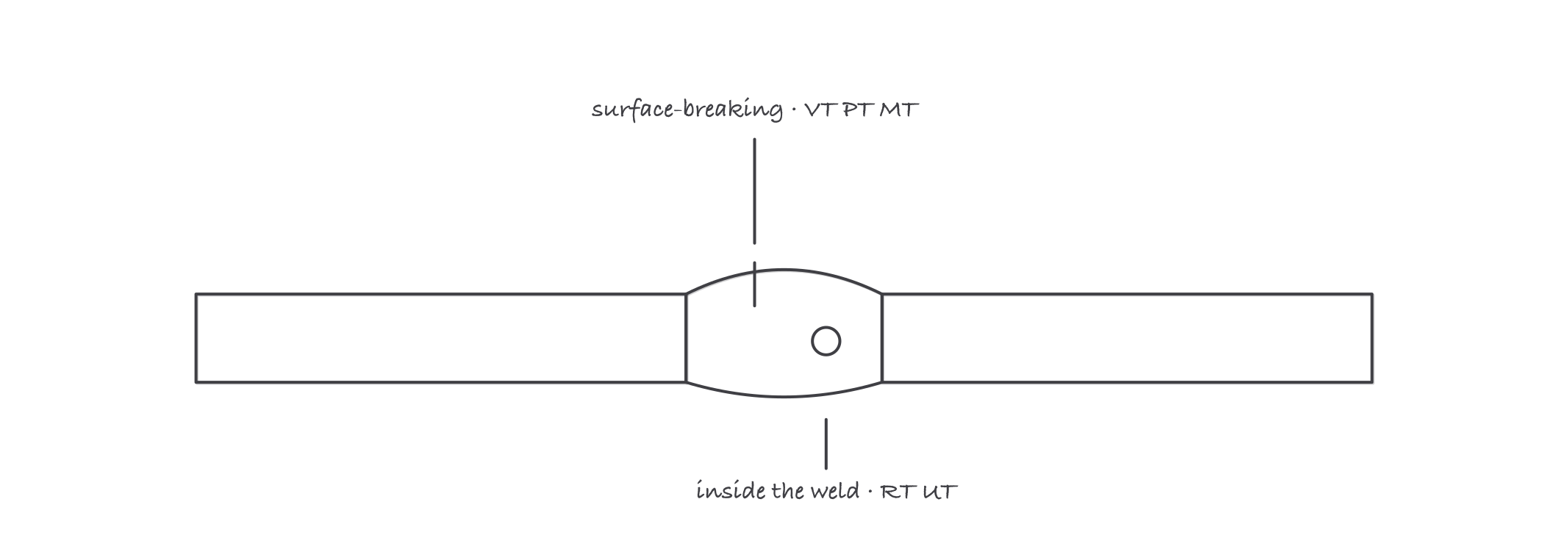
Two families, two questions: is the flaw open to the surface, or buried in the section
Who decides what is acceptable
Not the technician, and not the crew. The acceptance criteria come from the code the equipment is governed by, so the same indication can be acceptable on one job and rejectable on another. The technician reports what was found; the code and the inspector decide what it means.
The people performing and interpreting the examinations are qualified under a written practice their employer maintains, in much the same shape as welding qualification: the record belongs to an organization, and it is specific to the method and level.
Worked example: picking the method
Four situations, and what the choice hinges on.
- A butt weld in a carbon steel header, full penetration, in a repair. Surface first with magnetic particle, because the material is ferromagnetic and MT is quick. Volume second with radiography or ultrasonics, depending on access and on whether the concern is porosity and slag or lack of fusion.
- A weld on austenitic stainless tube. Magnetic particle is out because the material is not ferromagnetic. Penetrant for the surface, and radiography or ultrasonics for the volume.
- Access to one side only, and the concern is lack of fusion in the sidewall. Ultrasonics. Radiography would need access to both sides and would be looking for the flaw type it reads worst.
- A fillet weld attaching a lug. There is no meaningful volumetric examination of a small fillet, so this is a visual and surface-method job, and the real question is whether that lug is on a pressure part at all.
Where it bites
- A clean report from the wrong method proves nothing. Penetrant on a subsurface flaw and magnetic particle on stainless both produce a clean sheet by being incapable, not by the weld being sound.
- NDE does not replace the pressure test, and the pressure test does not replace NDE. They answer different questions, and a job normally needs both.
- Surface condition drives surface methods. Slag, spatter, paint and heavy scale will hide indications from penetrant and magnetic particle. Preparation is part of the examination.
- Radiography stops the job. The exclusion zone clears the area, so shooting film is a scheduling decision as much as a technical one. Plan it into the outage rather than discovering it on the night shift.