Learn · Boilermaking
Boilers and Pressure Vessels
Part of Boilermaker and the Code · step 1 of 22 · next: Tube Rolling and Replacement
In learning paths: Boilermaker and the Code
A pressure vessel is a closed container built to hold a fluid at a pressure different from the air around it. A boiler is a pressure vessel with heat added, so the water inside becomes steam and the stored energy climbs. Everything else about this trade follows from that one difference: the vessel in front of you holds energy, and the rules exist because of what happens when it lets go.
Why it matters on the job
You can build ordinary steel to a drawing. Meet the dimensions, meet the weld symbols, hand it over. Pressure equipment does not work that way. The design, the material, the welding procedure, the examinations and the final test are all governed by a published code, and an independent inspector signs off before the equipment carries a mark. Nothing on a code job is between you and the foreman alone.
Built to a code, not to a drawing
The code in the United States is the ASME Boiler and Pressure Vessel Code (BPVC). It is not a design handbook a shop chooses to follow. Jurisdictions adopt it into law, so on most code work the code is the legal minimum.
The other thing to understand early is who the code certifies. ASME certification applies to a manufacturer’s or assembler’s quality control system, which means a company holds the certificate and a company applies the mark. There are more than 6,800 ASME Certificate Holders, and every one of them is an organization. Your welding qualification, your skill and your reputation all live inside somebody’s certified quality system.
The equipment decides the section
Boilermakers work across three parts of the code, and the piece of equipment decides which one applies:
- Section I, power boilers. Its official title is “Rules for Construction of Power Boilers.” This is high-pressure steam generation: utility boilers, industrial steam plant, the units that feed turbines and process headers.
- Section IV, heating boilers. Boilers built for building heating service rather than power generation.
- Section VIII, pressure vessels. Divided into Division 1, Division 2 and Division 3. This is the tanks, drums, exchangers, separators and receivers that hold pressure without being boilers.
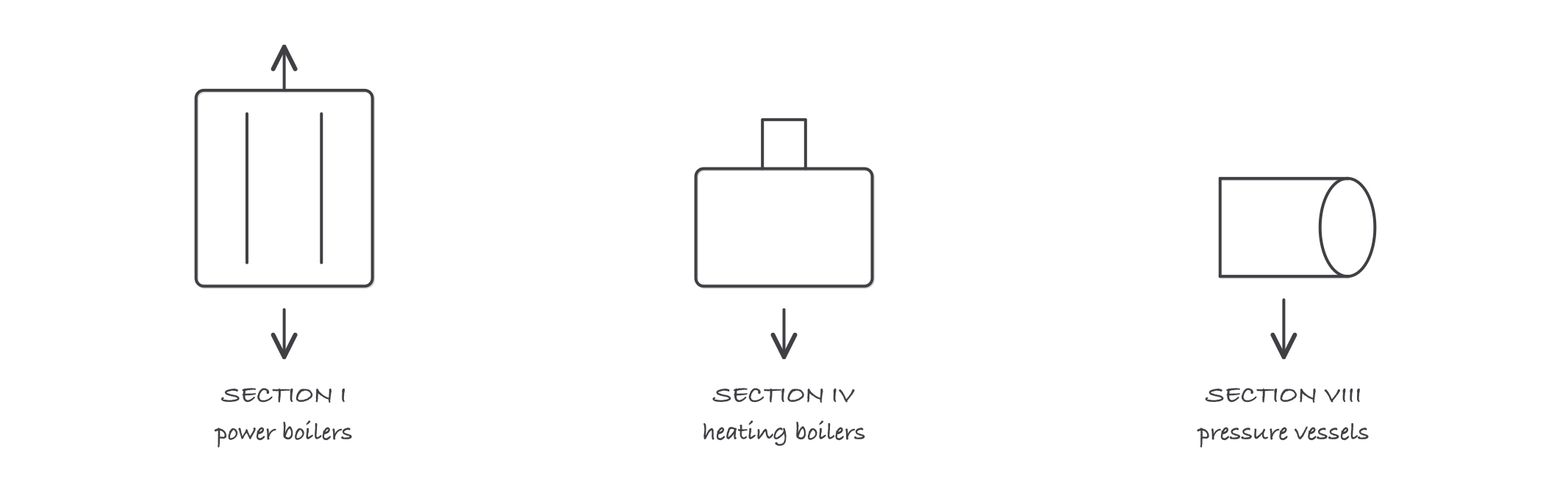
The equipment in front of you picks the section, not your job title and not the customer
ASME publishes a table of designator letters that maps a shop’s scope onto those sections. S, A, E, M and PP cover Section I work. H and HLW cover Section IV. U, UM, U2 and U3 cover Section VIII. V, HV, UV and UD cover pressure relief devices.
Worked example: sort a plant room
Walk a paper mill’s powerhouse with three items in it and decide which section governs each one.
- A watertube unit making superheated steam for a turbine generator. Steam generation for power, so Section I governs its construction. A shop building or replacing pressure parts on it needs Section I scope.
- A hot water boiler serving the office block radiation. Same site, same crew, different service. It is heating equipment, so Section IV governs.
- A compressed air receiver next to the compressor house. It holds pressure and takes no fire, so it is a pressure vessel under Section VIII.
Three items, one plant, three different sets of construction rules. Get in the habit of asking what the equipment is for before you ask anything else about it.
Where it bites
- Pressure part or structure. The drum, the headers and the tubes hold pressure and are code items with code paperwork. The steel that holds them up is ordinary structural work. Same crew, same shift, entirely different inspection regime, and confusing the two is how a shop ends up with a code item welded by someone qualified for the wrong thing.
- S, U and H are not a ladder. People see the letters and quietly rank them. A shop with a U certificate and no S is not a lesser shop: it is a shop scoped to pressure vessels rather than power boilers.
- Nobody holds a stamp personally. The certificate goes to the organization and the mark goes on the equipment. “I have my S stamp” describes something that cannot happen, and later lessons in this trade take that apart properly.