Learn · Boilermaking
Section IX vs AWS D1.1
Part of Boilermaker and the Code · step 7 of 22 · next: Hydrostatic Testing
In learning paths: Boilermaker and the Code
Assumes you know: WPS, PQR and WPQ
A structural welding qualification does not let you weld on a boiler, and a pressure qualification is not a structural credential. The two systems are not ranked against each other. They belong to different codes and they answer different questions, and the fastest way to get sent home from a job is to arrive believing one covers the other.
*Learn the Trades is a free study resource. We are not a licensing body, an authorized training provider, or an exam administrator. Reading this page does not award any card, license, or certification. Always verify requirements with the issuing authority linked in the sources.*Why it matters on the job
Boilermakers work on both sides of this line in the same week, sometimes on the same shift. The drum, the headers and the tubes are pressure parts. The supports, the buckstays, the platforms and the ductwork around them are structure. Same site, same crew, different code, different paperwork, different inspector.
Two codes, two questions
ASME Section IX asks whether a weld will hold pressure to the satisfaction of the code and the inspector. The equipment is a pressure boundary. Failure means stored energy released, so the qualification system is built around demonstrating that a specified set of conditions produces sound welds, and around an independent inspector confirming it.
AWS D1.1 is the structural steel welding code. It asks whether a connection will carry the load it was designed for. Failure means a structural failure, so the standard is built around joint design, workmanship and inspection of load-carrying connections.
Neither is a subset of the other.
Where the record lives is the second difference
Section IX qualification is employer-held. It sits inside one employer’s quality system and generally does not transfer when you change shops.
Structural qualification can work the same way when an employer qualifies you to D1.1, but the AWS Certified Welder program deliberately does the opposite: AWS maintains those records in a national registry, so the record follows the person. That is the source of most of the confusion, because a welder who has always carried a portable record assumes every qualification behaves that way.
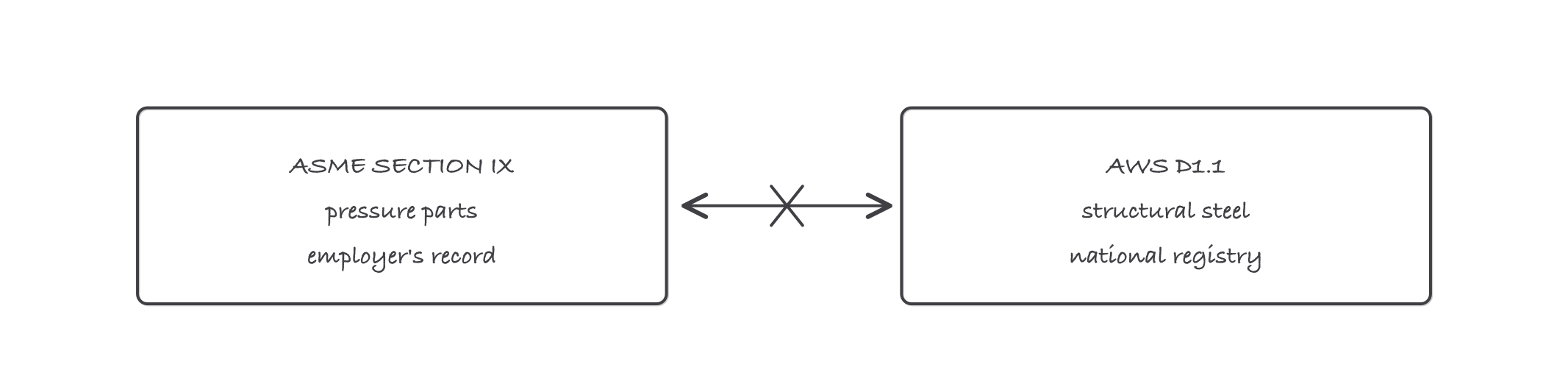
Two codes, two questions, and no crossing over: neither qualification covers the other’s work
Worked example: sort the welds on a boiler erection job
A new watertube unit is going up. Walk the job and put each weld on the right side of the line.
- Tube-to-header welds on a waterwall panel. Pressure boundary. Section IX, to the shop’s qualified procedure.
- A drum nozzle weld. Pressure boundary. Section IX.
- Buckstay-to-column connections in the boiler support steel. Load-carrying structure. Structural welding code.
- Handrail and grating supports on an access platform. Structure again, and the least glamorous welding on the site.
- A lug welded directly to the outside of a drum to hang something from. This one is the trap. It is attached to a pressure part, so it is not a free structural weld: attachments to pressure boundaries are governed by the pressure code and the repair procedure, not by the structural code. Ask before you strike an arc.
Item 5 is the one that costs people jobs. If the metal you are depositing lands on a pressure part, the pressure rules follow it there.
Where it bites
- “I’m a certified welder” answers nothing here. The useful sentence names the code and the procedure: “I’m qualified to this shop’s procedure under Section IX,” or “I hold an AWS Certified Welder record for this process.”
- The tests can look almost identical and mean different things. A coupon is a coupon. What differs is which standard set the conditions, which body holds the record, and what work it authorizes.
- Attachments to pressure parts follow the pressure code. Lugs, brackets, clips and temporary attachments on a drum or header are not structural work merely because they hold something up.
- Neither qualification is a license. They are records of demonstrated ability under a standard, held by an employer or a certifying body. Nothing about either one makes anyone eligible to operate a plant or to certify equipment.
Exam relevance
Both systems test by having you weld a coupon that is then examined, so the practical preparation is the same discipline in both worlds: follow the written procedure exactly, in the position you are being tested in. What is worth memorizing is the map rather than any numbers: which code, which body, who holds the record, and what work it covers. Those four questions answer almost everything either system will ask you at a shop door.
Verified requirements
| Where | Expires | Renewal | Continuing education |
|---|---|---|---|
| United States (federal) | No | Confirm with issuer | Confirm with issuer |
| United States (federal) | Yes | Confirm with issuer | Confirm with issuer |
Information comes from issuing-authority sources. Confirm current rules, fees and eligibility with the authority before acting.