Learn · Boilermaking
Confined Space Entry in Boilers and Vessels
Part of Boilermaker and the Code · step 10 of 22 · next: Welding, Cutting and Hot Work Safety
In learning paths: Boilermaker and the Code
A boiler drum is the textbook permit-required confined space. It has one small opening, no natural ventilation, a curved interior you cannot stand up in, and it fills with whatever the work puts into it. Nearly everything a boilermaker does inside pressure equipment happens under confined space rules, so this is not a specialist topic in this trade; it is a description of an ordinary Tuesday.
Why it matters on the job
Confined space incidents kill in a particular pattern: one person goes down inside, and the people who go in after them go down too. That pattern is the reason the rules are built around a person stationed outside rather than around the person doing the work.
Which rule governs depends on the work, not the vessel
This is the point people get taught wrong.
OSHA publishes separate confined space standards for general industry, construction and maritime. For boilermakers, two of them matter:
- Construction work falls under 29 CFR 1926 Subpart AA, Confined Spaces in Construction, standards 1926.1200 through 1926.1213.
- General industry and fixed-plant entry falls under 29 CFR 1910.146, Permit-Required Confined Spaces.
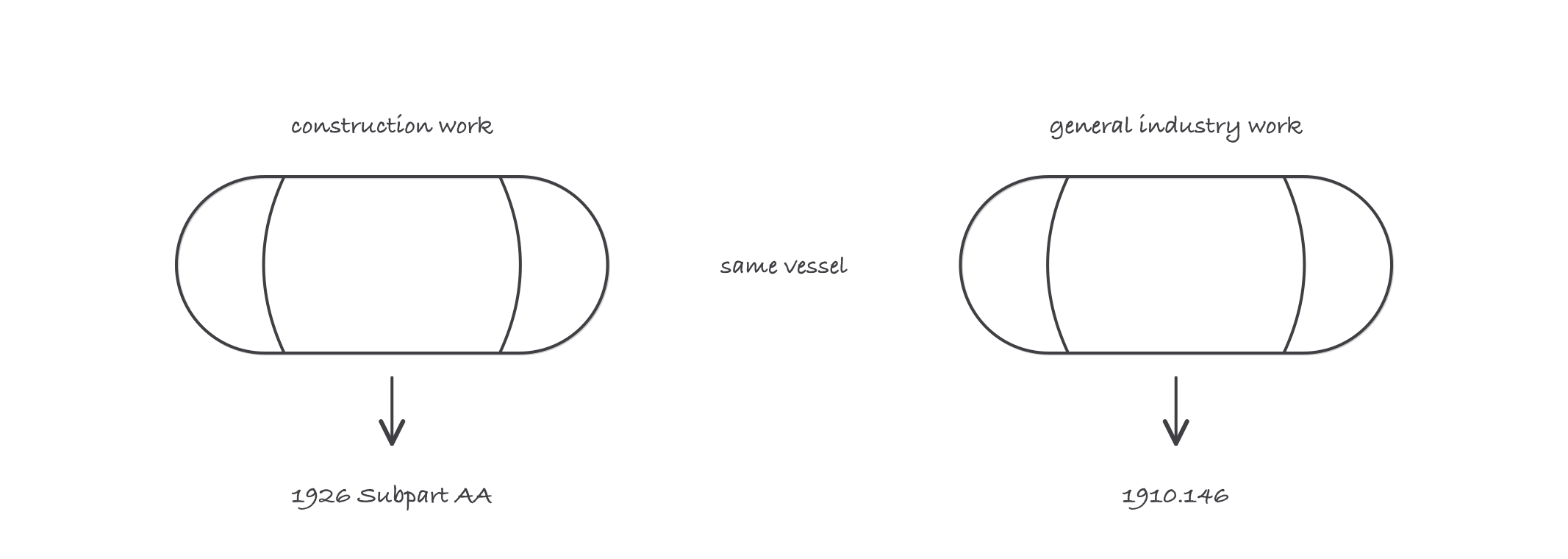
The same drum can be entered under either standard; what decides is the character of the work
The same physical drum can be entered under either standard on different jobs. Boilermakers cross this line constantly, working an outage in an operating plant one stretch and new erection the next. The determination belongs to your employer’s safety program and the scope of the standards themselves, and the scope of the construction rule is stated in 1926.1201, which also carries the exceptions where other subparts govern instead. A page that names only 1910.146 has told you about half of your working life and left out the other half.
Two requirements to know by heart
Two things hold across permit-required entry and are worth carrying as fixed points.
There is a written permit space program. The employer’s program is a document, not an attitude. It exists before your entry, it governs how spaces are identified and how entries are authorized, and the permit for your specific entry is written against it.
An attendant is stationed outside, for the duration. At least one attendant stays outside the space the whole time entrants are inside. The attendant is not a spare pair of hands, not a runner, and not a person who steps away to fetch a grinder. Their presence outside is the control.
Walking one entry
What a correct entry actually looks like from where you stand:
- Read the permit before you go near the opening. It names the space, the work, the hazards identified, the controls in place and the people authorized. If your name is not on it, you are not entering.
- Confirm the isolation. Pressure equipment gets connected to steam, feedwater, fuel and chemical systems. What is locked, blanked or blinded is on the permit, and confirming it is a walk you take rather than a box someone ticks.
- Confirm the attendant is in position and how you communicate. Agree the method before you are inside, where a shout does not carry the way you expect.
- Understand the controls your permit sets for the work. Testing, ventilation, communication and rescue arrangements are established by the program and recorded on the permit for this job. Know what yours says.
- Come out when a condition changes. New hazard, changed conditions, a control that stops working, a permit that has expired: the answer is out first, sort it out second.
- Close the entry properly. The permit is completed and the space is left in a known state, not an assumed one.
Where it bites
- The vessel does not tell you which standard applies. Naming the equipment is not naming the rule. Ask what the work is.
- The attendant role gets eroded first. It looks like standing around, and on a busy outage somebody will find something for that person to do. That erosion is the incident, arriving early.
- A drum has one way out, and it is small. Plan how an injured person comes out before you plan how the leads go in. Hoses, cables and welding leads through a manway are the physical obstacle in every rescue.
- Isolation is a boilermaker-specific problem. Pressure equipment is connected to more systems than it looks like from outside, and those systems are hot or under pressure elsewhere in the plant. Never accept an isolation you have not confirmed.
- Multi-employer sites multiply the confusion. On an outage there may be several employers with several programs on one site. Yours governs your entry, and the coordination between them is a thing to ask about rather than assume.