Learn · Boilermaking
Section I: Power Boilers
Part of Boilermaker and the Code · step 13 of 22 · next: Section VIII: Pressure Vessels
In learning paths: Boilermaker and the Code
Assumes you know: The ASME BPVC Sections
Section I of the ASME Boiler and Pressure Vessel Code carries the official title Rules for Construction of Power Boilers. It is the section under which most boilermakers spend most of their working lives, because it governs the steam-raising equipment the trade was built around: drums, headers, tubes and the piping that ties them together.
*Learn the Trades is a free study resource. We are not a licensing body, an authorized training provider, or an exam administrator. Reading this page does not award any card, license, or certification. Always verify requirements with the issuing authority linked in the sources.*Why it matters on the job
Section I is the reason the paperwork on a power boiler job looks the way it does. It is why a weld gets a procedure before it gets a welder, why an inspector has to accept work before the next stage covers it up, and why a nameplate exists at all. Understanding which of your work is Section I work and which is not tells you, on any given day, whose rules you are under.
A construction code, and only a construction code
Section I tells you how a power boiler is built. It does not tell you how to run one, and it does not tell you how to repair one that has been running for twenty years.
That second point is the one that catches people. Once equipment is installed and in service, the National Board Inspection Code takes over for installation, inspection, repair and alteration. A crew cutting out a failed tube in an operating plant is working under the NBIC and a repair organization’s quality system, with Section I sitting behind the job as the code the boiler was originally built to.
What is a pressure part, and what is not
Section I governs the pressure boundary. The drum, the headers and the tubes are pressure parts; they contain the working fluid and they are code items with code paperwork behind every joint.
The steel around them is not. Buckstays, platforms, supports and the structural frame that carries the boiler are structural work. Same jobsite, often the same crew, sometimes the same shift, and an entirely different documentation and inspection regime. Confusing the two is how a job ends up with the wrong procedure taped to the wrong wall.
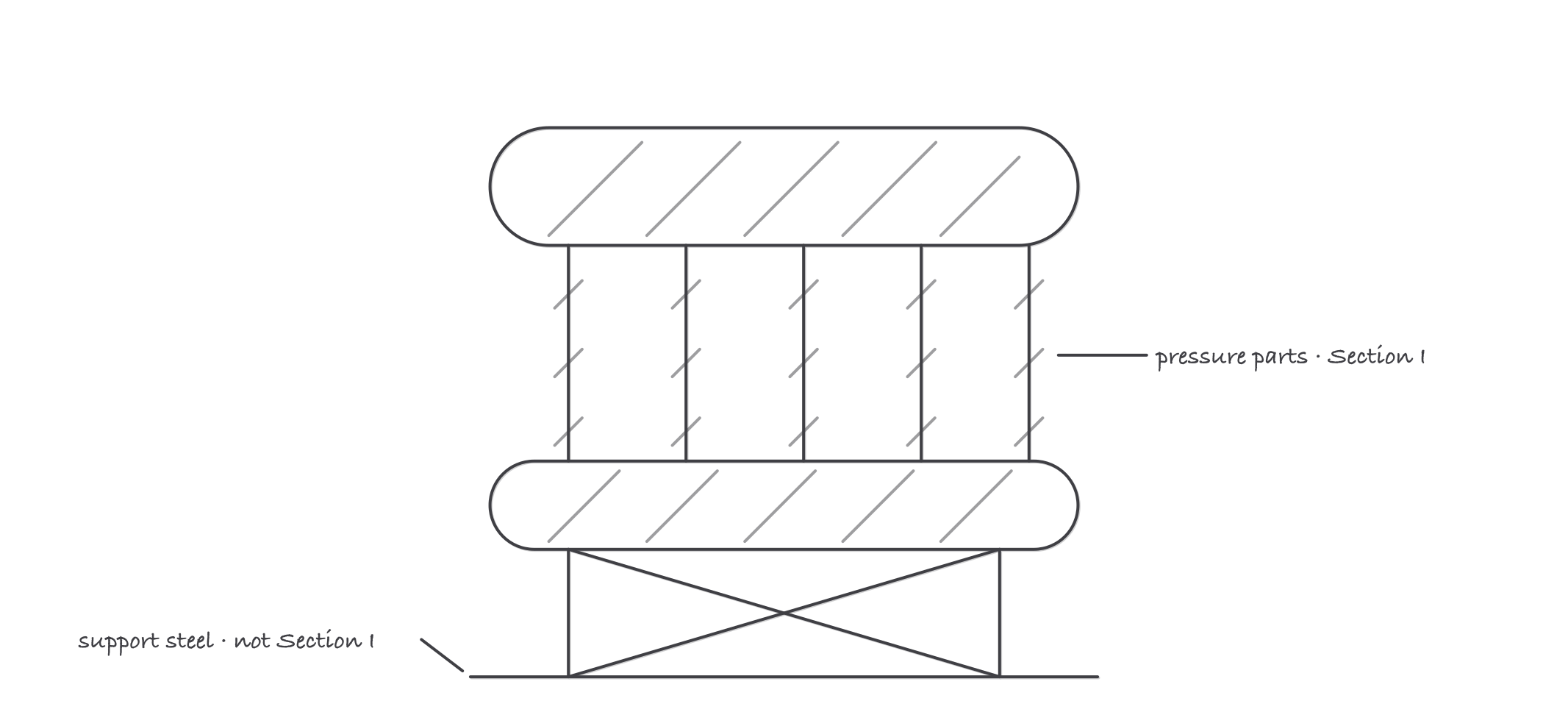
The hatched pressure boundary is Section I work; the steel holding it up is not
Tube is not pipe, and not every joint is a weld
Two vocabulary points that Section I work depends on.
Tube and pipe are different articles. Tube is specified by outside diameter and wall thickness, and inside a boiler it is doing heat transfer duty. Pipe is specified by nominal size and schedule, and it carries fluid between things. They are not two words for the same product, and a material list that says one does not mean the other.
Not every pressure joint is welded. Boiler tubes are commonly rolled and expanded into a drum or a tubesheet: a mechanical seal made with a tube expander rather than an arc. Some joints are expanded, some are seal welded, and some are both. The Boilermakers’ own apprenticeship curriculum lists tube rolling as its own skill alongside welding, which tells you how far it is from being a welding sub-task. Assume every pressure joint is a weld and you will misread every repair procedure you are ever handed.
Where the S certificate fits
Where it bites
- Section I stops when the boiler goes into service. From that point the NBIC governs. Repairs are performed under a repair organization’s certificate, not re-run through the construction code.
- The section is chosen by the equipment. A heating boiler is Section IV work and a pressure vessel is Section VIII work, whoever is holding the stinger.
- Pressure part and structure are different jobs on one job. Check which side of that line your weld sits on before you strike an arc.
- Never repeat a Section I number you have not read in Section I. The section is a purchased document, and ASME’s free pages carry the title and the designator table. Thicknesses, pressures and dimensional limits quoted from memory on a jobsite are guesses dressed as code, and they are wrong often enough to matter.