Business · Boilermaking
The Boilermaker Apprenticeship (BNAP)
Part of Boilermaker and the Code · step 19 of 22 · next: Outage and Turnaround Work
In learning paths: Boilermaker and the Code
The Boilermakers National Apprenticeship Program (BNAP) is a four-year, earn-while-you-learn apprenticeship: 6,000 hours of field construction work on the job, plus 576 hours of related classroom instruction at 144 hours a year. You apply through a local Lodge, and you are paid from the first day.
Why it matters on the job
This is the main road into the trade. Boilermaking has no journeyman license to sit for, so what employers actually screen on is whether you completed a registered apprenticeship and what you can demonstrate. Coming out the far end of BNAP means somebody has documented 6,000 hours of your work against a defined set of modules, which is a far stronger claim than “I have been welding for four years.”
What the four years are made of
On-the-job training: 6,000 field construction hours. The work is organized into 21 on-the-job training modules, and your work on them is supervised and signed by a qualified BNAP Foreman or Instructor. It is real production work on real jobs, not a training yard.
Related classroom instruction: 576 hours, at 144 hours a year. It runs alongside the field work rather than instead of it.
Testing: 49 tests, with a 70 percent minimum to pass. The program is assessed the whole way through, not judged at the end.
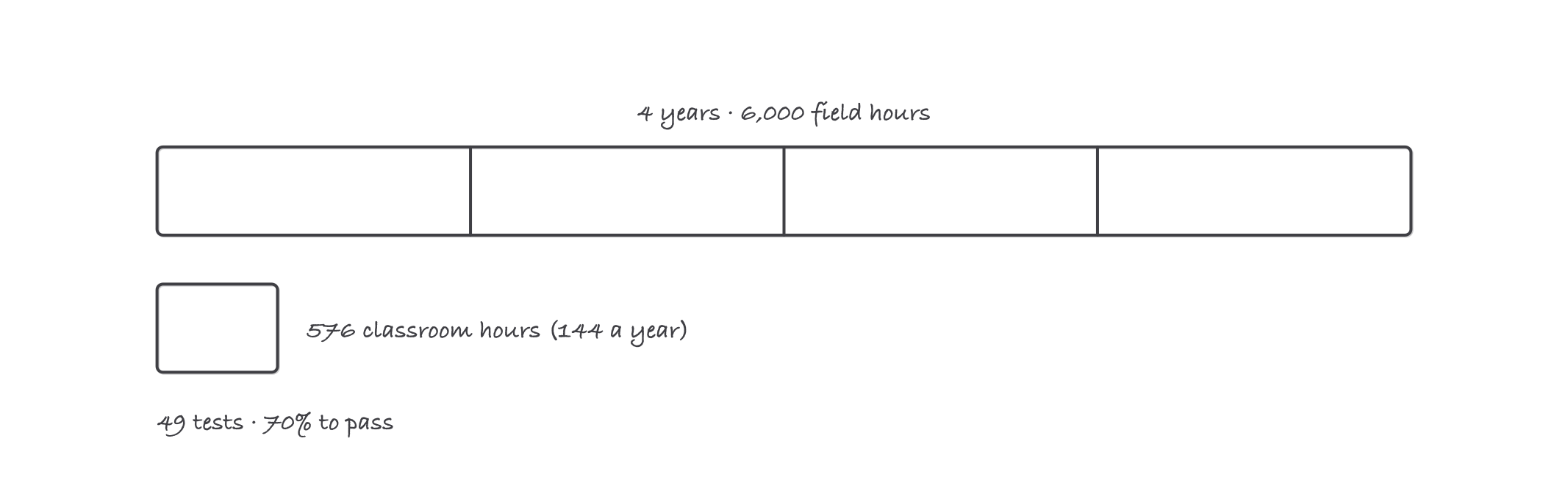
Drawn to scale: the classroom hours are the small bar, and they are still 576 hours you have to turn up for
What you actually learn
The union’s own description of the apprenticeship names the ground it covers, and it is wider than most people expect. Welding is on the list, but so are blueprint reading, rigging, layout and fabrication, tube rolling, cutting, knot tying, hand signals and reeving.
Read that list again and notice how much of it is not welding. Rigging and hand signals are there because boilermakers spend their lives moving heavy awkward things in tight places. Tube rolling is there because it is a separate skill from welding and the trade lives on it. Layout and fabrication are there because a boilermaker is expected to make the part fit, not to wait for someone else to.
Worked example: what four years costs you in hours
Take the program’s own numbers and turn them into a week.
- Field hours per year. 6,000 hours over four years is 6,000 / 4 = 1,500 hours a year.
- In working weeks. At 40 hours a week, 1,500 / 40 = 37.5 weeks of field work a year. That leaves room for the reality of the trade, which is that the work comes in bursts around outages rather than evenly.
- Classroom on top. 144 hours a year is a genuine second commitment, usually on evenings or in blocks.
- Total documented hours. 6,000 + 576 = 6,576 hours across the four years, all of it recorded against your name.
When you finish, you are not asking anyone to take your word for it.
How you get in
You apply through a local Lodge. Lodges intake on their own schedules and their own requirements, and the honest answer about what a specific Lodge asks for this year is that you have to ask that Lodge. What is consistent across the program is the shape of the thing: it is a registered four-year program, you are employed and paid while you do it, and you are assessed all the way through.
If a Lodge is not taking applications when you call, ask when the next intake is, and ask what they want to see from an applicant in the meantime. That is a better conversation than an application form.
Where it bites
- Boilermaker is not the same job as boiler operator. A boilermaker builds, erects and repairs the equipment. A boiler operator or stationary engineer runs the plant once it is in service, and that side of the industry is licensed by cities and states. Finishing this apprenticeship does not license anybody to operate a plant.
- The classroom hours are not optional. 576 hours over four years is a real load next to full-time field work, and it is the part people underestimate before they start.
- BNAP is the apprenticeship, not the curriculum publisher. You will see NCCER modules referenced around the trade, and NCCER publishes training material used widely in construction. The registered program with the four-year structure and the hour requirements above is BNAP.
- Expect to travel. The Bureau of Labor Statistics notes that boilermakers may travel to worksites and be away from home for extended periods. Ask any Lodge what that looks like in practice in their area before you decide it will not apply to you.