Learn · Boilermaking
Hydrostatic Testing
Part of Boilermaker and the Code · step 8 of 22 · next: Nondestructive Examination of Pressure Welds
In learning paths: Boilermaker and the Code
Assumes you know: Watertube and Firetube Boilers
A hydrostatic test fills the vessel completely with water, raises the pressure above its working pressure, holds it, and looks for leaks and distortion. The water is not there to be tested. The water is there because it is nearly incompressible, so it stores almost no energy at pressure and the test cannot turn into an explosion.
Why it matters on the job
The hydro is the last thing that happens before the equipment goes back to the owner, and it is the moment every joint the crew made is asked to hold at once. It is also a dangerous routine operation, because it is the one where people are standing next to a pressurized vessel by design. The hazard has one root cause worth naming up front: air that was still inside.
Water, not air
Compress air and it stores energy like a spring. Release it suddenly and it gives that energy straight back.
Water barely compresses at all. At test pressure, the water in a vessel occupies very nearly the volume it occupied at atmospheric pressure, so if the vessel splits, the water has nowhere to expand to. The pressure collapses immediately and the failure is a leak or a tear rather than a detonation.
Worked example: what the air would have done
Take a vessel with an internal volume of 200 ft³, pressurized to 300 psig, and suppose it lets go.
- Work in absolute pressure. 300 psig + 14.7 = 314.7 psia.
- Find the expansion ratio back to atmosphere: 314.7 / 14.7 = 21.41.
- Apply it to the volume. 200 ft³ × 21.41 = 4,282 ft³ of air, arriving in a fraction of a second.
That is more than twenty times the volume of the vessel, delivered as a blast wave, and it is why nobody stands beside a vessel under a pneumatic test without a written justification and a controlled exclusion zone.
Now run the same failure with water inside. The water at 314.7 psia occupies essentially the same 200 ft³ it occupied at atmosphere, so there is no stored volume to release. The pressure goes to zero the instant the boundary opens. Same vessel, same pressure, entirely different event.
The shape of the test
The details belong to the procedure for the job, but the sequence is always recognizable:
- Prepare the boundary. Blank or isolate anything that must not see test pressure, and deal with pressure relief valves exactly as the procedure says rather than by improvisation.
- Fill from the bottom and vent from the top. Every high point needs a vent open until water runs solid out of it. This is the step that keeps the test hydrostatic.
- Bring the metal to temperature. Steel is brittle when it is cold, so the code sets a minimum metal temperature for the test. Cold water into cold steel on a winter morning is a real hazard and not a scheduling inconvenience.
- Raise pressure slowly to the test pressure, using calibrated gauges with a range suited to the pressure being applied.
- Hold, then examine. Visual examination is usually done after the pressure has been reduced to a lower examination pressure, not at the peak.
- Depressurize slowly and drain, with the vents open so the vessel does not pull a vacuum on itself as it empties.
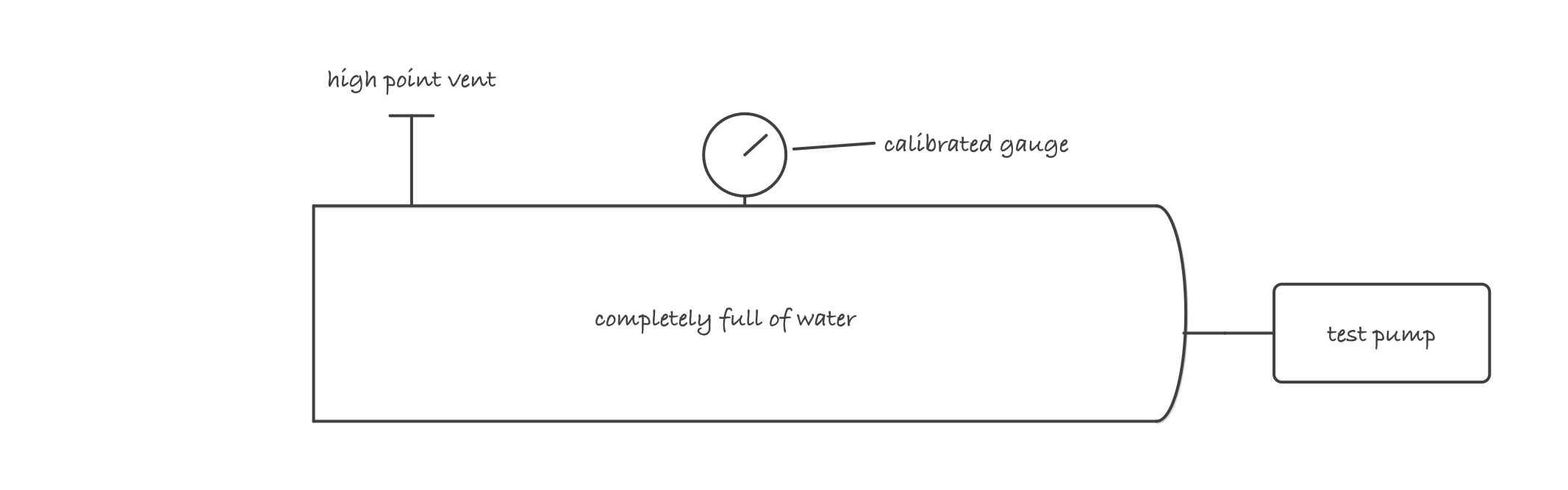
The vent is the safety argument: water goes in at the bottom until it comes out solid at every high point
What the test pressure is
The test pressure is a multiple of the equipment’s maximum allowable working pressure, and the multiplier is set by the code section that governs the equipment. Those multipliers have changed between code editions, so do not quote it from memory and do not take it from the person on the next crew. Take it from the governing code section and the job procedure, and confirm which edition your jurisdiction has adopted.
Who has to be there
On code work, the hydro is normally a hold point. The Authorized Inspector under the shop’s inspection agreement witnesses the test when the code requires it, which means the test time is agreed in advance and cannot be moved because the crew got ahead of schedule. Trying to run a witnessed test without the witness turns a completed job into a test that has to be done again.
Where it bites
- Trapped air is the accident. A pocket of air at a high point makes that part of the test pneumatic even though everything else is water. Vent every high point and confirm solid water, do not assume it.
- Never crack a joint under pressure. Tightening or loosening anything on a pressurized vessel is how people get cut by a jet they cannot see. Depressurize first, every time.
- Temperature moves the pressure. Water warming in a sealed vessel raises pressure with no pump running. On a sunny afternoon a test can climb past its target on its own, so watch the gauge during the hold.
- A relief valve is not a test control. Relief devices are handled per the procedure, and the pressure is controlled at the pump. Using a safety valve to manage a test is both unsafe and a good way to damage the valve.
- Do not leave water in and walk away in freezing weather. A vessel left full over a cold night is a repair job in the morning.