Learn · Boilermaking
The ASME Certification Mark and Its Designators
Part of Boilermaker and the Code · step 15 of 22 · next: The NBIC and the R Certificate of Authorization
In learning paths: Boilermaker and the Code
Assumes you know: The ASME BPVC Sections
The mark on a boiler nameplate is a statement about a company, never a statement about you. “Getting your stamp” is a phrase you will hear on jobsites for your entire career, and it describes something that cannot happen.
*Learn the Trades is a free study resource. We are not a licensing body, an authorized training provider, or an exam administrator. Reading this page does not award any card, license, or certification. Always verify requirements with the issuing authority linked in the sources.*Why it matters on the job
Two reasons, one practical and one professional. Practically, knowing what the mark certifies tells you what a shop can legally take on and what it has to turn away, which shapes where the work is and who is hiring. Professionally, saying “I have my S stamp” in an interview tells the person across the table that you have not understood the code environment you would be working in.
Certificate, mark, qualification
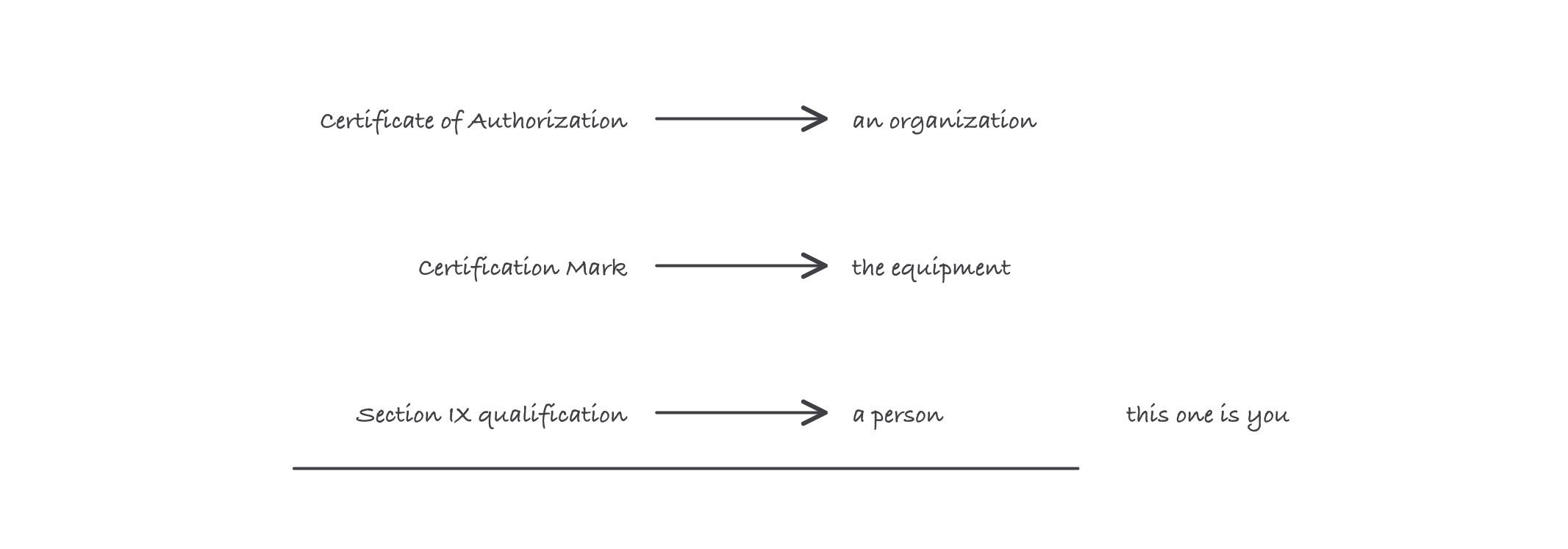
Three things, three owners; only the bottom row has anything to do with you
What a certificate actually reviews
A Certificate of Authorization is the outcome of a review of how an organization controls quality: its written quality manual, its procedures, its records, its people, and whether all of that is followed in practice rather than filed in a drawer. It is an audit of a system, which is why it is renewed rather than passed once, and why a shop can lose it.
That framing explains something that sounds odd at first. A shop with excellent welders and no quality system cannot hold a certificate. A shop with an intact quality system and a bad week still holds one until the review says otherwise. The certificate is not measuring individual skill, and it was never designed to.
The letters are scope, not rank
Designator letters mark what body of rules a certificate covers:
- S, A, E, M and PP cover Section I power boiler work.
- H and HLW cover Section IV heating boilers.
- U, UM, U2 and U3 cover Section VIII pressure vessels.
- V, HV, UV and UD cover pressure relief devices.
People see letters and imagine a ladder, with S at the top because power boilers sound like the hard end of the trade. There is no ladder. A shop with a U and no S is scoped for vessels, and a shop with an H is scoped for heating boilers, and neither is a lesser grade of the other. The scope each letter carries is set out in ASME’s designator table, which is the thing to consult rather than a coworker’s memory.
Who watches the certificate holders
ASME runs a separate program for the inspection side: accreditation for Authorized Inspection Agencies, the organizations whose inspectors inspect ASME Certificate Holders. Accreditation and certification are deliberately kept apart, one covering the inspecting organization and one covering the fabricating organization. Neither one issues anything to an individual.
That separation is the structural reason the system works. The organization doing the work and the organization checking the work are certified through different programs and answer to different reviews.
Where it bites
- “I have my S stamp” is always wrong. The accurate sentence is “I work for a shop that holds an S certificate.”
- The mark does not follow you to the next employer. Nothing does, in pressure work, except your own record of what you have qualified on and when.
- A shop’s letters tell you its scope, not its standard. Use them to work out what work comes through the door, never to rank employers.
- Applying the mark is controlled by the certificate, not by the welder. Who stamps, when, and against what records is set out in the organization’s quality system, and no individual has personal authority to apply it.
Verified requirements
| Where | Expires | Renewal | Continuing education |
|---|---|---|---|
| United States (federal) | Yes | Confirm with issuer | Confirm with issuer |
Information comes from issuing-authority sources. Confirm current rules, fees and eligibility with the authority before acting.